ISSN (Online): 3117-3926
ISSN (Print): 3117-535X
| Publication Fees: |  |

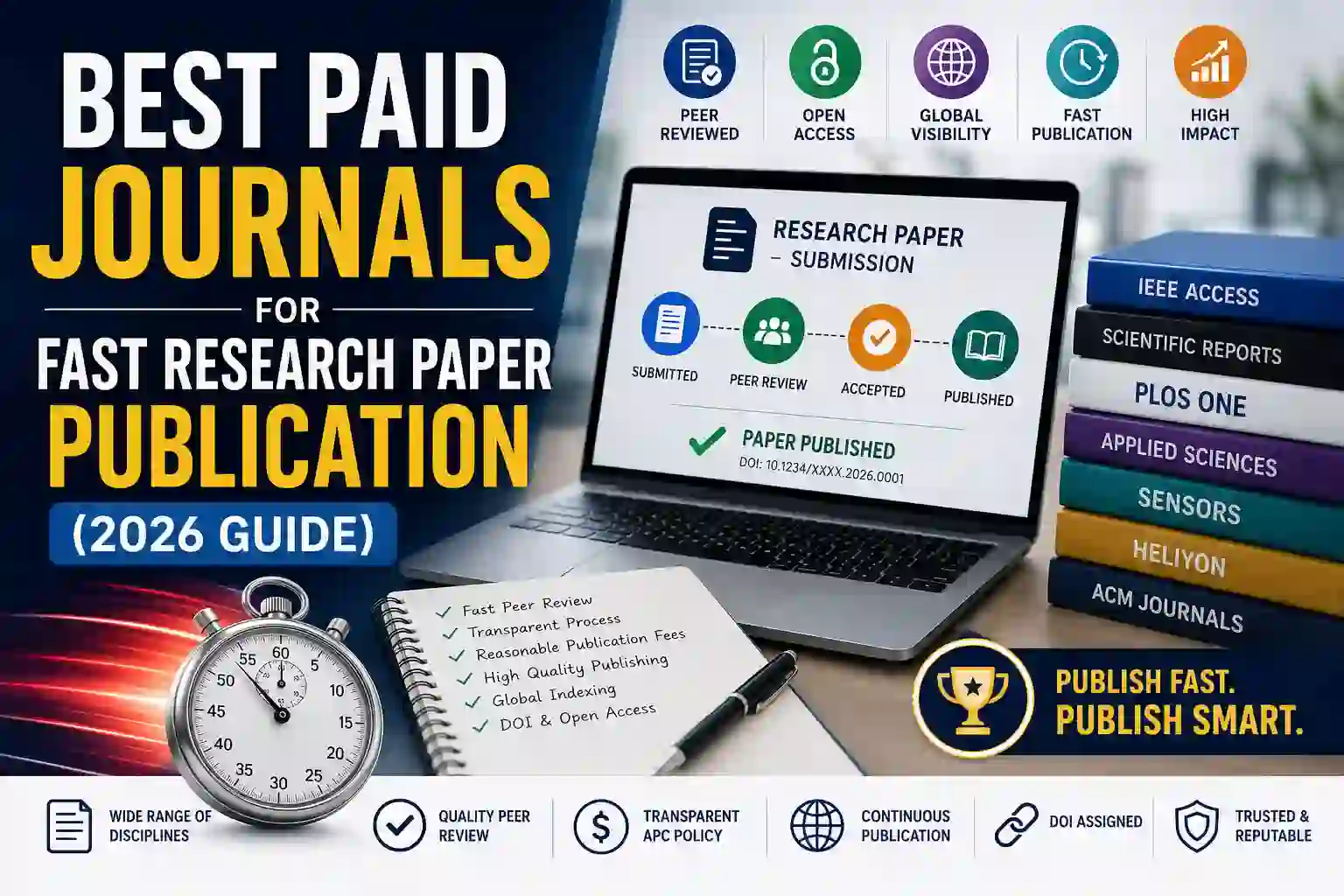
Publishing research quickly has become increasingly important for researchers, PhD scholars, faculty members, and industry professionals. Whether you're applying for a research grant, completing a doctoral degree, seeking academic promotion, or sharing timely scientific findings, selecting a journal with an efficient publication process can make a significant difference.
Many authors search for best paid journals for fast research paper publication, hoping to find journals that combine rigorous peer review with shorter publication timelines. However, speed should never come at the expense of research quality or publishing ethics.
Reputable journals may charge an Article Processing Charge (APC) to support editorial operations and open-access publishing, but they still follow a structured peer-review process before accepting any manuscript.
This comprehensive 2026 guide explains how fast publication journals operate, what influences publication speed, how to identify trustworthy paid journals, and what authors should consider before submitting their manuscripts.
Fast research paper publication refers to a publishing process where manuscripts move efficiently through editorial screening, peer review, revisions, acceptance, and online publication without unnecessary delays.
It does not mean skipping peer review or lowering editorial standards. Instead, reputable journals achieve shorter publication times by using modern manuscript management systems, experienced editorial teams, and continuous publication models.
| Publishing Stage | Typical Time |
|---|---|
| Editorial Screening | 2–5 Days |
| Peer Review | 2–4 Weeks |
| Author Revision | 1–2 Weeks |
| Final Editorial Decision | 3–7 Days |
| Online Publication | 1–2 Weeks |
These timelines are approximate and vary by journal, discipline, manuscript quality, reviewer availability, and the number of revision rounds required.
The demand for fast publication has increased significantly as research becomes more competitive and time-sensitive. Authors often need published work within specific academic or professional deadlines.
Publishing sooner also allows research findings to become available to the global scientific community more quickly, potentially increasing collaboration and citations.
Not necessarily.
Although many paid open-access journals are known for efficient editorial workflows, publication speed depends on several operational factors rather than the publication fee itself.
Legitimate paid journals invest APC revenue in editorial management, online publishing platforms, manuscript tracking systems, copyediting, typesetting, and digital publishing infrastructure. These investments can help streamline the publication process.
However, every manuscript must still undergo editorial evaluation and peer review before an acceptance decision is made.
Several factors influence how quickly a manuscript moves from submission to publication.
| Factor | Impact on Publication Time |
|---|---|
| Editorial Screening | High |
| Reviewer Availability | Very High |
| Number of Revision Rounds | Very High |
| Author Response Time | High |
| Production Workflow | Medium |
| Continuous Publication | Can Reduce Delays |
| Special Issues | May Vary |
Many modern journals now use a continuous publication model rather than waiting to publish complete issues.
Under this model, accepted manuscripts are published online individually as soon as they complete the production process. This allows authors to receive a DOI and share their work sooner.
Research findings become available to scholars, practitioners, and policymakers sooner.
Articles published earlier have more time to be discovered and cited by other researchers.
Timely publication can help researchers meet institutional deadlines for graduation, promotion, or funding applications.
Many fast-publication journals also publish articles online immediately after acceptance, making research accessible without waiting for a scheduled issue release.
Publishing earlier increases the chances of attracting collaborators working in similar research areas.
While publication speed is important, it should never be the only factor when choosing a journal.
A high-quality journal combines:
| Quality Indicator | Importance |
|---|---|
| Peer Review | ★★★★★ |
| Editorial Standards | ★★★★★ |
| Research Integrity | ★★★★★ |
| Publication Speed | ★★★★☆ |
| Publication Fee | ★★★☆☆ |
Continue to Part 2 → Next, we'll compare leading paid journals known for efficient publication workflows, discuss APC ranges, publishing models, and provide a practical comparison table to help you choose the right journal for your research.
Choosing the right journal involves more than finding the shortest publication timeline. Authors should evaluate the journal's scope, peer-review process, publication model, editorial quality, and transparency regarding publication fees.
The journals below are widely recognized publishers or established journals that are known for maintaining structured editorial workflows. Actual review and publication times vary depending on manuscript quality, reviewer availability, and revision requirements.
| Journal | Research Area | Publishing Model | Typical First Decision* | APC |
|---|---|---|---|---|
| IEEE Access | Engineering & Computer Science | Open Access | Approximately 4–6 Weeks | High |
| Heliyon | Multidisciplinary | Open Access | Approximately 4–8 Weeks | Moderate to High |
| PLOS ONE | Multidisciplinary | Open Access | Approximately 5–8 Weeks | High |
| Scientific Reports | Natural Sciences | Open Access | Approximately 5–8 Weeks | High |
| PeerJ | Life & Computer Sciences | Open Access | Approximately 4–6 Weeks | Moderate |
*Approximate editorial timelines vary by manuscript and are subject to change.
IEEE Access is a multidisciplinary open-access journal that publishes research across computer science, artificial intelligence, cybersecurity, cloud computing, networking, software engineering, robotics, IoT, blockchain, and data science.
Several ACM journals provide publishing opportunities across software engineering, human-computer interaction, computer systems, databases, and machine learning. Publication timelines differ depending on the journal.
Future Internet publishes research related to cloud computing, smart systems, internet technologies, cybersecurity, IoT, and distributed computing.
Applied Sciences publishes engineering and applied research across multiple disciplines including electrical engineering, mechanical engineering, materials science, and industrial engineering.
Sensors focuses on sensor technology, embedded systems, wireless communication, biomedical engineering, and IoT applications.
Electronics publishes research involving communication systems, integrated circuits, signal processing, embedded systems, and electronic engineering.
| Journal | Research Coverage | Publication Model |
|---|---|---|
| Heliyon | Science, Engineering, Medicine | Open Access |
| PLOS ONE | Multidisciplinary | Open Access |
| Scientific Reports | Natural Sciences | Open Access |
| PeerJ | Life & Computer Sciences | Open Access |
| APC Category | Approximate Range | Typical Publisher Type |
|---|---|---|
| Low | Below USD 300 | University & Independent Journals |
| Moderate | USD 300–1,000 | Society Publishers |
| High | Above USD 1,000 | Large International Publishers |
| Feature | Open Access | Subscription |
|---|---|---|
| Reader Access | Free | Subscription Required |
| Publication Fee | Often Yes (APC) | Usually No |
| Research Visibility | Very High | Limited to Subscribers |
| Immediate Availability | Usually Yes | Depends on Publisher |
| Copyright | Often Author Retained | Publisher Policies Vary |
Efficient journals streamline each stage of the publication process without compromising editorial quality.
Instead of selecting the journal with the shortest review time, consider whether the journal matches your research objectives.
| Evaluation Factor | Importance |
|---|---|
| Research Scope | ★★★★★ |
| Peer Review Quality | ★★★★★ |
| Editorial Board | ★★★★★ |
| Publication Ethics | ★★★★★ |
| Review Timeline | ★★★★☆ |
| Publication Fee | ★★★★☆ |
| Open Access Availability | ★★★★☆ |
Continue to Part 3 → Next, you'll learn how to identify legitimate fast-publication journals, avoid predatory publishers, compare journal quality, and follow a practical checklist before submitting your manuscript.
Selecting a journal simply because it advertises "fast publication" can be risky. The best journal for your manuscript is one that combines an efficient editorial process with rigorous peer review, transparent policies, and a strong match for your research topic.
Before submitting your paper, evaluate multiple aspects of the journal rather than focusing only on review time.
| Evaluation Factor | Why It Matters |
|---|---|
| Journal Scope | Your research should closely match the journal's aims and scope. |
| Peer Review Process | Ensures scientific quality and research integrity. |
| Editorial Board | Experienced editors improve review quality. |
| Publication Timeline | Helps authors plan around deadlines. |
| Publication Fee (APC) | Should be transparent with no hidden charges. |
| Publication Ethics | Demonstrates commitment to responsible publishing. |
| DOI Assignment | Provides permanent identification for published articles. |
| Digital Preservation | Protects articles for long-term access. |
| Author Guidelines | Clear instructions reduce submission errors. |
| Published Archive | Shows the journal's consistency and quality. |
Spending a few extra minutes evaluating a journal can help you avoid unnecessary publication delays, unexpected fees, or unreliable publishers.
A professional journal website should clearly provide:
Examine recently published papers to evaluate:
Reliable journals openly communicate:
Predatory journals often advertise unrealistically fast publication while bypassing proper editorial review.
| Red Flag | Why It Is Concerning |
|---|---|
| Guaranteed Publication | Editorial decisions should depend on peer review. |
| Acceptance Within 24–48 Hours | Quality peer review generally requires more time. |
| Payment Before Review | APCs are typically charged after acceptance. |
| Fake Impact Metrics | Verify any claimed metrics using trusted sources. |
| Poor Website Quality | Broken links and copied content reduce credibility. |
| Missing Editorial Board | Editorial transparency is an important quality indicator. |
| Hidden Publication Charges | Fees should be clearly disclosed before submission. |
The following workflow illustrates how reputable journals typically process manuscripts efficiently while maintaining quality control.
Research Paper Completed
          │
          ▼
Journal Selection
          │
          ▼
Online Submission
          │
          ▼
Editorial Screening
          │
          ▼
Peer Review
          │
          ▼
Author Revision
          │
          ▼
Final Editorial Decision
          │
          ▼
Production & DOI Assignment
          │
          ▼
Online Publication
Even journals with efficient workflows may experience delays due to factors beyond editorial control.
| Cause | Possible Impact |
|---|---|
| Difficulty Finding Reviewers | Longer peer-review period |
| Major Manuscript Revisions | Additional review rounds |
| Incomplete Submission Files | Administrative delays |
| Poor Manuscript Formatting | Returned before review |
| Language Issues | Extra revisions required |
| Scope Mismatch | Immediate rejection or transfer |
| Checklist Item | Status |
|---|---|
| Journal scope matches my research. | ☐ |
| Peer-review process is clearly explained. | ☐ |
| Editorial board is publicly listed. | ☐ |
| Publication fee is transparent. | ☐ |
| Author guidelines are available. | ☐ |
| Publication ethics policy is published. | ☐ |
| DOIs are assigned. | ☐ |
| Recent issues are accessible. | ☐ |
| Contact information is available. | ☐ |
| Copyright policy is explained. | ☐ |
| Licensing information is provided. | ☐ |
| Digital preservation policy exists. | ☐ |
| Publication timeline is reasonable. | ☐ |
| No unrealistic publication promises. | ☐ |
| The journal has a consistent publication history. | ☐ |
Continue to Part 4 → The final section includes frequently asked questions (FAQs), a summary of best practices, internal links, conclusion, SEO metadata, and a featured image prompt to complete this comprehensive guide.
Paid journals are scholarly journals that charge an Article Processing Charge (APC) or publication fee after a manuscript has been accepted. These fees help cover editorial management, peer review administration, DOI registration, online hosting, typesetting, and long-term digital preservation.
Not always. While many paid open-access journals have efficient editorial workflows and continuous publication models, publication speed depends on manuscript quality, reviewer availability, editorial processes, and revision time—not on the publication fee alone.
Some journals may complete the review and publication process within a month for high-quality manuscripts, but timelines vary significantly. Authors should rely on the journal's official publication information rather than advertisements promising guaranteed publication within a fixed number of days.
Many legitimate journals publish accepted manuscripts quickly while maintaining rigorous peer review. However, journals that guarantee acceptance or advertise unrealistically short publication times without a transparent review process should be evaluated carefully.
An APC is the fee charged by many open-access journals after a manuscript is accepted. It supports services such as editorial management, production, DOI registration, website maintenance, and digital archiving.
No. Authors should also consider the journal's scope, peer-review quality, editorial board, publication ethics, transparency, and suitability for their research.
Not necessarily. Many university-supported, society, and independent journals maintain high editorial standards while charging modest publication fees or no APC at all.
Yes. Undergraduate, postgraduate, and doctoral students frequently publish in reputable journals. The focus should be on selecting a journal that matches the research topic and follows transparent editorial practices.
Look for journals with:
| Feature | Legitimate Journal | Predatory Journal |
|---|---|---|
| Peer Review | Rigorous and transparent | Minimal or absent |
| Acceptance | Based on editorial evaluation | Often promised after payment |
| Publication Fees | Clearly disclosed | Hidden or unexpected |
| Editorial Board | Qualified and publicly listed | Missing or unverifiable |
| Publication Timeline | Realistic and transparent | Unrealistically short |
| Publishing Ethics | Clearly documented | Often missing |
While no journal can guarantee acceptance, authors can improve the efficiency of the publication process by submitting a complete, well-structured manuscript that fits the journal's scope.
Continue learning about academic publishing with these helpful resources:
Finding the best paid journals for fast research paper publication is about balancing speed, quality, and credibility. An efficient editorial workflow can help reduce publication delays, but genuine peer review remains essential for maintaining research integrity.
Instead of focusing only on rapid publication, evaluate journals based on their editorial standards, transparency, ethical practices, publication policies, and suitability for your research. A well-prepared manuscript submitted to the right journal has a much better chance of progressing smoothly through the review process.
Whether you are a student, researcher, faculty member, or industry professional, informed journal selection is one of the most important steps toward successful academic publishing.
Fast publication is valuable—but trustworthy peer review, transparent editorial practices, and a journal that aligns with your research are even more important. Choose quality first, and let speed be an added advantage rather than the only deciding factor.
ISSN (Online): 3117-3926
ISSN (Print): 3117-535X
| Publication Fees: | |