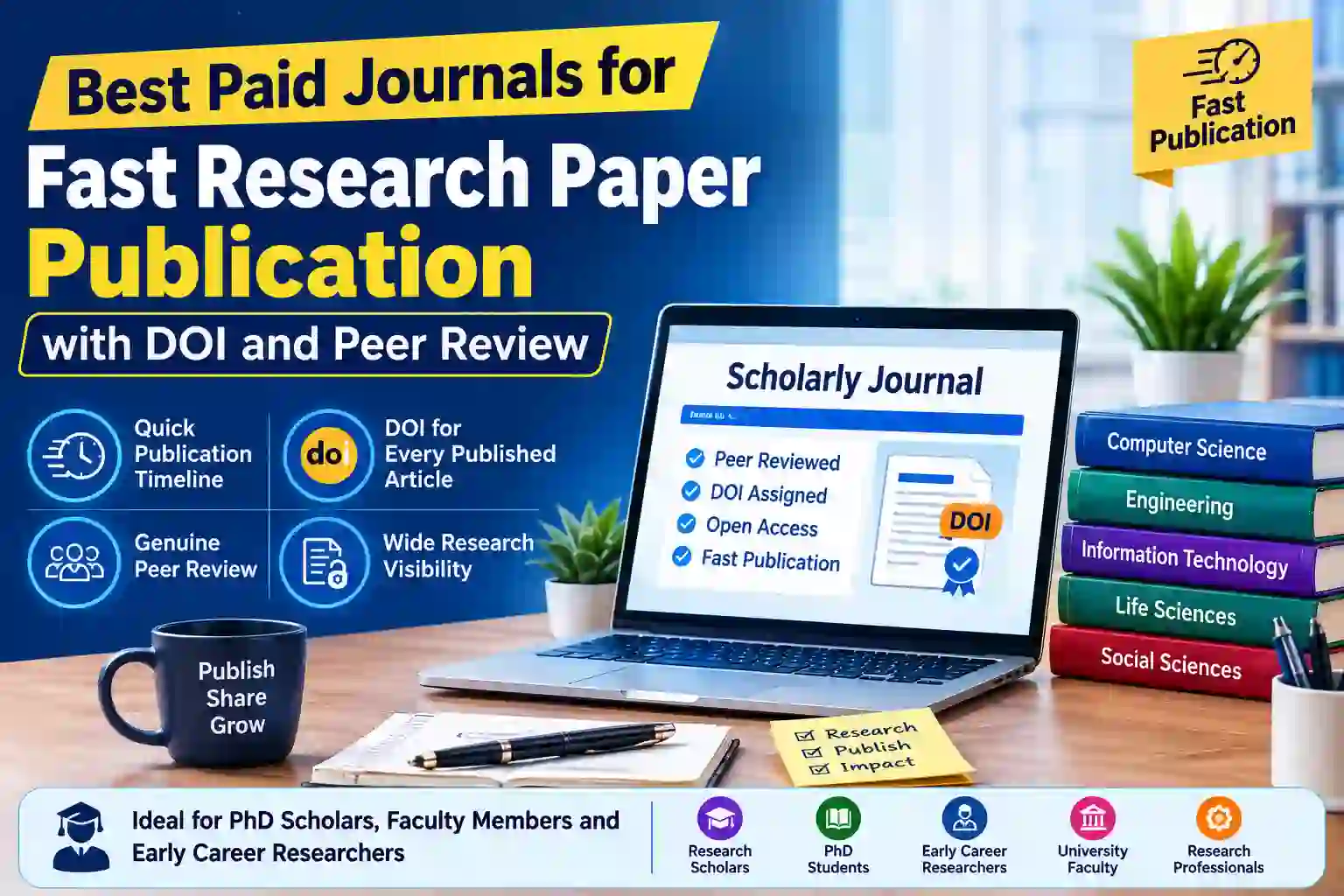
For researchers, PhD scholars, faculty members, and early-career academics, choosing the right journal can significantly affect how quickly a research paper moves from submission to publication. Many authors therefore search for paid journals for fast research paper publication that provide genuine peer review, DOI assignment, open access, and transparent Article Processing Charges (APCs).
However, fast publication should not mean skipping editorial evaluation or peer review. A credible journal should clearly explain its review process, publication fees, editorial policies, and expected publication timeline. Some journals use continuous publication or dedicated production workflows to publish accepted articles more quickly after acceptance. :contentReference[oaicite:1]{index=1}
This guide explains how to identify the best paid journals for fast research paper publication with DOI and peer review, what authors should check before paying an APC, how to compare publication speed and cost, and how to avoid journals that make unrealistic acceptance promises.
Quick Answer
The best paid journal for fast publication is not necessarily the journal with the highest publication speed or the lowest APC. Researchers should select a journal that combines relevant scope, genuine peer review, transparent APCs, DOI registration, publication ethics, editorial credibility, and a reasonable publication timeline.
What Are Paid Journals?
Paid journals are scholarly journals that charge authors a publication fee, commonly called an Article Processing Charge (APC), for publishing an accepted article. APCs are particularly common in open-access publishing because the journal provides readers with access to the published article without requiring a subscription.
The APC may support editorial administration, peer-review infrastructure, copyediting, typesetting, DOI registration, online hosting, metadata distribution, and digital preservation. The exact services included vary from one publisher to another.
For example, major publishers publish APC information on individual journal pages, and APCs can differ substantially between journals and publishing models. :contentReference[oaicite:2]{index=2}
Why Researchers Choose Fast Publication Journals
Researchers may need relatively fast publication for several legitimate reasons. PhD scholars may have thesis or academic deadlines, while faculty members may need recently published research for academic evaluations, grant reporting, conferences, or professional portfolios.
Common reasons include:
- PhD thesis submission deadlines
- Academic promotion requirements
- Research project reporting
- Conference-related publication schedules
- Time-sensitive scientific findings
- Building an early academic publication record
- Improving research visibility
- Sharing completed research with the academic community
Nevertheless, authors should distinguish between fast editorial processing, fast peer review, and fast publication after acceptance. These are different stages of the publishing workflow.
Fast Publication Does Not Mean Guaranteed Acceptance
One of the most important principles for researchers is that a legitimate fast-publication journal should not guarantee acceptance simply because an author pays a fee.
A genuine editorial process may include:
- Manuscript submission
- Initial editorial screening
- Plagiarism or similarity checks where applicable
- Reviewer selection
- Peer review
- Author revision
- Editorial decision
- Acceptance
- APC payment, where applicable
- Copyediting and typesetting
- Author proofing
- DOI registration
- Online publication
Be cautious of websites promising guaranteed acceptance, extremely unrealistic review periods, or publication within hours simply because an author pays a fee. Publication speed should never replace meaningful editorial and peer-review evaluation.
What Makes a Paid Journal a Good Choice?
Before selecting a paid journal, researchers should evaluate the complete publishing service rather than focusing only on the APC.
| Factor | What Authors Should Check |
|---|---|
| Research Scope | Does the journal publish research similar to your manuscript? |
| Peer Review | Is the review procedure clearly explained? |
| APC | Is the publication fee clearly disclosed? |
| DOI | Does the journal assign a persistent DOI to published articles? |
| Editorial Board | Are editors and their academic affiliations clearly identified? |
| Publication Ethics | Does the journal explain plagiarism, corrections, retractions, conflicts of interest, and authorship policies? |
| Publication Timeline | Are editorial and production timelines explained realistically? |
| Archive | Can readers access previously published articles? |
| Open Access Policy | Is the access model and licensing information transparent? |
Best Paid Journal Options for Fast Research Publication
There is no single journal that is objectively the "best" for every researcher. The appropriate choice depends on the subject area, manuscript quality, budget, desired audience, indexing requirements, and acceptable publication timeline.
Instead of presenting an unreliable universal ranking, researchers should consider the following categories of journals.
1. Established Open Access Publisher Journals
Large scholarly publishers operate numerous open-access journals across science, technology, medicine, engineering, and social sciences. These journals generally provide established editorial workflows and clearly published APC information.
Examples include journals published by organizations such as Elsevier, Springer Nature, Wiley, Taylor & Francis, Oxford University Press, IEEE, MDPI, and PLOS. Individual journal policies, APCs, review times, and publication schedules vary, so authors should evaluate each title separately.
For example, Elsevier currently provides an APC comparison feature that allows authors to compare APCs and selected journal indicators, while its pricing policy notes that APCs vary by journal. :contentReference[oaicite:3]{index=3}
2. Continuous-Publication Journals
Continuous publication can be attractive to authors who want accepted articles published online without waiting for a traditional issue to close.
Under this model, an accepted article can move through production and be published individually once the editorial and production processes are complete.
This can shorten the period between acceptance and online publication, although the peer-review stage may still require several weeks or longer depending on the journal.
3. Fast-Track or Rapid-Publication Journals
Some journals offer expedited editorial or production workflows. Authors should carefully determine exactly what "fast publication" means.
A journal may advertise:
- Fast initial editorial screening
- Rapid reviewer assignment
- Expedited peer review
- Priority production
- Early online publication
- Continuous publication
These services should be described transparently and should not eliminate meaningful editorial review.
4. Affordable International Open Access Journals
For researchers with limited budgets, affordable international open-access journals can be an attractive option. However, affordability should always be considered together with peer-review quality, editorial transparency, DOI registration, and publication ethics.
How Much Does Fast Research Paper Publication Cost?
There is no universal APC for fast research paper publication. Fees can range from journals that charge no APC to several thousand US dollars for some established open-access titles.
Current publisher pricing demonstrates how widely APCs can vary. For example, Elsevier states that its open-access APCs are set on a journal-by-journal basis and currently range from approximately USD $200 to $11,400, excluding taxes. :contentReference[oaicite:4]{index=4}
Therefore, researchers should never assume that every paid journal has a similar fee.
| Cost Element | What to Check |
|---|---|
| APC | Base publication charge |
| Taxes | Applicable VAT, GST, or other taxes |
| Fast-Track Fee | Whether expedited processing costs extra |
| Editing | Whether copyediting is included |
| Figures | Whether color or special artwork charges apply |
| Supplementary Material | Whether additional hosting charges apply |
| Waiver | Whether authors can request financial assistance |
How to Find Paid Journals with Low APCs
Researchers looking for affordable publication should compare journals systematically rather than searching only for the lowest price.
Step 1: Identify Your Research Area
Determine the main discipline and subdiscipline of your research. A journal specializing in computer science may not be appropriate for a civil engineering manuscript, even if its APC is lower.
Step 2: Create a Journal Shortlist
Prepare a shortlist of at least three to five potentially suitable journals.
Step 3: Compare APCs
Record the current publication charge, taxes, waiver conditions, and any additional fees.
Step 4: Check Peer Review
Read the journal's official peer-review policy. Look for information about reviewer selection, review type, editorial decision-making, and revision procedures.
Step 5: Check DOI Information
Confirm that the journal explains how DOIs are assigned to published articles. A DOI is useful for persistent identification and citation, but DOI availability alone should not be treated as evidence of journal quality.
Step 6: Check Recent Articles
Look at recently published papers. Compare publication dates, article formatting, author information, DOI links, references, and the overall quality of the journal's archive.
DOI and Its Importance in Research Publication
A Digital Object Identifier (DOI) is a persistent identifier used to identify scholarly publications and other digital objects.
For researchers, a DOI can make an article easier to locate and reference over time. DOI metadata can also support discovery and citation workflows across scholarly systems.
However, authors should remember that having a DOI does not automatically make a journal reputable. DOI assignment should be evaluated alongside peer review, editorial quality, publication ethics, transparency, and other journal characteristics.
Peer Review: The Most Important Quality Check
Peer review is a central part of scholarly publishing. Reviewers evaluate the manuscript's methodology, originality, technical quality, clarity, significance, and relationship to existing research.
Depending on the journal, the review may be single-blind, double-blind, or another documented review model.
Questions Authors Should Ask
- Is peer review mandatory for research articles?
- How many reviewers normally evaluate a manuscript?
- Is the review model explained?
- Who makes the final editorial decision?
- Are reviewer comments provided to authors?
- Is revision permitted?
- Does payment occur before or after acceptance?
Fast Publication vs. Fast Acceptance
These terms are often confused but they describe different processes.
| Term | Meaning |
|---|---|
| Fast Editorial Screening | The manuscript receives an initial editorial assessment quickly. |
| Fast Peer Review | Reviewers complete their evaluation within a relatively short period. |
| Fast Acceptance | The editorial decision is reached quickly after evaluation. |
| Fast Production | An accepted paper moves quickly through copyediting and typesetting. |
| Fast Publication | The complete process from submission to publication is comparatively short. |
Authors should ask the journal which stage its advertised timeline actually refers to.
Warning Signs of Questionable Fast-Publication Journals
- Guaranteed acceptance regardless of manuscript quality
- Claims of publication within hours without meaningful review
- Pressure to make immediate payment
- Unclear APC information
- No identifiable editorial board
- Unclear peer-review procedure
- Unverifiable indexing claims
- Unprofessional or misleading communication
- Unclear correction and retraction policies
- No archive of legitimate published research
Top Trending Research Publishing Keywords
Researchers searching for publication opportunities commonly use terms such as Research Journal, Peer-Reviewed Journal, Fast Publication Journal, DOI Journal, Open Access Journal, Computer Science Journal, Engineering Journal, Information Technology Journal, International Journal, and Publish Research Paper.
These terms can help authors explore relevant publishing resources, but keyword popularity should never replace careful journal evaluation.
How PhD Scholars Can Choose a Fast Publication Journal
PhD scholars often have specific thesis or institutional deadlines. However, selecting a journal only because it promises rapid publication can create unnecessary risks.
A better approach is to create a balanced shortlist:
| Priority | Recommended Approach |
|---|---|
| Research Fit | Choose journals publishing work in your exact research area. |
| Quality | Verify peer review and editorial standards. |
| Cost | Compare APCs and waiver opportunities. |
| Speed | Check realistic editorial and production timelines. |
| DOI | Confirm DOI registration policies. |
| Visibility | Evaluate discoverability and article metadata. |
APC Waivers and Discounts
Researchers with limited funding should investigate whether the journal offers APC waivers or discounts. Waiver policies vary significantly between publishers and journals.
In India, the One Nation One Subscription (ONOS) initiative also provides APC-related support for selected journals and has agreements that may enable eligible researchers at participating institutions to publish without APCs in certain journals. The eligibility and journal list should be checked through the current official ONOS information. :contentReference[oaicite:5]{index=5}
Some publishers have also introduced country-based pricing or discounts, making it particularly important for Indian researchers to check the actual APC applicable to their affiliation rather than relying on the standard international list price. :contentReference[oaicite:6]{index=6}
How to Improve Your Chances of Fast Publication
Authors can often reduce avoidable delays by preparing a complete manuscript before submission.
- Follow the journal's author guidelines.
- Use the required manuscript template.
- Check references carefully.
- Use high-quality figures and tables.
- Ensure author names and affiliations are correct.
- Include all required declarations.
- Check plagiarism and citation issues before submission.
- Write a clear abstract.
- Use relevant keywords.
- Respond to reviewer comments systematically.
Research Paper Publication Workflow
Research Completed
        ↓
Journal Selection
        ↓
Manuscript Preparation
        ↓
Online Submission
        ↓
Editorial Screening
        ↓
Peer Review
        ↓
Revision
        ↓
Editorial Decision
        ↓
Acceptance
        ↓
APC Payment
        ↓
Copyediting & Typesetting
        ↓
Author Proof
        ↓
DOI Registration
        ↓
Online Publication
Paid Journal Selection Checklist
- ☑ Journal scope matches the research.
- ☑ Peer-review process is clearly explained.
- ☑ Editorial board information is available.
- ☑ APC is clearly displayed.
- ☑ Additional fees are disclosed.
- ☑ DOI policy is explained.
- ☑ Publication ethics policies are available.
- ☑ Recent articles are accessible.
- ☑ Publication timeline is realistic.
- ☑ Waiver or discount options have been checked.
- ☑ Indexing claims have been independently verified.
- ☑ Payment terms have been understood before submission.
Frequently Asked Questions
What is the best paid journal for fast research paper publication?
There is no single best journal for every researcher. The appropriate journal depends on research scope, peer-review standards, publication fees, DOI policy, editorial quality, indexing requirements, and the author's required timeline.
Can a paid journal provide fast publication and peer review?
Yes. Some journals use streamlined editorial workflows and continuous publication while retaining peer review. Authors should verify exactly what the advertised timeline covers.
Does paying an APC guarantee acceptance?
No. A legitimate journal should make acceptance dependent on editorial and peer-review evaluation rather than payment.
How much does it cost to publish a research paper?
Publication costs vary substantially. Some journals have no APC, while others charge hundreds or thousands of dollars. Always check the journal's current official fee page.
Is a DOI necessary for a research paper?
A DOI is highly useful for persistent identification and citation, although DOI availability alone does not determine journal quality.
Are low APC journals reliable?
They can be. A low APC does not automatically indicate poor quality. Authors should evaluate peer review, editorial standards, publication ethics, transparency, and publication history.
What is continuous publication?
Continuous publication allows accepted articles to be published individually once production is completed rather than waiting for a traditional issue to close.
How can I find an affordable fast publication journal?
Compare several journals based on scope, APC, peer review, publication ethics, DOI policy, publication timeline, waiver options, and research visibility.
Should I choose a journal only because it promises publication in a few days?
No. Extremely short timelines should be investigated carefully. Genuine peer review requires sufficient time for qualified reviewers and editors to evaluate the manuscript.
Can Indian researchers receive APC discounts?
Potentially. Some publishers offer country-based pricing, discounts, or institutional agreements. Indian researchers should check their eligibility and the current terms before submission. :contentReference[oaicite:7]{index=7}
Final Recommendations
The search for the best paid journals for fast research paper publication with DOI and peer review should begin with quality rather than speed alone.
A strong journal choice balances research relevance, peer review, editorial credibility, transparent APCs, DOI registration, publication ethics, accessibility, research visibility, and a realistic publication timeline.
Researchers should also remember that the fastest possible publication is not always the best publication strategy. A credible journal with a transparent review process and reliable scholarly infrastructure can provide greater long-term value than a journal that promises immediate acceptance.
If you are preparing a manuscript for publication, explore our Research Journal resources and learn more about Peer-Reviewed Journal publishing, Fast Publication Journal options, DOI Journal publication, Open Access Journal models, and opportunities to Publish Research Paper.
Key Takeaways
- Fast publication should never mean bypassing peer review.
- Compare APCs carefully before submitting.
- Check whether the advertised timeline covers review or only production.
- Verify DOI registration policies.
- Evaluate the editorial board and publication ethics.
- Check indexing claims independently.
- Look for APC waivers and institutional discounts.
- Prepare your manuscript carefully to avoid preventable delays.
- Choose the journal based on overall value, not price alone.
- Always verify current fees and policies directly with the journal.
SEO Metadata
SEO Title:
Best Paid Journals for Fast Research Paper Publication with DOI and Peer Review
SEO Slug:
best-paid-journals-fast-research-paper-publication-doi-peer-review
Meta Description:
Discover the best paid journals for fast research paper publication with DOI and peer review. Learn about APCs, publication speed, waivers, journal selection, and ethical publishing.
Primary Keyword:
best paid journals for fast research paper publication
Secondary Keywords:
- fast publication journals
- paid journals for research paper publication
- research journals with DOI
- peer reviewed journals
- fast research paper publication
- low APC journals
- paid international journals
- open access journals with DOI
- fast peer review journals
- research paper publication fees
- article processing charges
- journal publication 2026
- best journals for research papers
- international research journals
Recommended Schema Markup
- Article
- FAQPage
- BreadcrumbList
- WebPage
- Organization
Conclusion
Fast research publication can be valuable when researchers have genuine academic deadlines, but speed should always be balanced with scholarly quality. Paid journals can provide efficient publication workflows, DOI registration, open-access distribution, and professional editorial services, but authors must investigate each journal before paying an APC.
The most reliable approach is to compare journals using a complete checklist: scope, peer review, editorial board, APC transparency, DOI, publication ethics, indexing, publication history, waiver policies, and realistic timelines.
By taking this approach, PhD scholars, faculty members, engineers, computer science researchers, and early-career academics can identify publication venues that provide a better balance between speed, affordability, credibility, and research visibility.