ISSN (Online): 3117-3926
ISSN (Print): 3117-535X
| Publication Fees: |  |

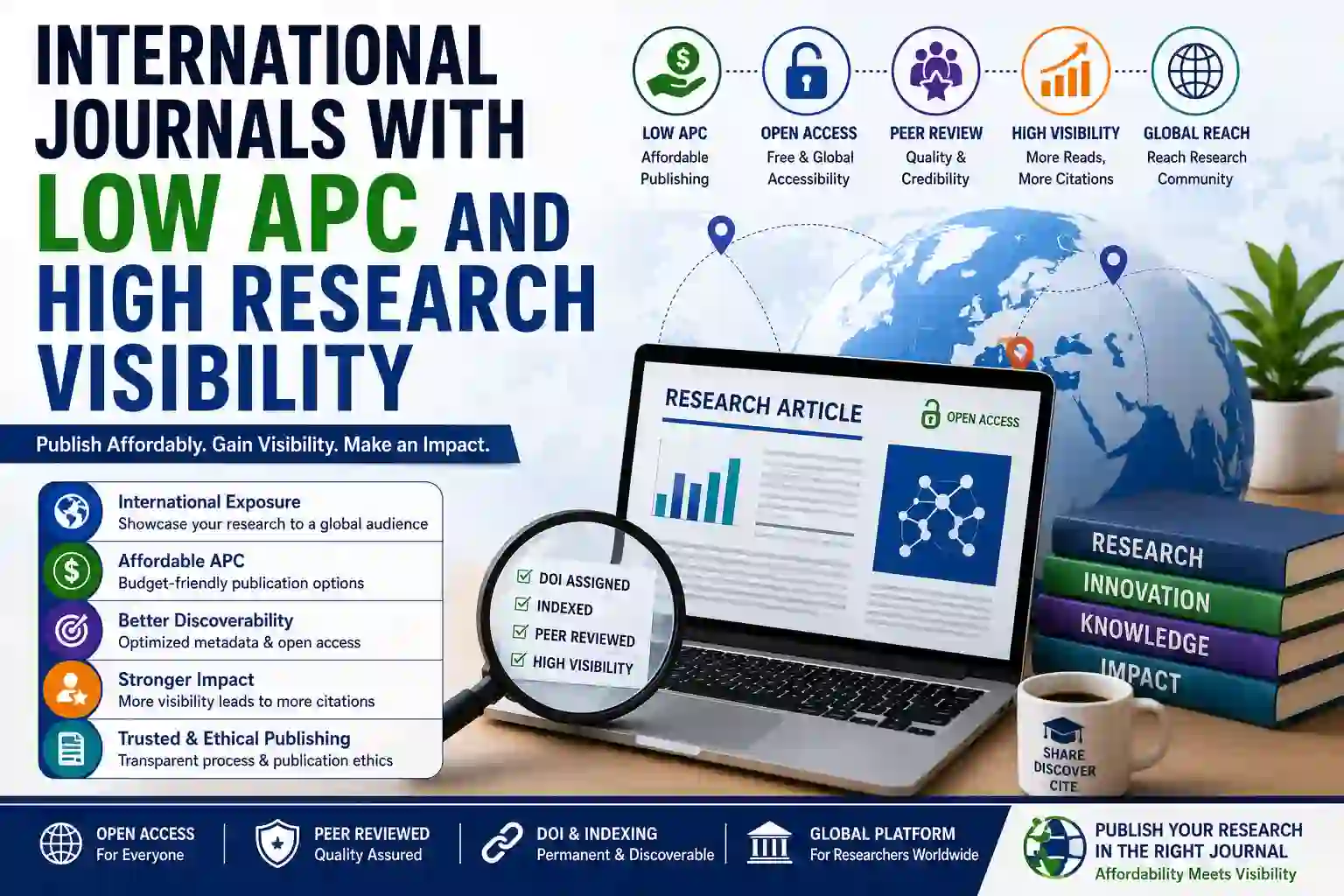
Publishing in an international journal is one of the most effective ways to share your research with a global academic audience. However, many researchers—especially students, early-career academics, and independent scholars—face a common challenge: finding a reputable journal that combines affordable Article Processing Charges (APCs) with strong research visibility.
A lower APC can help manage research budgets, but publication cost alone should never be the deciding factor. The ideal journal offers transparent editorial policies, rigorous peer review, a clear publication process, DOI assignment, long-term digital preservation, and broad discoverability through search engines and scholarly databases.
This comprehensive guide explains how to identify international journals that balance affordability with academic quality. You'll learn how APCs work, what influences research visibility, how to compare journals effectively, common mistakes to avoid, and practical strategies to maximize the impact of your published work.
An Article Processing Charge (APC) is a publication fee requested by many open-access journals after a manuscript has successfully passed peer review and has been accepted for publication. APCs help support the editorial and technical services required to publish scholarly articles online.
These services often include editorial management, peer-review coordination, copyediting, typesetting, DOI registration, metadata preparation, online hosting, and long-term digital preservation.
An APC is not a payment for acceptance. Ethical journals evaluate manuscripts based on originality, scientific quality, methodological soundness, and relevance to the journal's scope.
Publishing your article is only the beginning of its academic journey. A paper with strong research visibility is more likely to be discovered, read, discussed, and cited by other researchers. High visibility contributes to greater academic impact and can support career advancement, collaboration opportunities, and future funding applications.
Instead of selecting a journal solely because it has a low APC, consider how effectively it helps your work reach the global research community.
| Factor | Benefit |
|---|---|
| DOI Assignment | Provides a permanent and citable article identifier. |
| Quality Metadata | Improves discoverability in search engines and scholarly databases. |
| Open Access Availability | Allows researchers worldwide to read the article without subscription barriers. |
| Professional Copyediting | Enhances readability and presentation. |
| Clear Article Structure | Improves user experience and indexing. |
| Long-Term Digital Preservation | Supports ongoing access to published research. |
| Transparent Editorial Policies | Builds confidence among authors and readers. |
Affordable publication options make scholarly communication more accessible, particularly for researchers with limited funding. A well-managed journal with a reasonable APC can provide excellent value when combined with rigorous peer review, transparent editorial practices, and effective dissemination of published research.
If you're planning to Publish Research Paper, explore our homepage to discover a trusted Computer Science Journal, international Research Journal, reputable Peer-Reviewed Journal, high-quality Open Access Journal, multidisciplinary Engineering Journal, Information Technology Journal, and comprehensive guidance on Journal Publication.
Continue to Part 2 → In the next section, we'll compare different types of international journals, explain what influences APC pricing, show how to evaluate research visibility, and provide a practical framework for choosing the right journal for your manuscript.
Not all international journals operate in the same way. Some journals are fully open access, while others follow subscription or hybrid publishing models. Understanding these publishing models helps researchers compare publication costs, evaluate journal quality, and determine whether a journal offers good value for its APC.
The most suitable journal is not always the one with the lowest publication fee. Instead, authors should consider the journal's editorial standards, peer-review process, transparency, publication ethics, discoverability, and overall research visibility.
| Publishing Model | Author APC | Reader Access | Main Benefit |
|---|---|---|---|
| Diamond Open Access | No APC | Free | Authors and readers pay nothing. |
| Gold Open Access | Usually Yes | Free | Immediate global accessibility. |
| Hybrid Journal | Optional | Mixed | Authors choose open access or subscription publication. |
| Subscription Journal | Usually No | Paid Access | Traditional publishing model. |
A journal with a lower APC becomes truly valuable when it combines affordability with strong editorial quality and broad research visibility. Researchers should evaluate the complete publishing experience rather than comparing publication fees alone.
| Quality Indicator | Why It Matters |
|---|---|
| Transparent Editorial Policies | Builds author trust. |
| Peer Review | Maintains scientific quality. |
| DOI Assignment | Provides permanent citations. |
| Professional Website | Improves author confidence. |
| Regular Publication Schedule | Shows editorial consistency. |
| Long-Term Preservation | Supports permanent accessibility. |
| Clear APC Policy | Prevents unexpected publication costs. |
| Publication Ethics | Protects research integrity. |
Article Processing Charges vary among publishers because different journals invest in different editorial workflows, publishing technologies, and author services. A higher APC may reflect additional services, but it does not automatically indicate a higher-quality journal.
Publishing in a journal with high research visibility helps your work reach a wider academic audience. Increased visibility improves opportunities for citations, collaboration, and recognition within your research community.
A journal that supports discoverability through high-quality metadata, open access, persistent DOIs, and strong editorial practices often provides greater long-term value than a journal selected solely because of its lower publication fee.
| Visibility Factor | Benefit |
|---|---|
| Keyword-Optimised Title | Improves search engine rankings. |
| Structured Abstract | Helps readers quickly understand the research. |
| Relevant Keywords | Enhances discoverability. |
| Persistent DOI | Ensures permanent article identification. |
| Open Access Availability | Increases readership worldwide. |
| Quality Metadata | Supports indexing and academic search. |
| Professional Article Layout | Improves readability. |
Before submitting your manuscript, compare several journals using objective criteria rather than relying on publication fees alone.
If you're preparing to Publish Research Paper, explore our homepage to discover a trusted Computer Science Journal, reputable Peer-Reviewed Journal, international Research Journal, high-quality Open Access Journal, multidisciplinary Engineering Journal, Information Technology Journal, and expert guidance on Journal Publication.
Continue to Part 3 → Next, you'll learn how to identify reputable low APC journals, avoid common warning signs, understand APC waivers and funding opportunities, and discover expert strategies for selecting journals that maximize research visibility and academic impact.
Finding an affordable journal is relatively easy. Finding one that combines a reasonable Article Processing Charge (APC), transparent editorial practices, rigorous peer review, and strong research visibility requires a more systematic approach.
Rather than selecting a journal solely because of its publication fee, researchers should evaluate its publishing standards, author support, editorial quality, and long-term accessibility. Investing time in journal selection reduces the risk of unnecessary publication delays and improves the overall impact of your research.
| Feature | Why It Matters |
|---|---|
| Transparent APC Policy | Clearly explains publication fees and payment timing. |
| Defined Peer Review Process | Maintains scientific quality and fairness. |
| Qualified Editorial Board | Provides academic expertise and oversight. |
| Publication Ethics Policy | Demonstrates commitment to research integrity. |
| DOI Assignment | Ensures permanent identification and citation. |
| Regular Publication Schedule | Shows editorial consistency. |
| Professional Website | Reflects credibility and transparency. |
| Detailed Author Guidelines | Helps authors prepare successful submissions. |
A low APC should never compensate for poor publishing practices. Before submitting your manuscript, carefully evaluate the journal for warning signs that may indicate weak editorial standards or a lack of transparency.
Publishing in a reputable journal is only the first step. Authors who actively improve the discoverability of their articles often achieve greater readership, more citations, and broader academic recognition.
| Strategy | Benefit |
|---|---|
| Use Descriptive Titles | Improves search engine visibility. |
| Select Relevant Keywords | Supports academic search discovery. |
| Write a Structured Abstract | Helps readers quickly understand your work. |
| Provide Complete Metadata | Improves discoverability across platforms. |
| Use Clear Figures and Tables | Enhances readability. |
| Share Research Responsibly | Increases readership and engagement. |
Many publishers recognise that publication fees can be challenging for researchers with limited funding. As a result, waiver programmes and institutional funding opportunities are increasingly available.
Instead of comparing journals by APC alone, create a balanced evaluation using multiple quality indicators.
| Evaluation Criterion | Importance |
|---|---|
| Journal Scope | Ensures relevance to your research. |
| Editorial Expertise | Supports quality publishing. |
| Peer Review | Strengthens scientific reliability. |
| Publication Ethics | Protects research integrity. |
| DOI Availability | Improves citation stability. |
| Author Support | Creates a smoother publication experience. |
| Publication Consistency | Shows editorial reliability. |
Continue to Part 4 → In the next section, you'll learn the complete publication workflow, expected timelines, how peer review works, practical ways to improve acceptance chances, and advanced strategies to maximize your article's visibility and citation potential.
Publishing in an international journal involves much more than uploading a manuscript. Every reputable journal follows a structured editorial workflow designed to ensure scientific quality, research integrity, and long-term accessibility. Understanding this process helps authors prepare stronger submissions, reduce unnecessary delays, and improve their chances of successful publication.
Although editorial procedures vary between publishers, most international peer-reviewed journals follow a similar publication lifecycle from submission to online publication.
Research Completed
        │
        ▼
Choose the Right Journal
        │
        ▼
Read Author Guidelines
        │
        ▼
Prepare Manuscript
        │
        ▼
Online Submission
        │
        ▼
Editorial Screening
        │
        ▼
Peer Review
        │
        ▼
Minor / Major Revision
        │
        ▼
Final Editorial Decision
        │
        ▼
Acceptance
        │
        ▼
APC Payment (If Applicable)
        │
        ▼
Copyediting
        │
        ▼
Typesetting
        │
        ▼
Author Proof Approval
        │
        ▼
DOI Registration
        │
        ▼
Online Publication
        │
        ▼
Research Visibility & Citations
Journal selection is one of the most important decisions in the publishing process. A journal whose scope closely aligns with your research topic generally provides a smoother peer-review experience and better visibility among the appropriate academic audience.
A well-structured manuscript improves editorial efficiency and creates a positive first impression. Following the journal's formatting requirements reduces technical revisions and accelerates the review process.
| Section | Purpose |
|---|---|
| Title | Clearly communicates the research topic. |
| Abstract | Summarises objectives, methods, results, and conclusions. |
| Keywords | Improve discoverability in academic databases. |
| Introduction | Presents the research problem and objectives. |
| Methodology | Explains research methods and procedures. |
| Results | Presents research findings. |
| Discussion | Interprets the results and compares previous work. |
| Conclusion | Highlights the contribution and future scope. |
| References | Cites relevant scholarly literature. |
Before peer review begins, editors conduct an initial assessment to determine whether the manuscript meets the journal's scope, formatting requirements, and publication policies.
Peer review is the foundation of scholarly publishing. Independent experts evaluate the manuscript's originality, methodology, technical quality, significance, and clarity before recommending acceptance, revision, or rejection.
| Evaluation Area | Purpose |
|---|---|
| Originality | Measures the novelty of the research. |
| Scientific Quality | Evaluates research reliability. |
| Methodology | Assesses research design. |
| Technical Accuracy | Checks correctness of findings. |
| Writing Quality | Improves readability and clarity. |
| References | Evaluates supporting literature. |
Once the manuscript is accepted, journals that charge an APC generally request payment according to their published policies. The manuscript then enters the production stage, including copyediting, typesetting, proof correction, DOI registration, and online publication.
Always review the journal's APC policy before submission. Reputable journals clearly explain when publication fees are requested and which publishing services are included.
| Publication Stage | Typical Timeline* |
|---|---|
| Editorial Screening | Several days to a few weeks |
| Peer Review | Several weeks (varies by journal) |
| Author Revisions | Depends on revision complexity |
| Production | After acceptance |
| Online Publication | According to journal workflow |
*Timelines vary significantly between journals and disciplines.
Publishing in an international journal is only the first step. Increasing your article's visibility improves its potential readership, citations, and academic impact.
If you're planning to Publish Research Paper, explore our homepage for a trusted Computer Science Journal, international Research Journal, reputable Peer-Reviewed Journal, high-quality Open Access Journal, multidisciplinary Engineering Journal, Information Technology Journal, and comprehensive guidance on Journal Publication.
Continue to Part 5 → The next section covers 2026 publishing trends, AI in scholarly publishing, advanced citation strategies, funding opportunities, APC-saving techniques, a publishing glossary, and expert tips for increasing your research impact.
The academic publishing landscape continues to evolve rapidly. Researchers today are looking beyond publication alone—they want greater visibility, faster editorial decisions, transparent peer review, affordable Article Processing Charges (APCs), and long-term accessibility. International journals are increasingly adopting modern publishing technologies to improve both the author experience and research dissemination.
Understanding these trends helps researchers choose journals that provide long-term academic value instead of simply offering a low publication fee.
| Trend | Benefit to Researchers |
|---|---|
| Continuous Publication | Accepted articles become available online without waiting for issue release. |
| Open Access Growth | Increases worldwide accessibility and readership. |
| AI-Assisted Editorial Screening | Improves manuscript processing efficiency. |
| Enhanced Metadata | Boosts discoverability in search engines and academic databases. |
| Digital Preservation | Ensures long-term availability of published research. |
| Transparent Peer Review Policies | Improves trust between authors and journals. |
| Author-Centric Publishing | Provides better communication and submission experience. |
| Machine-Readable Articles | Supports AI-powered literature discovery. |
Artificial Intelligence (AI) is becoming an important part of scholarly publishing. Publishers use AI to support editorial workflows, improve technical checks, and enhance manuscript processing. Researchers also use AI responsibly to improve language quality, organize references, and identify relevant literature.
However, AI should support—not replace—scientific thinking, critical analysis, or the peer-review process. Authors remain fully responsible for the originality, accuracy, and integrity of their research.
| Application | Purpose |
|---|---|
| Grammar Improvement | Enhances readability and language quality. |
| Reference Management | Organizes citations more efficiently. |
| Literature Discovery | Helps researchers identify related studies. |
| Editorial Technical Checks | Improves submission quality. |
| Metadata Optimization | Supports indexing and discoverability. |
| Workflow Automation | Reduces editorial processing time. |
Publishing your article is only the beginning. The visibility of your research depends on how easily other researchers can discover, access, read, and cite your work.
Higher research visibility often leads to greater citation opportunities. Although citations cannot be guaranteed, authors can improve discoverability by following publishing best practices.
| Strategy | Benefit |
|---|---|
| Descriptive Title | Improves search rankings. |
| Relevant Keywords | Enhances discoverability. |
| Structured Abstract | Improves reader engagement. |
| Persistent DOI | Provides permanent citation. |
| Quality Metadata | Supports indexing across academic platforms. |
| Clear Research Presentation | Encourages wider readership. |
| Term | Meaning |
|---|---|
| APC | Article Processing Charge requested after manuscript acceptance. |
| DOI | Digital Object Identifier providing a permanent article link. |
| Open Access | Research freely available to readers worldwide. |
| Peer Review | Independent evaluation by subject experts. |
| Metadata | Structured information describing published research. |
| Editorial Screening | Initial manuscript assessment before peer review. |
| Continuous Publication | Publishing accepted articles immediately after production. |
| Research Visibility | The likelihood that research will be discovered, read, and cited. |
| Digital Preservation | Long-term protection of scholarly content. |
Continue to Part 6 → The final section includes 40+ SEO-optimized FAQs, complete SEO metadata, internal linking opportunities, schema recommendations, SEO checklist, conclusion, and a fully optimized resource for Google Search, Google Discover, and AI-powered search engines.
An international journal with a low Article Processing Charge (APC) is a scholarly journal that publishes research internationally while charging authors a relatively affordable publication fee after manuscript acceptance.
No. Publication cost does not determine editorial quality. Many reputable journals maintain rigorous peer review and transparent editorial policies while keeping APCs affordable.
Research visibility refers to how easily your published article can be discovered, accessed, read, and cited by researchers worldwide.
No. International journals may follow Diamond Open Access, Gold Open Access, Hybrid, or Subscription publishing models.
Reputable journals generally request APC payment only after a manuscript has successfully passed peer review and has been accepted for publication.
Yes. Some Diamond Open Access journals publish articles without charging authors. Others may offer APC waivers or discounts based on eligibility.
Review the journal's scope, editorial board, peer-review process, publication ethics, APC policy, DOI assignment, and author guidelines.
Open access removes subscription barriers, making research more accessible to readers around the world and potentially increasing readership.
A Digital Object Identifier (DOI) is a permanent identifier that provides a stable link for citing and accessing scholarly articles.
Use an informative title, a structured abstract, relevant keywords, accurate metadata, and publish in a reputable journal with transparent editorial practices.
Looking to Publish Research Paper? Visit our homepage to explore a trusted Computer Science Journal, international Research Journal, reputable Peer-Reviewed Journal, high-quality Open Access Journal, multidisciplinary Engineering Journal, Information Technology Journal, and expert guidance on Journal Publication.
SEO Title
International Journals with Low APC and High Research Visibility (2026 Guide)
SEO Slug
international-journals-with-low-apc-and-high-research-visibility
Meta Description
Discover how to choose international journals with low Article Processing Charges (APCs) and high research visibility. Learn how to compare journals, improve citations, maximize discoverability, and publish affordably in reputable peer-reviewed journals.
| SEO Element | Status |
|---|---|
| Primary Keyword in H1 | ✓ |
| SEO-Friendly URL | ✓ |
| Optimized Meta Title | ✓ |
| Optimized Meta Description | ✓ |
| Homepage Internal Links | ✓ |
| Related Blog Internal Links | ✓ |
| Structured H2/H3 Headings | ✓ |
| Comparison Tables | ✓ |
| FAQ Section | ✓ |
| Author Checklist | ✓ |
| Glossary | ✓ |
| E-E-A-T Optimized | ✓ |
| Google Discover Ready | ✓ |
| AI Search Optimized | ✓ |
Choosing an international journal with a low APC and high research visibility is about achieving the right balance between affordability, quality, and long-term academic impact. While publication costs are an important consideration, they should never outweigh essential factors such as rigorous peer review, transparent editorial policies, publication ethics, DOI assignment, and discoverability.
A carefully selected journal increases the likelihood that your research will reach the appropriate audience, contribute to scholarly discussions, and remain accessible for years to come. By evaluating journals systematically and preparing a high-quality manuscript, authors can maximize both publication success and research influence.
Whether you are publishing your first paper or expanding an established research portfolio, informed journal selection is one of the most valuable investments you can make in your academic career.
This guide was created to help researchers, postgraduate students, faculty members, and independent scholars make informed decisions when selecting international journals with affordable publication fees and strong research visibility. It follows current academic publishing best practices and is designed to remain useful as an evergreen reference for responsible scholarly publishing.
ISSN (Online): 3117-3926
ISSN (Print): 3117-535X
| Publication Fees: | |