ISSN (Online): 3117-3926
ISSN (Print): 3117-535X
| Publication Fees: |  |

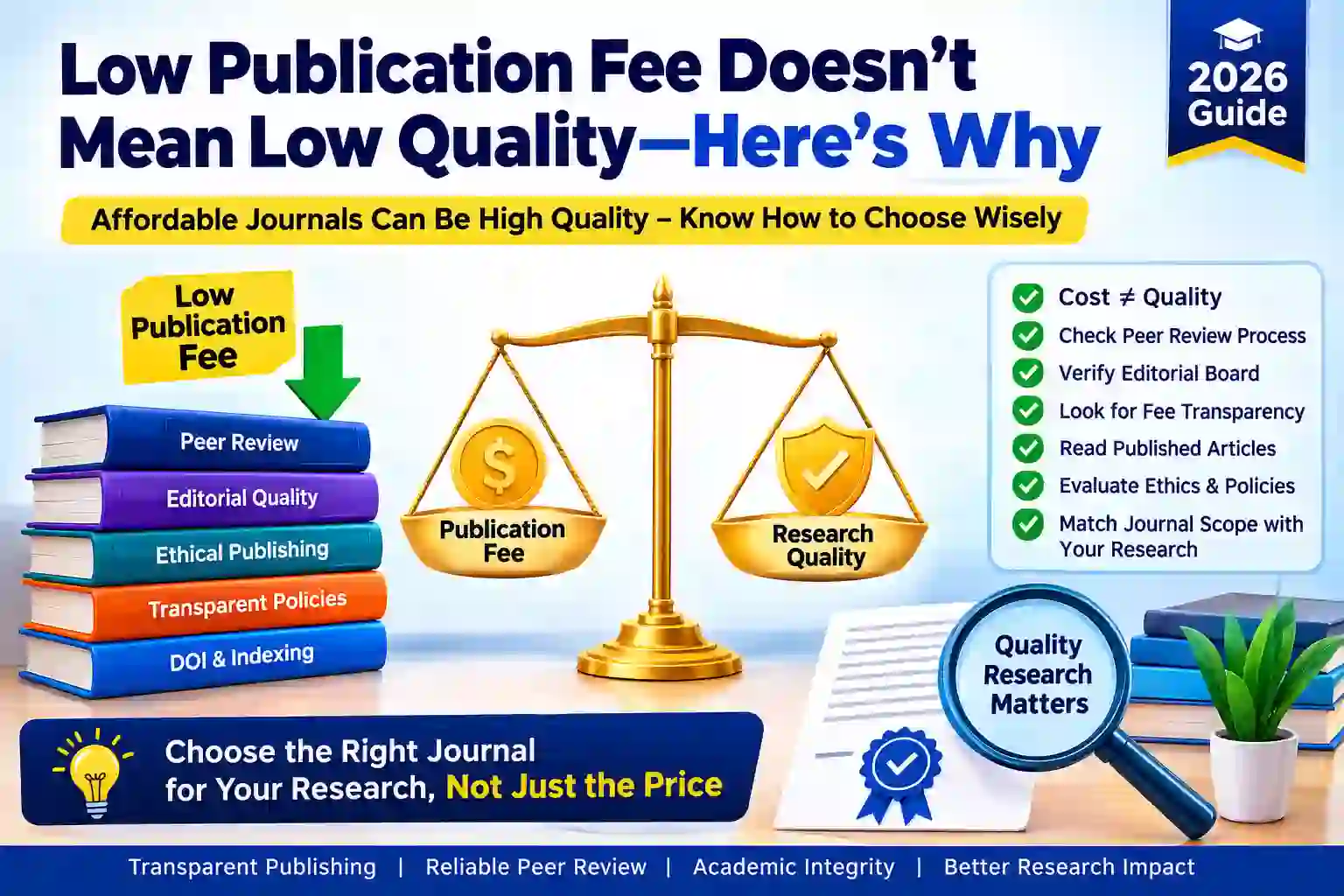
One of the most common assumptions in academic publishing is that an expensive journal must be better than an affordable one. For researchers, PhD scholars, students, and early-career academics working with limited publication budgets, this assumption can make journal selection unnecessarily difficult.
The truth is simple: publication cost and research quality are not the same thing.
A journal may charge a low Article Processing Charge (APC), no publication fee, or offer a waiver while still maintaining a transparent editorial process, genuine peer review, professional article production, and appropriate scholarly standards.
At the same time, a high publication fee does not automatically guarantee a prestigious, high-quality, or suitable journal.
This article explains why low publication fees do not necessarily indicate poor quality and provides a practical framework for evaluating an affordable journal before submitting your research paper.
If you are looking for information about computer science journals, engineering publications, and affordable research journal options, you can explore the JRIST homepage for additional author and publication information.
A low publication fee simply means that the financial charge requested from the author is relatively affordable compared with other journals offering similar publishing services.
It does not automatically tell you anything about:
Publication fees are primarily connected to a journal's publishing business model. Quality, on the other hand, depends on editorial and scholarly practices.
These are related to publishing, but they are not the same measurement.
Imagine two journals covering the same field.
| Factor | Journal A | Journal B |
|---|---|---|
| Publication fee | Low | High |
| Peer-review policy | Clearly explained | Clearly explained |
| Editorial board | Publicly listed | Publicly listed |
| Author guidelines | Detailed | Detailed |
| Publication ethics | Clearly stated | Clearly stated |
| Research scope | Relevant to your paper | Relevant to your paper |
There is no logical reason to conclude that Journal B is automatically better simply because it charges more.
There are many legitimate reasons why one journal can operate with a lower APC than another.
Journals can use different financial models. Some are supported by universities, research institutions, professional societies, grants, sponsorships, or other sources of funding.
Others recover a larger proportion of their operating costs through APCs.
Academic publishers may use open-source publishing platforms and digital workflows that reduce certain infrastructure costs.
Lower technical costs can make it possible for a journal to maintain a relatively affordable publication fee.
A journal supported by an academic institution or scholarly organization may not need to recover every operational expense directly from authors.
Publishing operations differ between journals. Some may have large production teams and extensive paid services, while others operate with smaller specialized teams.
This difference does not by itself establish that one journal provides better peer review.
Operating costs, academic infrastructure, currency values, and publishing expenses vary significantly between countries and regions.
Consequently, comparing APCs across countries without considering the publishing environment can produce misleading conclusions.
No.
A high Article Processing Charge should never be treated as a direct measurement of scholarly quality.
An expensive journal may provide excellent editorial services, but the price itself is not proof of excellence.
Similarly, a low-cost journal may have strong editorial policies and a legitimate peer-review system.
Researchers should therefore avoid two assumptions:
A better approach is to evaluate evidence of quality rather than the price tag.
For most researchers, peer review should be one of the first things examined when evaluating a potential journal.
A journal should explain how submitted manuscripts are evaluated and what happens after submission.
Depending on the journal, the process may involve editorial screening, reviewer assignment, peer review, revision, a final editorial decision, copyediting, typesetting, and publication.
Be cautious about journals that promise guaranteed acceptance simply because an author pays a publication charge.
A legitimate publishing model should not replace scholarly evaluation with payment.
One of the most useful indicators for authors is not whether a journal is cheap, but whether its charges are clear and predictable.
Before submitting a manuscript, determine the complete cost of publication.
A journal that charges a modest APC but clearly explains every condition can be more transparent than a journal advertising an apparently attractive price while revealing additional charges later.
Always check the official journal fee page before submission. Fees and policies can change, so an old blog post or third-party directory should not be treated as the final authority.
The cheapest journal is not useful if it is not suitable for your research.
Suppose your manuscript focuses on artificial intelligence for medical image analysis. A journal specializing in unrelated mechanical manufacturing research may have a low APC, but it would not necessarily be an appropriate publication venue.
Likewise, an engineering researcher should not choose a journal simply because it has an affordable fee if the journal does not regularly publish research in the relevant engineering discipline.
For computer science research, relevant areas may include:
For engineering research, areas may include:
A strong engineering research journal or computer science research journal should clearly communicate which subjects it accepts.
Indexing can influence the discoverability of your research, but authors should verify indexing claims independently.
Do not assume that a logo displayed on a journal website proves current inclusion in a database.
This is particularly important because researchers sometimes confuse directories, search engines, repositories, abstracting services, and selective indexing databases.
For example, being discoverable through a scholarly search service is not automatically equivalent to being indexed by every major citation database.
Verification is more valuable than a long list of logos.
A journal's publication ethics page can reveal much more about its publishing practices than its APC page.
Look for clear policies concerning:
Researchers should also check whether the journal explains what happens if an article requires correction or withdrawal after publication.
A low APC combined with strong transparency and ethical policies can be a positive sign. A low APC combined with unclear editorial practices should prompt further investigation.
One of the simplest ways to evaluate a journal is to read several of its recently published articles.
Do not read only one paper. Select several articles from different issues or publication dates.
Reading published papers can also help you determine whether the journal is genuinely publishing research similar to yours.
If every article appears unrelated to the stated scope, the journal may not be a suitable choice regardless of its publication fee.
Affordable publishing is not inherently suspicious. However, certain combinations of claims should make researchers investigate more carefully.
A promise that every manuscript will be accepted after payment is a major warning sign.
Fast publication is possible, but claims suggesting that a manuscript will definitely be accepted and published almost immediately should be evaluated carefully.
If a journal claims inclusion in a database, verify it through the database's official source.
If editors, affiliations, contact information, and responsibilities are difficult to verify, investigate further.
An advertised low APC becomes less attractive if mandatory additional fees appear only after acceptance.
A journal should provide meaningful information about how manuscripts are reviewed.
A basic website does not automatically mean a journal is poor quality. However, broken pages, contradictory policies, missing articles, outdated information, or inconsistent journal details deserve attention.
| Low Publication Fee | Potential Quality Concern |
|---|---|
| Affordable APC | Guaranteed acceptance |
| Clear fee policy | Hidden charges |
| Transparent peer review | No meaningful review information |
| Qualified editorial board | Unverifiable editors |
| Relevant published research | Articles unrelated to journal scope |
| Verifiable indexing | Unverified indexing logos |
| Clear ethics policies | Missing publication ethics information |
The key lesson is that low price is not the problem. Lack of transparency and poor scholarly practices are the real concerns.
Before submitting your manuscript, ask yourself the following:
If you can answer these questions confidently, you have much stronger evidence for your decision than the APC amount alone.
Students and PhD scholars often face a difficult balance between academic requirements and publication budgets.
A limited budget does not mean that you must automatically choose the most expensive journal you can afford.
Instead, discuss the publication requirements with your supervisor or institution and determine what actually matters for your degree or research project.
This is important because a journal can be academically legitimate but still not satisfy a particular university's degree or promotion requirements.
Therefore, “low fee” should mean affordable and appropriate—not simply cheap.
Research should not become inaccessible simply because an author does not have access to a large publication budget.
Affordable publishing models can be particularly useful for:
When journals clearly disclose their charges and maintain appropriate editorial standards, lower publication costs can help more researchers participate in scholarly communication.
For researchers in computer science, engineering, information technology, and interdisciplinary fields, exploring an affordable open access journal can therefore be one part of a broader publication strategy.
An APC tells you about cost, not automatically about scholarly quality.
Understand how manuscripts are evaluated before submitting.
Choose journals that clearly explain fees, policies, editorial procedures, and licensing.
Check indexing, ISSN, editorial information, and publisher details using reliable sources.
A journal should satisfy both your research needs and any academic requirements applicable to your degree, institution, or funding body.
No. A low APC by itself is not evidence that a journal is predatory. Researchers should evaluate peer review, editorial transparency, publication ethics, indexing claims, fees, and other publishing practices.
Yes. Publication price alone cannot establish scholarly quality.
Yes. Some journals operate through institutional, society, grant, or other forms of support and therefore do not need to charge authors an APC.
Neither should automatically be considered more important. The right priorities depend on your academic objective. If your university requires a particular indexing service, that requirement may be critical. Otherwise, scope, peer review, ethics, transparency, and discoverability should all be evaluated together.
Fast publication is not necessarily a problem, but you should understand how the journal achieves its stated timeline. Be cautious if speed is combined with guaranteed acceptance or little information about peer review.
Search for the journal directly on the official website of the claimed indexing or abstracting service. Do not rely only on logos displayed on the journal website.
Confirm the journal scope, peer-review policy, editorial information, fee amount, additional charges, licensing terms, publication ethics, indexing claims, and your institution's requirements.
Primary Keywords:
Secondary Keywords:
Long-Tail Keywords:
The cost of publishing is an important consideration, especially for researchers with limited funding. But an affordable APC should not immediately be interpreted as evidence of poor quality.
The better question is:
“Does this journal provide transparent, appropriate, and trustworthy scholarly publishing at a cost I can afford?”
To answer that question, examine the journal's scope, peer-review process, editorial board, publication ethics, fee policy, licensing, published articles, indexing claims, and overall transparency.
A low publication fee can be perfectly legitimate when it is part of a sustainable and transparent publishing model. Conversely, a high APC should never be considered a substitute for careful journal evaluation.
For researchers seeking affordable opportunities in computer science, engineering, information technology, and related fields, you can explore the international research journal resources and publication information available through JRIST.
Remember: choose a journal because it is appropriate for your research and meets your academic requirements—not simply because it is cheap or expensive.
ISSN (Online): 3117-3926
ISSN (Print): 3117-535X
| Publication Fees: | |