ISSN (Online): 3117-3926
ISSN (Print): 3117-535X
| Publication Fees: |  |

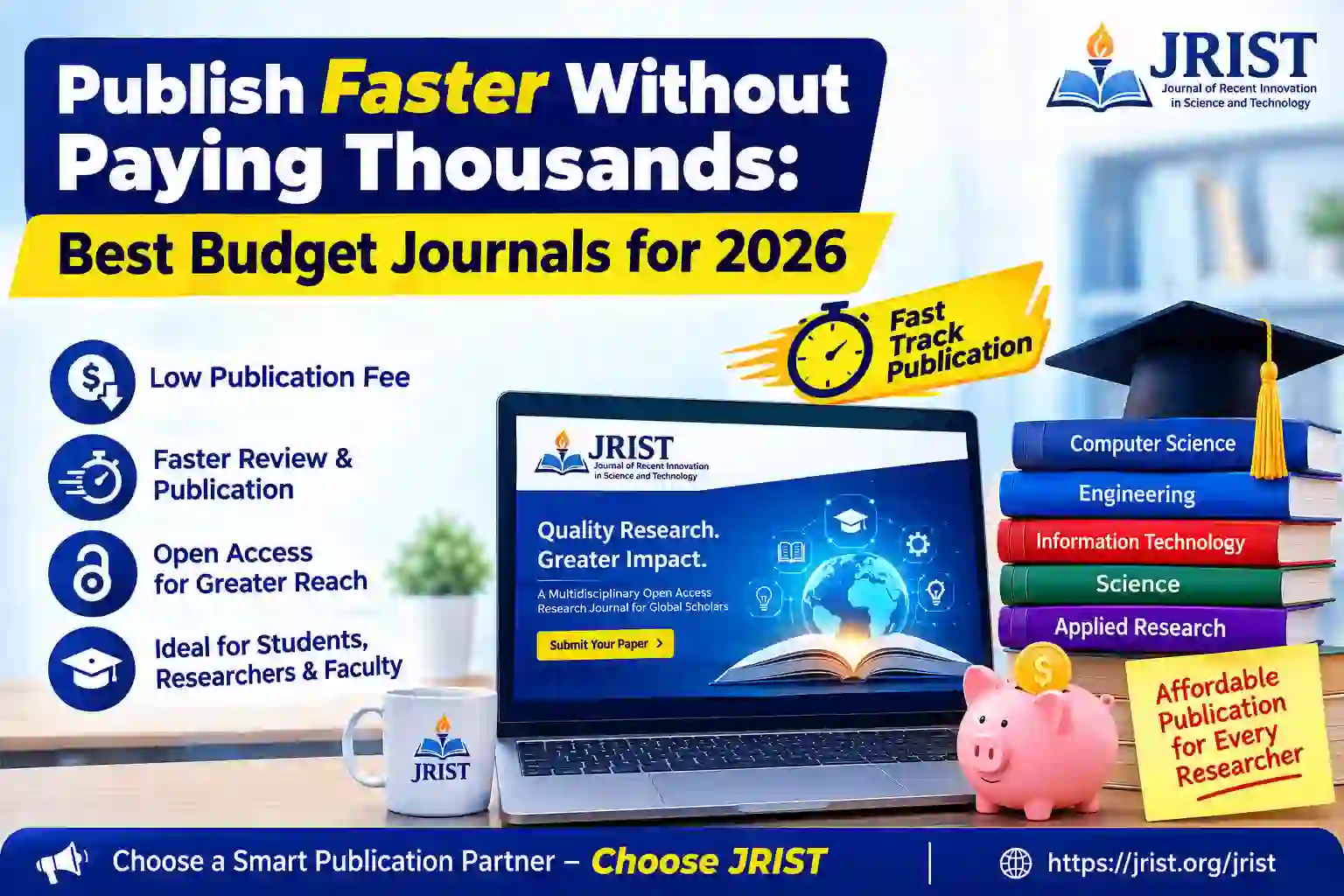
For many researchers, publishing a research paper is not only an academic task—it is also a financial decision. Article Processing Charges (APCs), editing expenses, formatting services, and other publication-related costs can quickly become a concern, particularly for students, PhD scholars, early-career researchers, and authors working without institutional funding.
But publishing affordably does not mean compromising on academic standards.
In 2026, researchers can find budget-friendly journal options that combine reasonable publication costs with transparent policies, peer review, open-access availability, and clear author guidelines. The key is knowing what to evaluate before choosing a journal.
For researchers in computer science, information technology, engineering, science, and related interdisciplinary areas, JRIST – Journal of Recent Innovation in Science and Technology is one publication option worth exploring.
This guide focuses on how researchers can pursue faster and affordable research publication while using JRIST as a practical example of what authors should examine before submitting a manuscript.
A budget research journal is a scholarly publication that keeps the financial cost of publishing manageable for authors.
There is no universal definition of a “budget journal.” What is affordable depends on the researcher's country, currency, funding availability, university support, and publication requirements.
However, an affordable journal should not be evaluated by price alone.
A useful budget journal should ideally provide:
The objective is therefore not simply to find the cheapest journal. It is to find a cost-effective journal that is appropriate for your research and academic requirements.
Not necessarily.
Publication speed depends on several stages, including editorial screening, reviewer availability, revision requirements, final editorial decisions, copyediting, typesetting, and online publication.
A journal can maintain an affordable publication model while operating an efficient editorial workflow.
However, researchers should be careful with journals that promise immediate acceptance or publication without explaining how manuscripts are evaluated.
Fast publication should mean an efficient process—not skipped peer review.
Authors can also improve their own publication speed by submitting a complete, well-formatted manuscript that follows the journal's instructions from the beginning.
Journal of Recent Innovation in Science and Technology (JRIST) is positioned as a multidisciplinary research journal covering computer science, information technology, engineering, science, and related technology fields.
This broad scope can be useful for researchers whose work crosses traditional disciplinary boundaries—for example, projects combining artificial intelligence with engineering, IoT with electronics, data science with environmental applications, or software with industrial systems.
JRIST is also designed as an open-access research publication, making published research available to readers without relying solely on subscription access.
For authors comparing affordable publication options, the important point is to examine JRIST's current author guidelines, publication policies, fee information, and journal scope before submission rather than selecting a journal solely because of its price.
Authors should always confirm the current scope on the official JRIST research journal website before submitting.
Computer science researchers may find a multidisciplinary journal useful when their research involves artificial intelligence, machine learning, software development, data analytics, cybersecurity, networking, cloud computing, IoT, or other emerging technologies.
A researcher should still compare the manuscript's exact subject with the journal's current scope before submission.
Research involving electronics, communication systems, embedded systems, control, power systems, instrumentation, and related technologies can fall within the broader engineering research landscape.
Mechanical research may include manufacturing, automation, thermal systems, mechanical design, robotics, materials, CAD/CAM, and related engineering applications.
Researchers working on structures, construction materials, transportation, water resources, environmental systems, sustainability, and related subjects may consider multidisciplinary engineering journals where the manuscript fits the stated scope.
Some modern research cannot be placed neatly into one discipline. A study may combine computer science, engineering, mathematics, environmental science, electronics, or data analytics.
For these manuscripts, a multidisciplinary international research journal can be worth considering when its scope clearly accommodates the work.
Before submitting to any journal, authors should understand exactly what they are expected to pay.
A publication fee may support activities such as editorial management, article processing, typesetting, online hosting, metadata management, DOI registration, and other publishing operations.
However, researchers should never assume that an advertised APC represents the complete cost without checking the journal's official fee information.
For JRIST, authors should review the official JRIST publication information before submission because fees and policies can change over time.
Do not rely on an old blog post or third-party article for the current APC. Always check the journal's own website.
The journal controls the editorial and peer-review timeline, but authors can significantly reduce avoidable delays.
Submitting a manuscript outside the journal's scope can result in rejection or unnecessary delays.
Read the aims and scope carefully before preparing your submission.
Check formatting requirements, manuscript structure, reference style, figures, tables, file formats, and other submission requirements.
Incomplete manuscripts often require additional communication between the author and editorial office.
Make sure citations and references are consistent and that important bibliographic information is accurate.
Grammar, structure, figures, tables, methodology, results, and conclusions should be reviewed before submission rather than waiting for reviewers to identify basic problems.
If revisions are requested, address every reviewer comment systematically. A clear response document can make the revision stage more efficient.
Do not submit the same manuscript to multiple journals at the same time unless the journals and applicable publishing policies explicitly permit it. Duplicate or simultaneous submission can create serious ethical problems.
One of the biggest misconceptions in academic publishing is that a low APC automatically indicates low quality.
Publication fees and research quality measure different things.
A journal's publication cost may be influenced by its financial model, infrastructure, institutional support, editorial workflow, and operational expenses.
Quality should instead be assessed through evidence such as:
Therefore, researchers should avoid judging a journal simply by comparing APC amounts.
A peer-reviewed journal with an affordable publishing model can be a reasonable option when it meets the researcher's academic and institutional requirements.
Your research should fit the journal's stated subject areas.
The journal should provide meaningful information about how submitted manuscripts are evaluated.
Review the listed editors and their affiliations and research expertise.
Look for policies covering plagiarism, conflicts of interest, authorship, corrections, retractions, and research misconduct.
Make sure you understand the complete financial commitment before submission.
Verify important indexing claims using the official database or service rather than relying only on logos displayed on a journal website.
Read several recent papers to determine whether the journal publishes research relevant to your field.
Understand how your copyright and the reader's reuse rights are handled.
The cheapest journal is not necessarily the best match for your paper.
Always verify significant indexing claims independently.
A low APC cannot compensate for a mismatch between your manuscript and the journal's subject area.
Fast publication is useful, but the integrity of the editorial and peer-review process is more important.
Technical and language problems can create avoidable revision cycles.
A journal can be legitimate and affordable but still not meet the specific publication requirements of your university, institution, supervisor, or funding agency.
Students and early-career researchers may have strong research ideas but limited access to publication funding.
An affordable publication model can therefore make scholarly communication more accessible.
This is particularly relevant for:
However, affordability should always be considered alongside academic suitability.
Before submitting to JRIST or another journal, researchers should determine whether the publication meets the requirements applicable to their degree, institution, promotion criteria, or research project.
For researchers exploring budget-conscious publication opportunities, JRIST offers a multidisciplinary platform covering computer science, information technology, engineering, science, and related technology areas.
The value of an affordable journal should not be measured solely by its APC. Researchers should consider the complete publication experience.
| What Authors Should Evaluate | Why It Matters |
|---|---|
| Research scope | Determines whether the paper is suitable |
| Peer review | Supports scholarly evaluation |
| Publication fee | Determines affordability |
| Editorial policies | Provides transparency |
| Publication ethics | Supports responsible publishing |
| Open-access model | Improves reader accessibility |
| Article metadata | Supports discoverability |
| Indexing claims | Should be independently verified |
Researchers interested in submitting should review the current JRIST journal information and author instructions before preparing their final submission.
Researchers often search for terms such as low publication fee journals, affordable research journals, and low APC journals because publication budgets can be limited.
JRIST can be considered within this broader search when the journal's scope matches the manuscript and its current publication policies meet the author's requirements.
The important distinction is that affordability should support—not replace—careful journal evaluation.
Yes. Publication costs vary widely. Some journals charge no APC, while others operate with relatively affordable publication fees. Researchers should compare the complete cost and publishing policies rather than assuming that reputable publishing must always be expensive.
JRIST covers computer science, information technology, engineering, science, and related technology areas. Authors should compare their specific manuscript with the current journal scope before submission.
JRIST has a multidisciplinary scope that includes engineering areas. Researchers should verify that their specific topic fits the current aims and scope before submitting.
No. APC amount and peer-review quality are separate considerations. Authors should evaluate the actual review policy and editorial practices.
Choose an appropriate journal, follow its author guidelines carefully, submit a complete manuscript, check references and figures, and respond promptly and thoroughly to revision requests.
Not by itself. Researchers should investigate how the journal conducts editorial screening and peer review. Speed should not come at the expense of scholarly evaluation.
Check the official fee information, additional charges, peer-review policy, journal scope, editorial information, licensing terms, and any academic requirements that apply to your research.
Primary Keywords:
Secondary Keywords:
Long-Tail Keywords:
Publishing a research paper does not have to mean spending thousands on publication fees. Researchers can find budget-conscious journals by comparing publication costs with editorial standards, peer review, scope, ethics, licensing, discoverability, and institutional requirements.
For computer science, information technology, engineering, science, and interdisciplinary research, JRIST is an option researchers can explore when its scope and current policies match their manuscript and academic objectives.
The most important lesson is to choose based on value and suitability, not price alone.
A sensible publication strategy is to prepare a strong manuscript, identify journals that genuinely match the research, compare their current fees and policies, verify important claims, and then submit to the most appropriate venue.
Affordable publishing is possible—but the goal should always be affordable, transparent, and academically appropriate publishing.
To learn more about JRIST, its research areas, author information, and current publication policies, visit the JRIST homepage.
ISSN (Online): 3117-3926
ISSN (Print): 3117-535X
| Publication Fees: | |