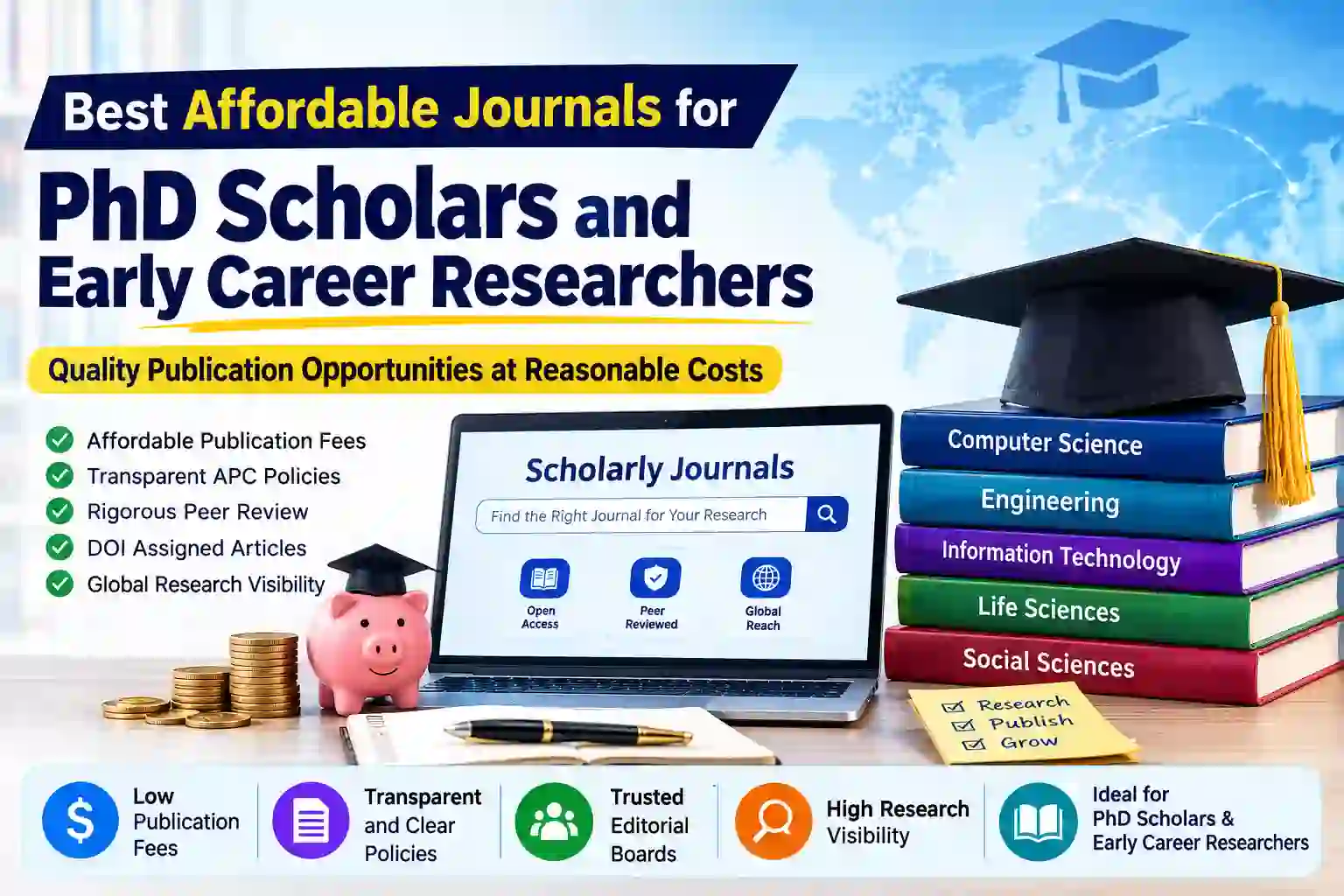
Best Affordable Journals for PhD Scholars and Early Career Researchers
Publishing a research paper is an important milestone for PhD scholars, postdoctoral researchers, university faculty, and early career academics. However, publication costs can become a significant concern, particularly for researchers working with limited funding or without institutional support.
The good news is that an affordable journal does not necessarily mean a low-quality journal. Researchers can find reputable publication opportunities by carefully evaluating Article Processing Charges (APCs), peer-review practices, editorial policies, DOI availability, indexing, publication ethics, and overall transparency.
This comprehensive guide explains how PhD scholars and early career researchers can identify affordable journals, compare publication costs, avoid misleading offers, understand APC waivers, and select journals that provide a reasonable balance between cost, credibility, accessibility, and research visibility.
The best affordable journal is not necessarily the journal with the lowest APC. Researchers should look for a journal with a transparent fee policy, genuine peer review, appropriate subject scope, clear editorial information, DOI assignment, ethical publishing practices, and a publication model that fits their research and budget.
Why Affordable Journals Matter for PhD Scholars
PhD scholars often publish research under financial constraints. A researcher may have to manage laboratory expenses, conference registration, research software, fieldwork, data collection, thesis preparation, and publication costs within a limited research budget.
For early career researchers, publication expenses can be equally challenging. Researchers beginning their academic careers may not yet have access to large institutional grants or dedicated publication funds.
This makes affordable scholarly publishing particularly important. However, cost reduction should never come at the expense of research integrity.
An affordable journal should ideally provide:
- Transparent publication charges
- A clearly described peer-review process
- Qualified editorial leadership
- Relevant subject scope
- Clear publication ethics policies
- DOI assignment where applicable
- Reliable article hosting
- Clear author guidelines
- Transparent waiver or discount policies
What Is an Affordable Journal?
An affordable journal is a scholarly publication whose total publication cost is reasonable relative to the services and editorial infrastructure it provides. The definition of "affordable" differs between researchers and countries.
For example, a publication fee that is manageable for a researcher with institutional funding may be difficult for an independent PhD scholar. Therefore, authors should evaluate affordability according to their own funding situation rather than relying on a universal APC threshold.
Affordable Does Not Mean "Free"
Some journals operate without charging authors, while others charge APCs to support open-access publishing. Both models can be legitimate.
The important question is whether the journal clearly explains how its publishing model works and what authors receive in return for any publication fee.
How Much Should PhD Scholars Expect to Pay?
There is no single standard publication fee for scholarly journals. APCs vary substantially according to discipline, publisher, publishing model, geographic region, editorial infrastructure, and the services offered.
| Publishing Model | Possible Author Cost | What Authors Should Check |
|---|---|---|
| Diamond Open Access | Often no APC | Funding model, editorial standards and peer review |
| Gold Open Access | APC may apply | APC amount, waiver policy and included services |
| Hybrid | May vary significantly | Open-access option and subscription model |
| Subscription Journal | Often no APC for standard publication | Reader access and optional publication charges |
Because journal fees change, authors should always verify the current fee displayed on the journal's official website before submission.
Top Factors to Consider When Choosing an Affordable Journal
1. Journal Scope
The first consideration should be subject relevance. A low-cost journal is not useful if it does not publish research in your discipline.
PhD scholars should examine the journal's aims and scope and review recently published papers. The closer the research match, the more appropriate the journal is likely to be.
2. Peer-Review Process
A credible journal should explain how submitted manuscripts are evaluated. Authors should understand whether manuscripts undergo editorial screening and peer review before publication.
Avoid selecting a journal simply because it promises extremely fast acceptance. Genuine peer review requires appropriate editorial and reviewer evaluation.
3. APC Transparency
The publication fee should be clearly stated. Authors should know whether the displayed APC is the complete publication fee or whether additional charges may apply.
Before submitting, check:
- APC amount
- When payment is required
- Currency used
- Applicable taxes
- Waiver availability
- Discount conditions
- Additional optional charges
4. Editorial Board
Review the journal's editorial board and verify that the listed editors have appropriate academic backgrounds relevant to the journal's subject areas.
5. Publication Ethics
A reputable journal should provide information about plagiarism, research misconduct, conflicts of interest, corrections, retractions, authorship, and other publication ethics matters.
6. DOI Availability
A DOI, or Digital Object Identifier, provides a persistent identifier for a published article. DOI assignment can make articles easier to locate and cite.
However, a DOI by itself does not prove that a journal is reputable. Authors should evaluate DOI information together with other quality indicators.
Affordable Journal vs. Predatory Journal
One of the biggest challenges facing early career researchers is distinguishing an affordable legitimate journal from a predatory or deceptive publication outlet.
| Affordable Reputable Journal | Potential Warning Sign |
|---|---|
| Clearly explains APCs | Unexpected fees appear late in the process |
| Explains peer review | Guarantees acceptance |
| Provides editorial information | Unclear or unverifiable editorial board |
| Publishes research consistently | Unclear publication history |
| Provides author guidelines | Minimal submission information |
| Provides publication ethics policies | No meaningful ethics information |
| Uses professional communication | Aggressive unsolicited acceptance messages |
A low APC should never be the only reason to submit a manuscript. Researchers should investigate the journal's editorial standards and publishing practices before making a payment.
APC Waivers for PhD Scholars and Early Career Researchers
Researchers with limited financial resources should always investigate whether the journal provides an APC waiver or discount.
Depending on the journal, financial assistance may be available through:
- Full APC waivers
- Partial APC discounts
- Institutional agreements
- Research funding programs
- Society membership benefits
- Country-based waiver programs
- Special early career researcher initiatives
Waiver eligibility differs among publishers, so researchers should read the current policy carefully and contact the journal before submission if clarification is required.
How to Find Affordable Journals for Your Research
Step 1: Identify Your Research Area
Define the primary discipline and subdiscipline of your manuscript. For example, a technical paper may belong to computer science, artificial intelligence, information technology, electrical engineering, mechanical engineering, civil engineering, environmental engineering, or another specialized area.
Step 2: Prepare a Shortlist
Create a shortlist of several journals rather than submitting immediately to the first journal you find.
Step 3: Compare Scope
Read the aims and scope of each journal and compare them with your research objectives.
Step 4: Compare Publication Costs
Record the current APC, waiver policy, optional charges, and payment conditions for every shortlisted journal.
Step 5: Evaluate Editorial Quality
Check peer review, editorial board information, publication ethics, author guidelines, DOI policies, and publication history.
Step 6: Make the Final Decision
Choose the journal offering the strongest overall fit rather than simply selecting the journal with the lowest price.
Best Affordable Journal Selection Framework
| Factor | Priority | Question to Ask |
|---|---|---|
| Research Scope | Very High | Does the journal publish research like mine? |
| Peer Review | Very High | Is the review process clearly explained? |
| Publication Ethics | Very High | Are ethical policies transparent? |
| APC | High | Can I realistically afford the fee? |
| Waiver Policy | High | Can I apply for financial assistance? |
| DOI | Medium | Will my article receive a persistent identifier? |
| Visibility | High | How easily can readers discover the published research? |
Affordable Publishing Strategies for PhD Scholars
Use Your University Resources
Many universities provide access to research databases, language support, writing centers, library services, and sometimes publication funding. Before paying for external services, check what your institution already provides.
Apply for Funding Early
If your research is funded by a grant, determine whether publication expenses are eligible before the manuscript reaches the acceptance stage.
Prepare the Manuscript Carefully
A carefully prepared manuscript reduces unnecessary revisions and can prevent avoidable formatting or language-related delays.
Do Not Pay for Unnecessary Services
Authors should distinguish between essential journal requirements and optional third-party services. Not every manuscript requires professional editing, figure redesign, translation, or formatting services.
Common Mistakes Early Career Researchers Should Avoid
- Choosing a journal only because it is cheap.
- Believing guaranteed acceptance claims.
- Ignoring the journal's scope.
- Failing to read APC and waiver policies.
- Assuming a DOI automatically means high quality.
- Submitting without checking author guidelines.
- Ignoring publication ethics information.
- Paying before understanding the complete fee structure.
- Using outdated information about journal fees.
- Submitting the same manuscript simultaneously to multiple journals.
How to Improve Research Visibility After Publication
Affordable publication should not mean compromising on discoverability. After publication, authors should ensure that their article has accurate metadata and is shared through appropriate academic channels.
- Use a descriptive research title.
- Choose relevant keywords.
- Write a strong abstract.
- Use accurate author affiliations.
- Maintain researcher profiles.
- Share publications through appropriate academic networks.
- Link published work from institutional or professional profiles where permitted.
Researchers can also explore our Research Journal resources and publishing guidance to learn more about improving research visibility and selecting appropriate publication venues.
Internal Resources for Researchers
Researchers looking to Publish Research Paper can explore our homepage for information related to Peer-Reviewed Journal options, Open Access Journal publishing, Computer Science Journal opportunities, Engineering Journal publication, Information Technology Journal research, and Journal Publication guidance.
Related Reading
- How Much Does It Cost to Publish a Research Paper? Complete APC Guide
- Research Paper Publication Fees in 2026: A Complete Guide to APCs and Hidden Costs
- Fast Publication Paid Journals with Low Article Processing Charges
- International Journals with Low APC and High Research Visibility
- Top Paid Engineering Journals Accepting Research Papers in 2026
- Top Paid Computer Science Journals with Peer Review and DOI
PhD Scholar Journal Selection Checklist
- ☑ Confirm that the journal matches your research topic.
- ☑ Check the current APC on the official journal website.
- ☑ Review waiver and discount policies.
- ☑ Verify the peer-review process.
- ☑ Review the editorial board.
- ☑ Check publication ethics policies.
- ☑ Confirm DOI information.
- ☑ Review recently published articles.
- ☑ Check author guidelines.
- ☑ Investigate indexing claims independently.
- ☑ Understand all mandatory and optional charges.
- ☑ Keep evidence of submission and payment communication.
Glossary for Early Career Researchers
| Term | Meaning |
|---|---|
| APC | Article Processing Charge associated with publishing an article, commonly in open-access journals. |
| DOI | Digital Object Identifier providing a persistent identifier for scholarly content. |
| Peer Review | Evaluation of research by qualified reviewers before publication. |
| Open Access | A publishing model in which readers can access research without subscription barriers. |
| Waiver | A reduction or removal of an applicable publication fee under specified conditions. |
| Editorial Board | Academic experts responsible for supporting the journal's editorial direction and quality. |
| Publication Ethics | Principles and policies governing responsible scholarly publishing. |
| Metadata | Information describing an article, including title, authors, abstract, keywords, and publication information. |
Frequently Asked Questions
Are affordable journals suitable for PhD scholars?
Yes. Affordable journals can be suitable for PhD scholars when they maintain appropriate peer-review, editorial, ethical, and publication standards.
Is a low APC a sign of a predatory journal?
No. A low APC alone does not indicate poor quality. Authors should evaluate the complete journal profile, including editorial practices, peer review, ethics, transparency, and publication history.
Can PhD students publish without paying an APC?
Yes. Some journals operate without author publication charges, and some APC-based journals offer full or partial waivers.
Should I choose the cheapest journal?
No. Cost should be considered together with scope, peer review, editorial quality, publication ethics, DOI availability, visibility, and author services.
What is the most important factor when choosing an affordable journal?
Research-journal fit should generally come first. A journal that closely matches your research is usually a stronger choice than a cheaper journal that does not serve your field.
How can early career researchers fund APCs?
Possible sources include university funding, research grants, institutional agreements, scholarships, society programs, and publisher waiver schemes.
Do all journals provide DOI numbers?
No. DOI policies differ among journals. Authors should check the journal's publication information before submission.
Does DOI assignment prove journal quality?
No. A DOI is a persistent identifier, not a quality certification. Journal quality should be evaluated using multiple independent criteria.
How can I check whether a journal's indexing claim is reliable?
Check the claimed database or indexing service directly rather than relying only on badges, logos, or statements displayed on a journal website.
Should I submit my paper to multiple journals simultaneously?
Generally, no. Simultaneous submission of the same manuscript to multiple journals can violate journal policies and publication ethics.
Final Recommendations for PhD Scholars
The most affordable journal is ultimately the one that provides a credible publication pathway at a cost that fits your research budget. Researchers should resist the temptation to select a journal based entirely on price or promises of rapid publication.
Instead, evaluate the complete publishing environment: scope, peer review, editorial board, publication ethics, APC transparency, waiver options, DOI policies, publication history, and research visibility.
For PhD scholars and early career researchers, a careful journal-selection strategy can save money while protecting the credibility and long-term value of their research.
Key Takeaways
- Affordable does not mean low quality.
- Never choose a journal based on APC alone.
- Always verify peer review and publication ethics.
- Check APC waiver and funding opportunities.
- Review the complete fee structure before submission.
- Confirm the journal's scope and recent publications.
- Investigate indexing claims independently.
- Consider DOI, metadata, accessibility, and long-term visibility.
- Use institutional resources whenever available.
- Prioritize research integrity over speed or price.
SEO Metadata
SEO Title:
Best Affordable Journals for PhD Scholars and Early Career Researchers
SEO Slug:
best-affordable-journals-for-phd-scholars-early-career-researchers
Meta Description:
Discover how PhD scholars and early career researchers can find affordable journals with peer review, transparent APCs, DOI publication, waiver options, and strong research visibility.
Primary Keyword:
affordable journals for PhD scholars
Secondary Keywords:
- affordable journals for early career researchers
- low APC journals for PhD students
- best journals for PhD scholars
- affordable research journals
- low publication fee journals
- low APC journals
- journals for early career researchers
- PhD research paper publication
- affordable peer reviewed journals
- research journal with DOI
- open access journals with low APC
- publish research paper at low cost
Recommended Schema
- Article
- FAQPage
- BreadcrumbList
- WebPage
- Organization
Conclusion
Finding an affordable journal is an important part of responsible research publishing, particularly for PhD scholars and early career researchers with limited publication budgets. However, affordability should always be evaluated alongside research quality, editorial standards, peer review, publication ethics, transparency, and long-term discoverability.
The strongest publication decision is not necessarily the cheapest one. It is the decision that provides a credible and appropriate platform for communicating your research while keeping publication expenses manageable.
By comparing journals carefully, investigating APC waivers, using institutional support, preparing manuscripts professionally, and avoiding misleading publication promises, researchers can publish their work more confidently and build a stronger academic profile.