ISSN (Online): 3117-3926
ISSN (Print): 3117-535X
| Publication Fees: |  |

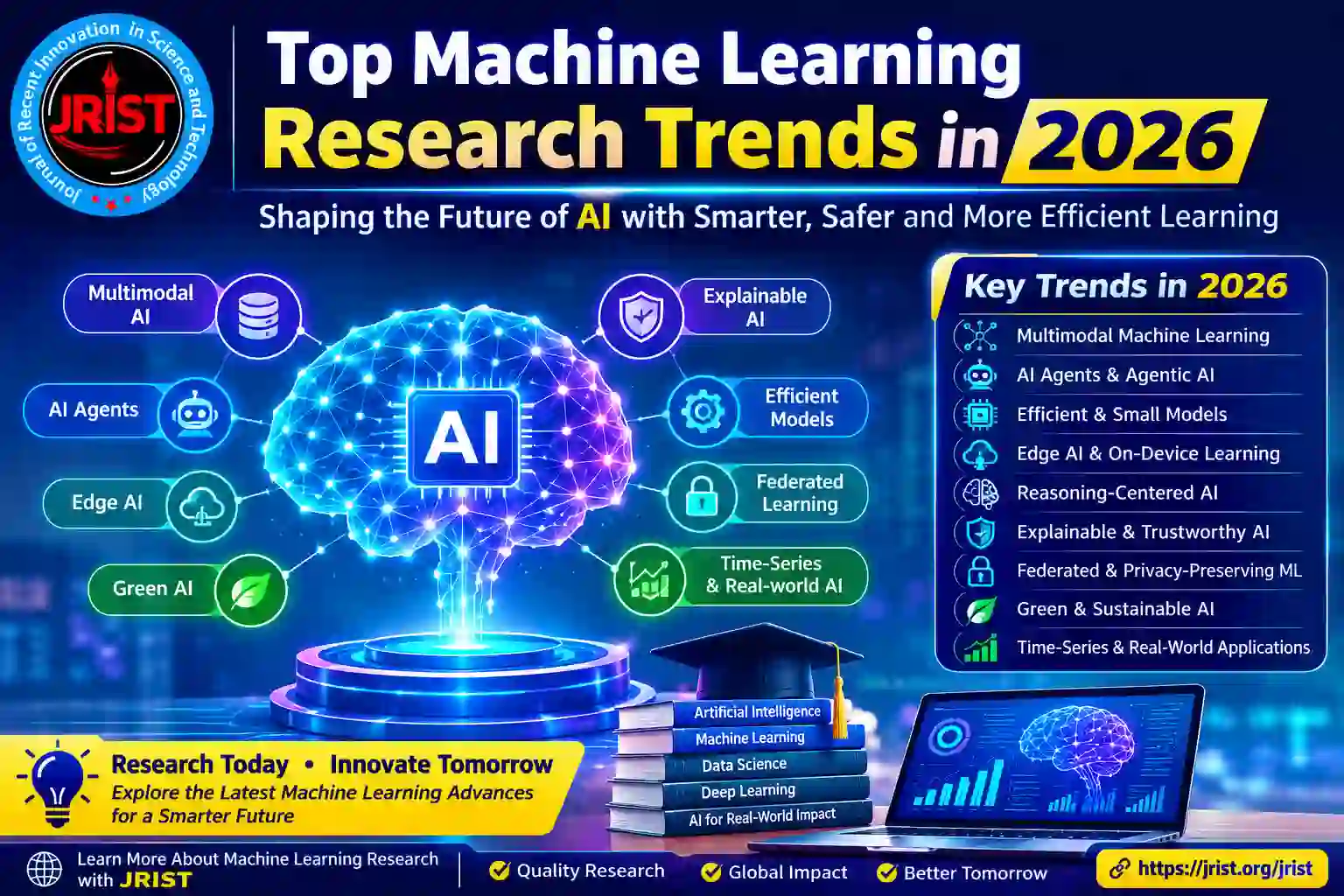
Machine learning research is entering a new phase in 2026. The field is no longer focused only on improving prediction accuracy or building larger neural networks. Researchers are increasingly working on systems that can reason across different types of data, operate with less computational cost, adapt to changing environments, explain their decisions, and interact with real-world systems.
For researchers, PhD scholars, students, and engineers, this shift creates new opportunities for meaningful research. At the same time, it changes what makes a machine learning paper interesting and publishable. A study that simply applies a well-known algorithm to a familiar dataset may have limited novelty, while research addressing efficiency, reliability, multimodal learning, trustworthy AI, domain-specific models, or real-world deployment can offer stronger research questions.
Recent research developments show particularly strong interest in multimodal AI, foundation models, efficient machine learning, AI agents, edge intelligence, responsible AI, and machine learning for scientific and engineering applications. Multimodal research is expanding beyond text and images toward combinations involving video, sensors, time-series data, graphs, and other modalities.
For researchers looking for a suitable venue for computer science and technology research, the Journal of Recent Innovation in Science and Technology (JRIST) covers artificial intelligence and machine learning alongside data science, cybersecurity, IoT, cloud and edge computing, computer vision, natural language processing, software engineering, and other technology areas.
Machine learning has traditionally been associated with supervised learning, classification, regression, clustering, recommendation systems, and deep neural networks. Those areas remain important, but research priorities are becoming broader.
Three major changes are particularly important.
Researchers are increasingly investigating models capable of handling multiple tasks and data types rather than being optimized for only one narrow application.
Accuracy remains important, but researchers are also examining inference cost, latency, memory usage, robustness, interpretability, energy consumption, privacy, and deployment requirements.
Real-world systems contain noisy, incomplete, changing, biased, and multimodal data. As a result, machine learning research increasingly needs to address what happens after a model leaves a controlled benchmark environment.
These changes create opportunities for researchers who can connect theoretical machine learning with practical problems.
Multimodal machine learning is one of the most important research directions in 2026.
Instead of processing only one form of information, multimodal systems combine multiple data modalities such as:
Recent research reviews describe multimodal systems as an expanding research area that is moving beyond traditional text-and-image combinations toward broader combinations of modalities and tasks.
For researchers, an interesting contribution does not necessarily require building a completely new model. Improving fusion strategies, reducing computational requirements, evaluating robustness, or applying multimodal learning to a previously understudied domain can also produce valuable research questions.
Another major direction is the development of AI systems that can perform sequences of tasks rather than producing a single prediction or response.
Agentic systems can combine machine learning models with tools, memory, planning mechanisms, external information, software environments, or physical devices.
This is becoming particularly relevant in areas such as software engineering, scientific research, robotics, automation, and enterprise workflows. Recent developments are also exploring frameworks that allow AI agents to interact with physical laboratory and industrial equipment.
A strong research paper in this area should clearly define the problem and evaluation methodology rather than simply demonstrating that an existing AI model can call external tools.
The assumption that better machine learning always requires larger models is being challenged by practical deployment requirements.
Many applications cannot afford enormous computational requirements. Researchers are therefore investigating methods for achieving useful performance with smaller, faster, and more efficient models.
This trend is particularly important for researchers working on mobile devices, IoT systems, robotics, embedded systems, and edge computing.
Instead of asking only, “How accurate is the model?”, researchers can ask:
These questions can turn a conventional machine learning experiment into a more practically meaningful research study.
Edge AI moves machine learning closer to where data is generated.
Instead of sending every observation to a centralized cloud server, an edge device can process information locally.
This approach is particularly useful for:
JRIST's stated coverage includes IoT and cloud/edge computing, making this an especially relevant area for multidisciplinary computer science and engineering research.
Researchers can investigate how model compression affects edge inference, how distributed devices can collaborate, how privacy can be improved through local processing, or how machine learning systems can operate reliably under limited computational resources.
Modern machine learning research is increasingly interested in systems that do more than recognize patterns.
Researchers are examining how models can perform structured reasoning, planning, verification, and multi-step problem solving.
This opens opportunities in:
An important research challenge is determining whether an apparent reasoning capability is robust or simply a result of memorization, pattern matching, or benchmark-specific behavior.
Therefore, evaluation design is becoming as important as model architecture.
General-purpose AI systems attract significant attention, but specialized machine learning models remain highly relevant.
A model designed specifically for a particular domain can potentially take advantage of domain-specific terminology, data structures, constraints, and evaluation criteria.
The research opportunity is not simply to train another model. Researchers should identify what domain-specific information improves performance and whether the resulting system is reliable outside the training environment.
Time-series machine learning remains an important research area because many real-world systems produce continuously changing data.
Examples include:
Research is increasingly moving beyond simple forecasting toward anomaly detection, long-horizon prediction, multivariate modeling, uncertainty estimation, and multimodal temporal learning.
For engineering researchers, combining time-series data with machine learning can create practical research problems involving equipment monitoring, energy optimization, manufacturing, and infrastructure management.
Machine learning systems often require large quantities of data, but centralizing sensitive information can create privacy and security challenges.
Federated learning provides a framework in which multiple devices or organizations can participate in model training without necessarily transferring all raw data to a central location.
A particularly important challenge is that real-world participants rarely have identical data distributions. Designing algorithms that remain effective under heterogeneous data is therefore an active research problem.
As machine learning systems influence decisions in increasingly important domains, researchers are paying greater attention to whether users can understand and evaluate model behavior.
Explainable AI research investigates methods for interpreting predictions and understanding which factors influence a model's output.
Trustworthy machine learning extends the discussion to areas such as:
A strong paper in this area should avoid treating explainability as a decorative feature. Researchers should evaluate whether explanations are faithful, useful, stable, and appropriate for the intended users.
A model that performs well on a clean benchmark may behave differently when confronted with noisy, manipulated, or unexpected inputs.
This makes robustness an important machine learning research topic.
Researchers can also examine how model performance changes under realistic distribution shifts rather than relying only on conventional test sets.
This direction connects naturally with JRIST's coverage of cybersecurity and information assurance.
Machine learning is increasingly being used as a research tool in scientific and engineering problems rather than being studied only as a standalone computational technique.
Examples include:
This is particularly promising for multidisciplinary researchers because a contribution can combine machine learning with domain knowledge.
For example, instead of simply comparing five classifiers on a standard dataset, an engineering researcher could investigate whether a machine learning method can improve fault prediction under realistic sensor noise and changing operating conditions.
That type of research has a clearer connection to a real engineering problem.
Better models cannot compensate indefinitely for poor data.
As a result, research attention is increasingly focused on the data itself.
Data-centric machine learning investigates how data quality, labeling, representation, augmentation, sampling, and preprocessing influence model performance.
Synthetic data can also be used when real-world datasets are expensive, limited, sensitive, or difficult to collect.
An important research question is not simply whether synthetic data increases accuracy, but whether it improves generalization to real-world data.
Large-scale machine learning can require substantial computing resources. This has increased interest in the environmental and economic cost of training and inference.
Green machine learning research can investigate:
A useful study can compare not only predictive performance but also computational cost, inference time, memory requirements, and energy consumption.
This creates a more complete picture of whether a machine learning method is practical.
One of the most important research trends may be less visible than new model architectures: better evaluation.
Machine learning researchers increasingly need to ask whether reported improvements are statistically meaningful, reproducible, and relevant outside a particular benchmark.
Researchers should avoid reporting only the single best accuracy score.
A paper becomes more useful when readers can understand why a method works, where it fails, and what resources are required to reproduce the result.
Researchers looking for a practical topic can consider the following areas:
| Research Area | Possible Research Direction |
|---|---|
| Multimodal AI | Fusion of text, image, sensor, or time-series data |
| Efficient ML | Model compression and resource-aware learning |
| Edge AI | Low-latency machine learning on IoT devices |
| AI Agents | Planning, tool use, memory, and evaluation |
| Explainable AI | Reliable and user-centered explanations |
| Cybersecurity | ML-based intrusion or anomaly detection |
| Federated Learning | Privacy-preserving distributed training |
| Time-Series ML | Forecasting and anomaly detection |
| Scientific ML | ML-assisted scientific and engineering simulation |
| Synthetic Data | Improving training data with generated datasets |
| Green AI | Reducing training and inference costs |
| Robust ML | Performance under noise and distribution shifts |
These research directions align closely with the multidisciplinary technology areas covered by JRIST.
The journal's stated computer science and information technology coverage includes Artificial Intelligence and Machine Learning, Data Science and Big Data Analytics, Cybersecurity, Internet of Things, Cloud and Edge Computing, Software Engineering, Computer Vision, Natural Language Processing, and related fields.
This means researchers do not necessarily need to limit machine learning work to conventional classification or regression studies. A manuscript can explore how machine learning interacts with a broader technical problem, provided that the topic fits the journal's current scope.
JRIST's published research already demonstrates examples of machine learning and AI applications, including work involving AI-based renewable-energy control, deep-learning anomaly detection, and machine-learning/deep-learning approaches to stock-market prediction.
Researchers considering submission can also review JRIST's guide to low publication fee journals for computer science and engineering researchers to understand factors that should be considered when comparing affordable publication options.
Following a trend does not automatically create a strong research paper.
The research question is more important than the trend itself.
“I used a machine learning algorithm to classify a dataset.”
“I developed and evaluated a resource-efficient anomaly detection method for edge devices under constrained memory and noisy sensor conditions.”
The second approach defines a practical problem, a constraint, and an evaluation opportunity.
When selecting a topic, researchers should balance novelty, feasibility, data availability, technical difficulty, computing resources, and practical relevance.
A smaller, well-designed research question is often more valuable than an overly ambitious project that cannot be evaluated properly.
Once the research is complete, the next challenge is communicating the work clearly.
A typical machine learning research paper should explain:
Researchers should also explain experimental settings sufficiently for another researcher to understand how the results were obtained.
Before submitting to JRIST, authors should review the journal's current author requirements and manuscript format. The JRIST journal page provides the current publication information and article template access.
Choosing a research topic is only one part of the publication process. Researchers should also plan where the manuscript will be submitted.
Before selecting a journal, compare:
JRIST authors can also review the 2026 guide to research paper publication fees and APCs when planning publication expenses.
For a broader understanding of paid publishing models and the questions authors should ask before submission, see the JRIST article on paid research journals in 2026.
Researchers interested in broader changes affecting scholarly communication can also read JRIST's guide to scientific journal publishing trends in 2026.
There is no single trend that dominates every research area. Multimodal learning, AI agents, efficient models, edge AI, reasoning, trustworthy AI, and domain-specific machine learning are among the important directions receiving significant research attention.
Yes. Deep learning remains a major foundation of modern machine learning research. However, current research increasingly focuses on making deep-learning systems more efficient, reliable, multimodal, explainable, secure, and useful in real-world environments.
Predictive maintenance, fault detection, renewable-energy optimization, industrial computer vision, sensor analytics, digital twins, edge AI, time-series forecasting, structural monitoring, and engineering design optimization are examples of possible directions.
It can be, particularly when the researcher identifies a specific problem involving multiple data types. Simply combining two datasets is not necessarily enough for novelty; the research should explain why multimodal information improves the problem being studied.
Yes. Researchers can choose smaller datasets, efficient models, transfer learning, cloud resources where available, or computationally lightweight research questions. Topic selection should match the resources realistically available to the researcher.
Start with a specific problem, review recent literature, identify a research gap, determine whether suitable data and resources are available, and design an evaluation strategy before selecting the final methodology.
JRIST's stated coverage includes Artificial Intelligence and Machine Learning within Computer Science and Information Technology. Researchers should review the current scope and author guidelines to confirm that their specific manuscript is suitable.
Primary Keywords:
Secondary Keywords:
Long-Tail Keywords:
JRIST-Focused Keywords:
Machine learning research in 2026 is moving beyond the simple goal of achieving higher benchmark accuracy. Researchers are increasingly interested in systems that can work across modalities, reason through complex tasks, operate efficiently, protect sensitive data, explain their decisions, resist attacks, and function in real-world environments.
For researchers, this creates a wide range of opportunities. Multimodal learning, AI agents, efficient models, edge intelligence, trustworthy AI, federated learning, robust machine learning, synthetic data, scientific machine learning, and sustainable AI can all provide valuable research directions when connected to a clearly defined problem.
The strongest research topic is not necessarily the trend receiving the most attention. It is the topic where the researcher can identify a genuine gap, conduct a rigorous experiment, and produce a measurable contribution.
For computer science, information technology, engineering, and interdisciplinary researchers, JRIST provides a multidisciplinary publication platform whose stated coverage includes AI and machine learning along with data science, cybersecurity, IoT, edge computing, computer vision, NLP, and other technology areas.
Researchers should therefore focus on three things: choose a meaningful problem, design a rigorous study, and select a journal that genuinely matches the research.
For more information about submitting research and exploring publication resources, visit the JRIST homepage.
ISSN (Online): 3117-3926
ISSN (Print): 3117-535X
| Publication Fees: | |