ISSN (Online): 3117-3926
ISSN (Print): 3117-535X
| Publication Fees: |  |

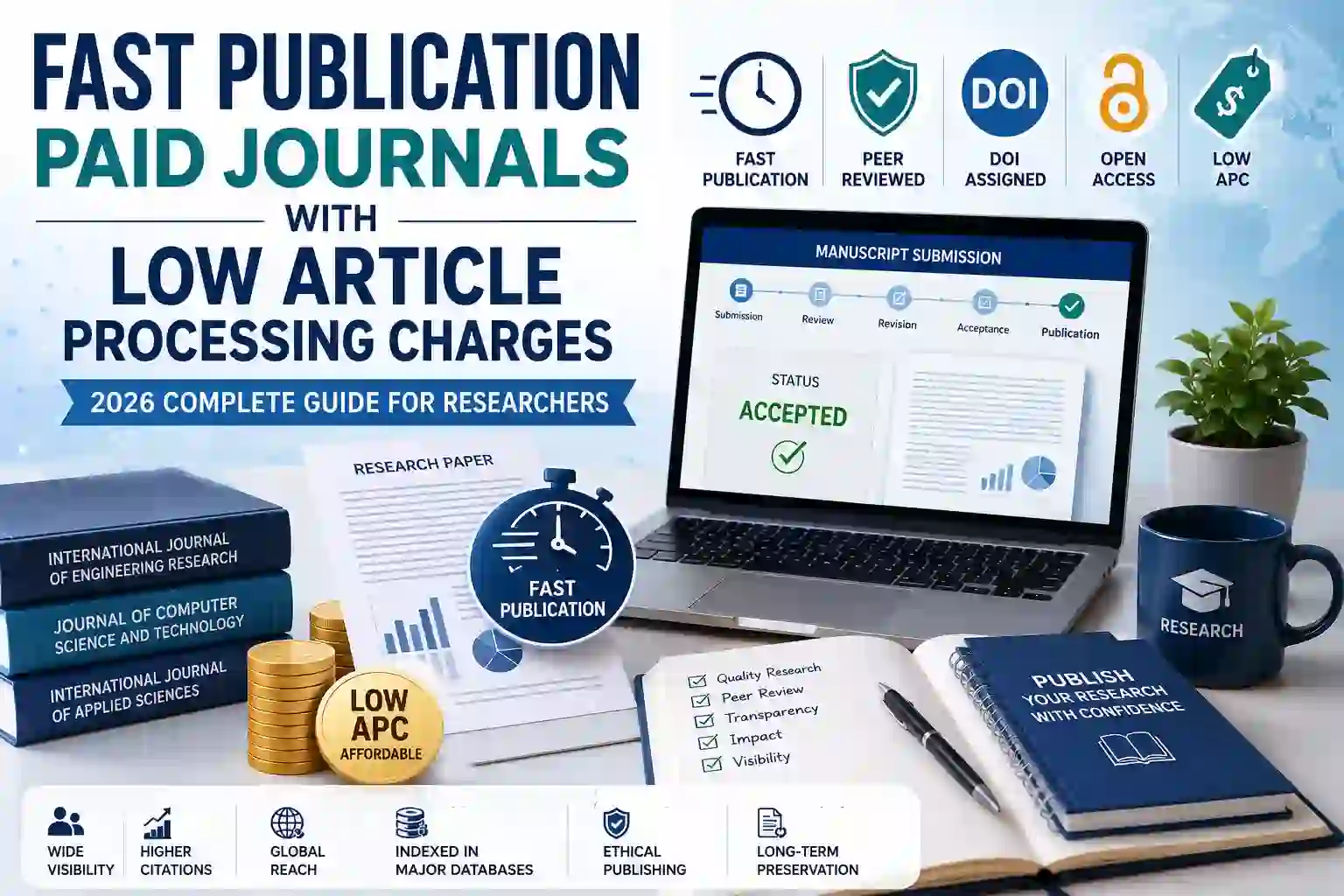
Researchers today face increasing pressure to publish high-quality work within limited project timelines, graduation deadlines, funding requirements, and career milestones. As a result, many authors actively search for fast publication paid journals with low article processing charges (APCs) that combine affordable publication costs with transparent peer review, DOI assignment, and professional editorial standards.
While affordability is an important consideration, selecting a journal solely because it advertises rapid publication or low fees can lead to poor publishing decisions. The most suitable journals maintain rigorous peer review, ethical editorial practices, transparent publication policies, and permanent article identification through Digital Object Identifiers (DOIs).
This comprehensive guide explains how fast publication journals operate, what influences publication speed, how low APC journals compare, how to evaluate journal quality, and practical strategies for choosing an affordable journal without compromising research credibility.
Fast publication paid journals are scholarly journals that aim to move manuscripts efficiently through editorial screening, peer review, revision, production, and online publication. These journals generally charge an Article Processing Charge (APC) after a manuscript has successfully completed the editorial process.
The publication fee typically supports editorial administration, reviewer management, copyediting, typesetting, DOI registration, online hosting, digital preservation, and long-term accessibility.
Fast publication should never mean skipping peer review. Reputable journals maintain rigorous editorial standards while improving workflow efficiency through modern manuscript management systems and continuous publication models.
An Article Processing Charge (APC) is the fee collected by many open-access journals after a manuscript has been accepted for publication. APCs help cover the operational costs associated with producing and maintaining scholarly publications.
| APC Covers | Purpose |
|---|---|
| Editorial Management | Coordinates manuscript processing. |
| Peer Review Administration | Manages reviewer assignments. |
| Copyediting | Improves grammar and consistency. |
| Typesetting | Formats the article professionally. |
| DOI Registration | Provides permanent article identification. |
| Website Hosting | Publishes articles online. |
| Digital Preservation | Supports long-term accessibility. |
Affordable journals make scholarly publishing more accessible, particularly for students, independent researchers, and institutions with limited research funding.
Not necessarily. A journal's quality depends on its editorial policies, peer-review process, publication ethics, editorial board, and overall transparency—not simply on the publication fee it charges.
Many reputable journals maintain affordable APCs while still providing professional editorial services, DOI assignment, and rigorous peer review.
Peer review remains the foundation of credible academic publishing. Qualified reviewers assess whether submitted research is original, technically sound, methodologically appropriate, and valuable to the scientific community.
| Benefit | Why It Matters |
|---|---|
| Research Quality | Improves scientific reliability. |
| Expert Feedback | Strengthens the manuscript. |
| Error Detection | Identifies weaknesses before publication. |
| Academic Credibility | Builds confidence among readers. |
| Ethical Publishing | Supports responsible scholarly communication. |
A Digital Object Identifier (DOI) provides a permanent and globally recognised identifier for scholarly articles. DOIs improve citation accuracy, long-term accessibility, and discoverability across digital research platforms.
| DOI Feature | Research Benefit |
|---|---|
| Permanent Link | Reliable long-term access. |
| Citation Accuracy | Improves referencing consistency. |
| Global Recognition | Accepted across scholarly databases. |
| Metadata Support | Improves discoverability. |
| Persistent Access | Reduces broken links. |
If you are looking for a trusted Computer Science Journal, an international Research Journal, a reputable Peer-Reviewed Journal, or an Open Access Journal to Publish Research Paper, visit our homepage to explore author guidelines, publication policies, current issues, and research resources.
Researchers working in artificial intelligence, software engineering, cloud computing, cybersecurity, blockchain, machine learning, data science, civil engineering, electronics, and emerging technologies can also explore our Engineering Journal and Information Technology Journal publication opportunities.
Continue to Part 2 → In the next section, we'll compare leading fast publication paid journals with low article processing charges, including their publishers, research scope, peer-review models, DOI availability, open-access policies, and important considerations before submission.
Finding an affordable journal that also provides professional peer review, DOI assignment, transparent editorial policies, and timely publication can significantly improve the research publishing experience. While publication timelines vary depending on manuscript quality, reviewer availability, and revision requirements, many reputable journals have streamlined editorial workflows that reduce unnecessary delays.
The journals listed below are recognized publishers or journals that offer peer-reviewed publication with DOI support. Always review the latest author guidelines and APC information directly from the publisher before submission, as policies and fees may change over time.
Never choose a journal based only on publication speed or APC. Prioritize research scope, editorial quality, publication ethics, peer review, and transparency.
| Journal | Publisher | Peer Review | DOI | Open Access | Research Areas |
|---|---|---|---|---|---|
| IEEE Access | IEEE | ✔ | ✔ | Yes | Computer Science & Engineering |
| Heliyon | Elsevier | ✔ | ✔ | Yes | Multidisciplinary |
| Scientific Reports | Springer Nature | ✔ | ✔ | Yes | Science & Technology |
| IEEE Open Journal Series | IEEE | ✔ | ✔ | Yes | Engineering & Computing |
| PeerJ Computer Science | PeerJ | ✔ | ✔ | Yes | Computer Science |
| Journal of Open Source Software (JOSS) | Open Source Initiative | ✔ | ✔ | Yes | Research Software |
| Applied Sciences | MDPI | ✔ | ✔ | Yes | Engineering & Applied Science |
| Sensors | MDPI | ✔ | ✔ | Yes | IoT & Electronics |
| Electronics | MDPI | ✔ | ✔ | Yes | Electronics & Computer Science |
| SoftwareX | Elsevier | ✔ | ✔ | Yes | Research Software |
IEEE Access publishes multidisciplinary engineering and computer science research using a continuous publication model. It is well known for publishing work related to artificial intelligence, machine learning, cloud computing, networking, cybersecurity, software engineering, robotics, and IoT.
Best For
Heliyon is an open-access multidisciplinary journal that accepts research from numerous scientific disciplines, including computer science, engineering, environmental science, mathematics, and health sciences.
Highlights
Scientific Reports publishes technically sound research across numerous scientific disciplines. Computer science studies involving interdisciplinary applications are regularly considered.
IEEE publishes several fully open-access journals dedicated to computing, communications, artificial intelligence, signal processing, and engineering research.
PeerJ Computer Science focuses exclusively on high-quality computer science research, including algorithms, artificial intelligence, machine learning, software engineering, human-computer interaction, and data science.
JOSS is designed for researchers developing scientific software and computational tools. It combines software review with scholarly publication and DOI assignment.
Applied Sciences publishes engineering and applied science research covering computing, automation, electronics, artificial intelligence, and interdisciplinary engineering applications.
Sensors publishes research involving sensor technologies, embedded systems, Internet of Things (IoT), wireless communication, automation, and smart systems.
Electronics covers digital systems, communication engineering, embedded computing, signal processing, semiconductor technologies, and intelligent computing systems.
SoftwareX focuses on research software, reproducible computing, scientific programming, software frameworks, computational methods, and software engineering innovations.
| Research Area | Recommended Journals |
|---|---|
| Artificial Intelligence | IEEE Access, PeerJ Computer Science |
| Machine Learning | IEEE Access, Applied Sciences |
| Software Engineering | SoftwareX, PeerJ Computer Science |
| Cybersecurity | IEEE Access |
| Internet of Things | Sensors, IEEE Access |
| Computer Networks | IEEE Access |
| Research Software | SoftwareX, JOSS |
| Multidisciplinary Research | Heliyon, Scientific Reports |
Even journals known for efficient workflows cannot guarantee identical publication times for every submission. Several factors influence the overall timeline.
| Factor | Impact |
|---|---|
| Manuscript Quality | Well-prepared papers usually progress more smoothly. |
| Reviewer Availability | Finding suitable reviewers may affect timelines. |
| Revision Quality | Prompt and complete revisions help reduce delays. |
| Editorial Workload | Submission volume can influence processing times. |
| Production Process | Copyediting and typesetting occur after acceptance. |
Continue to Part 3 → In the next section, you'll learn how to compare APCs, evaluate affordable journals, identify trustworthy publishers, and use an expert checklist to choose the best fast publication journal for your research.
Selecting the right journal involves much more than comparing publication fees. A journal should match your research area, maintain transparent editorial standards, provide rigorous peer review, assign a DOI, and clearly explain its publication policies. A low APC is beneficial only when these quality indicators are also present.
The most successful authors compare several journals before submitting rather than choosing the first journal that advertises fast publication.
| Step | What to Evaluate | Why It Matters |
|---|---|---|
| 1 | Journal Scope | Ensures your research fits the journal. |
| 2 | Peer Review Process | Maintains research quality. |
| 3 | Editorial Board | Shows academic credibility. |
| 4 | Publication Ethics | Protects research integrity. |
| 5 | DOI Assignment | Provides permanent article identification. |
| 6 | Publication Schedule | Indicates editorial consistency. |
| 7 | Author Guidelines | Helps avoid technical rejection. |
| 8 | Publication Fees | Should be transparent and clearly explained. |
Low APC journals reduce publication costs while maintaining scholarly publishing services. However, a lower publication fee does not automatically indicate lower quality, nor does a higher APC guarantee a better publication experience.
Authors should compare journals based on editorial quality, peer review, publication ethics, and relevance to their research rather than cost alone.
| Evaluation Area | Questions to Ask |
|---|---|
| Research Scope | Does the journal regularly publish similar research? |
| Editorial Quality | Is the editorial board publicly listed? |
| Peer Review | Is the review process explained clearly? |
| Publication Ethics | Are ethical guidelines available? |
| DOI Support | Will every accepted article receive a DOI? |
| Publication Frequency | Are issues published consistently? |
| Website Quality | Is the journal website professional and up to date? |
| Author Experience | Are submission instructions easy to follow? |
Some journals advertise rapid publication, but reputable publishers still complete editorial screening, assign qualified reviewers, evaluate revisions, perform copyediting, and prepare final proofs before publication.
A realistic publication timeline depends on manuscript quality, reviewer availability, editorial workload, and how quickly authors respond to revision requests.
Continue to Part 4 → The next section explains the complete publication workflow, including editorial screening, peer review, revisions, copyediting, DOI registration, online publication, common publishing mistakes, and practical strategies for achieving faster publication without compromising quality.
Selecting the right journal involves much more than comparing publication fees. A journal should match your research area, maintain transparent editorial standards, provide rigorous peer review, assign a DOI, and clearly explain its publication policies. A low APC is beneficial only when these quality indicators are also present.
The most successful authors compare several journals before submitting rather than choosing the first journal that advertises fast publication.
| Step | What to Evaluate | Why It Matters |
|---|---|---|
| 1 | Journal Scope | Ensures your research fits the journal. |
| 2 | Peer Review Process | Maintains research quality. |
| 3 | Editorial Board | Shows academic credibility. |
| 4 | Publication Ethics | Protects research integrity. |
| 5 | DOI Assignment | Provides permanent article identification. |
| 6 | Publication Schedule | Indicates editorial consistency. |
| 7 | Author Guidelines | Helps avoid technical rejection. |
| 8 | Publication Fees | Should be transparent and clearly explained. |
Low APC journals reduce publication costs while maintaining scholarly publishing services. However, a lower publication fee does not automatically indicate lower quality, nor does a higher APC guarantee a better publication experience.
Authors should compare journals based on editorial quality, peer review, publication ethics, and relevance to their research rather than cost alone.
| Evaluation Area | Questions to Ask |
|---|---|
| Research Scope | Does the journal regularly publish similar research? |
| Editorial Quality | Is the editorial board publicly listed? |
| Peer Review | Is the review process explained clearly? |
| Publication Ethics | Are ethical guidelines available? |
| DOI Support | Will every accepted article receive a DOI? |
| Publication Frequency | Are issues published consistently? |
| Website Quality | Is the journal website professional and up to date? |
| Author Experience | Are submission instructions easy to follow? |
Some journals advertise rapid publication, but reputable publishers still complete editorial screening, assign qualified reviewers, evaluate revisions, perform copyediting, and prepare final proofs before publication.
A realistic publication timeline depends on manuscript quality, reviewer availability, editorial workload, and how quickly authors respond to revision requests.
Continue to Part 4 → The next section explains the complete publication workflow, including editorial screening, peer review, revisions, copyediting, DOI registration, online publication, common publishing mistakes, and practical strategies for achieving faster publication without compromising quality.
Academic publishing continues to evolve as researchers, publishers, and institutions adopt new technologies and editorial practices. Modern journals are increasingly focused on faster editorial workflows, greater transparency, improved research integrity, wider accessibility, and enhanced digital discoverability.
For researchers seeking fast publication paid journals with low article processing charges, understanding these trends can help identify journals that combine affordability with high publishing standards.
| Trend | Impact on Researchers |
|---|---|
| Continuous Publication | Accepted articles become available online sooner. |
| AI-Assisted Editorial Tools | Improve grammar, formatting, and editorial efficiency. |
| Open Access Growth | Expands global accessibility to research. |
| Research Transparency | Encourages reproducible and reliable science. |
| Digital Preservation | Supports long-term access to published articles. |
| Structured Metadata | Improves indexing and discoverability. |
| International Collaboration | Promotes multidisciplinary research. |
Many journals have transitioned from traditional issue-based publishing to continuous publication. Under this model, articles are published online immediately after completing peer review, production, and DOI registration, rather than waiting for an entire issue to be finalised.
Artificial intelligence is increasingly supporting researchers throughout the publication process. AI tools can assist with language refinement, reference management, code generation, literature discovery, plagiarism screening, and editorial workflow optimisation.
Responsible use remains essential. Authors are accountable for the originality, accuracy, interpretation, and integrity of every submitted manuscript, regardless of whether AI-assisted tools were used during preparation.
| AI Application | Purpose |
|---|---|
| Grammar Improvement | Enhances readability. |
| Reference Organisation | Manages citations efficiently. |
| Literature Discovery | Finds relevant publications. |
| Code Assistance | Supports programming research. |
| Language Editing | Improves academic writing. |
| Workflow Automation | Reduces editorial processing time. |
Publishing your article is only the first step. Increasing visibility helps researchers reach a broader academic audience and encourages future citations.
| Strategy | Benefit |
|---|---|
| Descriptive Title | Improves search engine visibility. |
| Clear Abstract | Helps readers understand the study quickly. |
| Relevant Keywords | Supports indexing and discovery. |
| Persistent DOI | Enables reliable citation. |
| High-Quality Metadata | Improves discoverability across databases. |
| Responsible Research Sharing | Expands readership where permitted. |
| Cause | How to Reduce Delays |
|---|---|
| Poor Formatting | Follow author guidelines exactly. |
| Weak Abstract | Provide a clear summary of the research. |
| Missing References | Review citations carefully. |
| Reviewer Queries | Respond comprehensively to every comment. |
| Low-Quality Figures | Submit publication-ready graphics. |
| Incomplete Files | Double-check all submission documents. |
| Term | Meaning |
|---|---|
| Abstract | A concise summary of a research paper. |
| APC | Article Processing Charge paid after acceptance. |
| Author Guidelines | Instructions for manuscript preparation. |
| Continuous Publication | Publishing articles immediately after production. |
| Copyediting | Language and formatting improvement. |
| DOI | Digital Object Identifier. |
| Editorial Screening | Initial manuscript evaluation. |
| Indexing | Inclusion in scholarly databases. |
| Keywords | Terms describing the research. |
| Metadata | Structured information about an article. |
| Open Access | Free online access to research. |
| Peer Review | Independent expert assessment of research. |
| Proof | Final version reviewed before publication. |
| Revision | Author changes after reviewer feedback. |
| Scope | Subjects covered by a journal. |
| Typesetting | Preparing the final publication layout. |
Continue to Part 6 → The final section includes 40+ frequently asked questions, a comprehensive conclusion, internal linking opportunities, SEO metadata, recommended slug, meta description, focus keywords, schema recommendations, and a complete optimisation summary for this guide.
ISSN (Online): 3117-3926
ISSN (Print): 3117-535X
| Publication Fees: | |