ISSN (Online): 3117-3926
ISSN (Print): 3117-535X
| Publication Fees: |  |

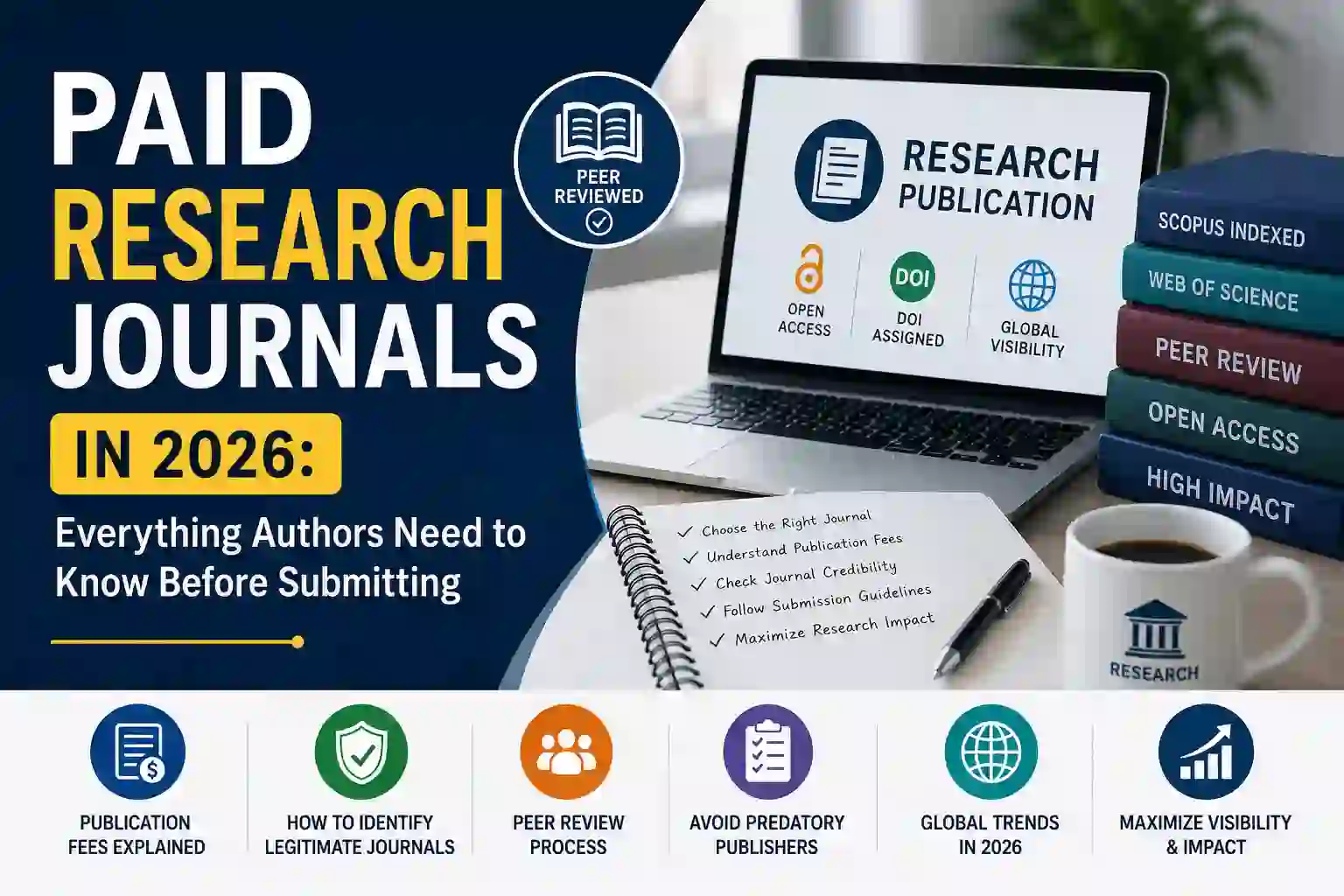
Publishing a research paper has become more accessible than ever before. Thousands of peer-reviewed journals now allow researchers from around the world to publish their work quickly through digital platforms. Along with this growth, one question continues to appear in search engines:
"Why do some journals charge publication fees, and are paid journals trustworthy?"
The answer is not as simple as "yes" or "no." Many of the world's most respected journals charge an Article Processing Charge (APC), while many reputable subscription journals charge authors nothing at all. At the same time, thousands of predatory publishers misuse publication fees without providing genuine peer review or editorial quality.
Understanding this difference is essential before submitting your manuscript.
This comprehensive 2026 guide explains how paid research journals work, why publication fees exist, what authors receive in return, how to recognize legitimate publishers, and how to avoid costly mistakes during the publication process.
A paid research journal is a scholarly journal that requires authors to pay a publication fee, commonly known as an Article Processing Charge (APC), after their manuscript has successfully completed peer review and been accepted for publication.
Contrary to a common misconception, paying an APC does not mean an article is automatically accepted. Reputable journals evaluate submissions through editorial screening and independent peer review before any publication decision is made.
The publication fee supports the operational costs associated with publishing scholarly work online and ensuring that articles remain freely accessible to readers around the world.
Academic publishing involves much more than uploading a PDF to a website. Behind every published article is an editorial workflow that requires professional management, technology infrastructure, long-term preservation, and quality assurance.
Open-access journals make articles freely available to readers without subscription barriers. Since readers do not pay for access, many publishers recover operational costs through APCs.
Not every journal provides all of these services, which is why publication fees vary widely between publishers.
The Article Processing Charge (APC) is the fee an author, institution, or funding agency pays to publish an accepted manuscript in an open-access journal.
The APC model allows anyone, anywhere in the world, to read, download, and cite published research without purchasing a subscription.
| Publishing Service | Usually Included |
|---|---|
| Editorial Review | ✔ |
| Peer Review Management | ✔ |
| Copyediting | Often |
| DOI Assignment | ✔ |
| PDF Production | ✔ |
| XML Metadata | Often |
| Online Hosting | ✔ |
| Permanent Archiving | Often |
| Open Access Distribution | ✔ |
Not every journal that charges authors operates in the same way. Understanding the different publishing models helps researchers choose the most appropriate venue for their work.
These journals publish every accepted article as freely accessible content. Readers never pay subscription fees, while publication costs are generally covered through APCs.
This model has become increasingly popular because it improves research visibility, citation potential, and global accessibility.
Hybrid journals primarily operate as subscription journals but also provide authors with an option to make individual articles open access by paying an APC.
In these journals, some articles remain behind a subscription paywall while others are immediately available to everyone.
Many academic societies publish journals to support their research communities. Some charge publication fees while others subsidize publishing costs through society memberships, conference revenue, or institutional support.
Universities and research organizations often publish journals that charge minimal publication fees—or none at all—because institutional funding helps cover operational expenses.
| Feature | Paid Journals | Free Journals |
|---|---|---|
| Publication Fee | Usually Yes | Usually No |
| Reader Access | Often Open Access | Often Subscription |
| Peer Review | Yes (Legitimate Journals) | Yes |
| DOI | Usually Included | Usually Included |
| Publication Speed | Often Faster | Varies |
| Author Copyright | Often Retained | Depends on Publisher |
Many early-career researchers assume that paying a publication fee guarantees acceptance. This belief is incorrect and often stems from confusion between legitimate publishers and predatory journals.
Reputable journals maintain independent peer review regardless of whether an APC is charged. Reviewers evaluate originality, methodology, ethical compliance, and scientific contribution before recommending acceptance, revision, or rejection.
As open-access publishing continues to expand globally, researchers are faced with more journal choices than ever before. At the same time, funding agencies, universities, and research institutions increasingly encourage or require open-access dissemination of publicly funded research.
This shift has led to significant growth in journals using APC-based publishing models. While many of these journals follow high editorial standards, the rapid expansion has also created opportunities for unethical publishers to exploit inexperienced authors.
For this reason, understanding how publication fees work—and knowing how to evaluate a journal before submission—is now an essential skill for every researcher.
Publication fees vary significantly depending on the publisher, journal reputation, discipline, publishing model, and the services included. While some journals do not charge authors anything, others may require Article Processing Charges (APCs) ranging from less than USD 100 to several thousand dollars.
It is important to remember that a higher APC does not automatically indicate a better journal. Editorial quality, peer-review standards, indexing, transparency, and ethical publishing practices are much more important than publication cost alone.
| Journal Category | Typical APC | Suitable For |
|---|---|---|
| Institutional or University Journals | Free – USD 100 | Students, Early Career Researchers |
| Independent Open Access Journals | USD 100 – USD 500 | General Academic Publishing |
| Professional Society Journals | USD 300 – USD 1,200 | Discipline-Specific Research |
| Large International Publishers | USD 1,000 – USD 4,000+ | High-Visibility Open Access Journals |
Several factors determine why one journal charges USD 75 while another charges USD 2,500 or more.
Managing editors coordinate manuscript handling, assign reviewers, communicate with authors, monitor revisions, and oversee publication schedules. Larger editorial teams generally increase operational costs.
Although reviewers typically volunteer their expertise, managing a rigorous peer-review workflow requires dedicated editorial systems and staff.
Many publishers invest in metadata quality, search engine optimization, archiving services, and partnerships that improve article discoverability.
The publication fee is not always paid directly by the author. Depending on funding arrangements, several organizations may cover the APC.
| Funding Source | Common Situation |
|---|---|
| Author | Self-funded research |
| University | Institutional publication support |
| Research Grant | Grant includes publishing expenses |
| Government Agency | Open-access funding initiatives |
| Research Institute | Institutional publication budget |
| Fee Waiver | Eligible authors receive partial or full waiver |
Legitimate journals separate editorial decisions from financial transactions.
The normal publication workflow looks like this:
If payment is requested before peer review—or if acceptance is guaranteed upon payment—the journal deserves closer scrutiny.
When authors choose reputable journals, APCs often support services that improve the visibility, accessibility, and long-term preservation of research.
Anyone with an internet connection can read, download, and cite the article without subscription barriers.
Open-access articles often reach wider audiences because they are freely available to researchers, students, policymakers, and industry professionals.
Many open-access journals publish articles online shortly after acceptance rather than waiting for a complete issue.
Most reputable journals assign a permanent Digital Object Identifier (DOI), making articles easier to cite and locate.
Researchers in developing countries can access open-access articles without expensive institutional subscriptions.
Professional publishers archive articles using preservation services to ensure long-term accessibility.
No.
Many highly respected journals charge modest APCs, while some expensive journals may not necessarily provide better editorial quality.
Instead of focusing on publication cost, evaluate journals based on:
Yes.
Many respected journals charge no publication fees at all. Others provide fee waivers or discounts for eligible authors.
Authors should always read the journal's publication fee policy before submission.
Diamond Open Access is becoming increasingly popular worldwide.
In this publishing model:
Diamond journals demonstrate that high-quality scholarly publishing does not always require APCs.
Early-career researchers often face limited research funding, making publication fees an important consideration.
Rather than selecting a journal solely because it has a low APC, authors should consider the journal's overall quality and suitability for their research.
| Factor | More Important Than APC? |
|---|---|
| Quality of Research | ✔ Yes |
| Peer Review | ✔ Yes |
| Editorial Standards | ✔ Yes |
| Research Relevance | ✔ Yes |
| Publication Ethics | ✔ Yes |
| Journal Reputation | ✔ Yes |
| Publication Fee | Important—but Not the Main Indicator |
One of the biggest challenges facing researchers in 2026 is distinguishing reputable journals from predatory publishers. While thousands of journals legitimately charge Article Processing Charges (APCs), unethical publishers also use publication fees as a way to profit without providing genuine editorial or peer-review services.
Before submitting your manuscript—or paying any publication fee—it is essential to evaluate the journal carefully.
A reputable journal clearly explains:
Hidden publication charges or unexpected invoices are warning signs.
Legitimate journals explain how manuscripts are evaluated before acceptance.
Their website should describe:
Editors should have recognizable academic affiliations and expertise relevant to the journal's scope.
Look for:
A quality journal publishes research within specific academic disciplines.
Be cautious if a journal claims to publish every subject imaginable without specialization.
Legitimate journals publish detailed policies covering:
Most reputable scholarly journals assign Digital Object Identifiers (DOIs), providing permanent and citable links to published research.
A journal's website should include:
A poorly maintained website with broken pages, spelling errors, or missing policies deserves additional scrutiny.
Review previously published articles.
Consider:
A legitimate journal should clearly display its International Standard Serial Number (ISSN), whether online, print, or both.
Reliable journals provide:
Predatory publishers often imitate legitimate journals but prioritize collecting publication fees instead of maintaining scholarly standards.
| Warning Sign | Why It Matters |
|---|---|
| Guaranteed Acceptance | Peer review should determine publication decisions. |
| Publication in 24–72 Hours | Quality peer review requires time. |
| Payment Requested Before Review | Editorial decisions should come first. |
| Fake Impact Factors | Verify any claimed metrics from trusted sources. |
| Spam Email Invitations | Mass solicitation is common among predatory publishers. |
| Poor Website Quality | Broken links and copied content reduce credibility. |
| Hidden Publication Fees | Transparent pricing is expected. |
| Missing Editorial Information | Editorial transparency is essential. |
Use the following checklist before uploading your research paper.
| Question | Yes | No |
|---|---|---|
| Is the journal's scope suitable for my research? | ☐ | ☐ |
| Is the publication fee clearly displayed? | ☐ | ☐ |
| Does the journal explain its peer-review process? | ☐ | ☐ |
| Are publication ethics publicly available? | ☐ | ☐ |
| Is the editorial board listed? | ☐ | ☐ |
| Are previous issues available? | ☐ | ☐ |
| Does the journal assign DOIs? | ☐ | ☐ |
| Are author guidelines detailed? | ☐ | ☐ |
| Is copyright information available? | ☐ | ☐ |
| Are licensing terms clearly explained? | ☐ | ☐ |
| Evaluation Factor | Journal A | Journal B |
|---|---|---|
| Journal Scope | ⭐⭐⭐⭐⭐ | ⭐⭐⭐ |
| Peer Review Transparency | ⭐⭐⭐⭐⭐ | ⭐⭐⭐⭐ |
| Editorial Board | ⭐⭐⭐⭐⭐ | ⭐⭐⭐ |
| Publication Ethics | ⭐⭐⭐⭐⭐ | ⭐⭐⭐⭐ |
| Publication Fee Transparency | ⭐⭐⭐⭐⭐ | ⭐⭐⭐ |
| Archive Quality | ⭐⭐⭐⭐ | ⭐⭐⭐⭐⭐ |
| Submission Experience | ⭐⭐⭐⭐⭐ | ⭐⭐⭐⭐ |
A paid research journal is a scholarly journal that charges an Article Processing Charge (APC) after a manuscript has successfully completed peer review and has been accepted for publication. The APC helps cover publishing services such as editorial management, production, DOI registration, online hosting, and long-term archiving.
No. Reputable journals make editorial decisions independently of payment. Manuscripts are accepted only after editorial assessment and peer review. Payment is normally requested after acceptance.
No. Many respected journals charge APCs, but some predatory publishers also charge publication fees without providing genuine peer review or editorial oversight. Authors should evaluate each journal carefully before submitting.
An APC is the publication fee charged by many open-access journals to support editorial workflows, manuscript processing, DOI registration, digital publishing, website maintenance, and article preservation.
Yes. Many subscription journals, university-supported journals, scholarly society journals, and Diamond Open Access journals do not charge authors any publication fees.
Before submitting your manuscript, verify that the journal provides:
Not necessarily. Editorial quality depends on the peer-review process, editorial standards, publishing ethics, and journal scope—not on the publication fee alone.
Yes. Many undergraduate, postgraduate, and doctoral researchers publish successfully in legitimate paid journals. Students should select journals that match their research topic and carefully review publication policies before submitting.
No. Although publication speed is important, authors should prioritize rigorous peer review, editorial quality, transparency, and the journal's suitability for their research.
Confirm that:
The academic publishing landscape continues to evolve rapidly, with more journals adopting open-access models and digital-first publishing workflows. While publication fees are now common across many disciplines, successful publishing depends far more on selecting the right journal than simply choosing the lowest APC or the fastest review time.
Researchers should prioritize journals that demonstrate transparency, ethical publishing practices, rigorous peer review, and a clear commitment to long-term scholarly communication.
Remember that publishing a research paper is not only about getting accepted—it is about ensuring that your work remains discoverable, citable, and valuable to the research community for years to come.
| Myth | Reality |
|---|---|
| Every paid journal is predatory. | No. Many respected journals use APCs to support open-access publishing. |
| Paying guarantees publication. | No. Legitimate journals require successful peer review before acceptance. |
| Expensive journals are always better. | Editorial quality and ethics matter more than publication cost. |
| Free journals have lower quality. | Many high-quality journals do not charge authors. |
| Fast publication means poor review. | Some journals achieve efficient publication while maintaining rigorous peer review. |
Paid research journals play an important role in modern scholarly communication, particularly within the open-access publishing ecosystem. When managed responsibly, publication fees support editorial operations, professional production, digital preservation, and global access to research.
However, authors should never judge a journal solely by its publication fee. Instead, evaluate the journal's editorial standards, peer-review process, transparency, ethics, and overall suitability for your manuscript.
Taking the time to investigate a journal before submission can help you avoid unnecessary expenses, reduce publication delays, and increase the visibility and long-term impact of your research.
Whether you are an undergraduate student, postgraduate researcher, PhD scholar, or experienced academic, informed journal selection remains one of the most important steps in the publication process.
Choosing the right journal is one of the most important decisions in a researcher's publishing journey. While Article Processing Charges (APCs) are common in open-access publishing, they should never be the sole factor influencing your decision. A reputable journal combines transparent policies, ethical editorial practices, rigorous peer review, and long-term accessibility to ensure that your research reaches the widest possible audience.
By understanding how paid research journals operate, recognizing the warning signs of predatory publishers, and following a structured evaluation process, you can publish your work with confidence and maximize its academic impact.
Invest time in selecting the right journal today, and your research will continue to benefit readers, scholars, and the broader scientific community well into the future.
A publication fee is not a measure of quality. The best journal for your research is one that offers transparent policies, ethical publishing practices, a rigorous peer-review process, and a strong fit with your manuscript's subject area.
ISSN (Online): 3117-3926
ISSN (Print): 3117-535X
| Publication Fees: | |