ISSN (Online): 3117-3926
ISSN (Print): 3117-535X
| Publication Fees: |  |

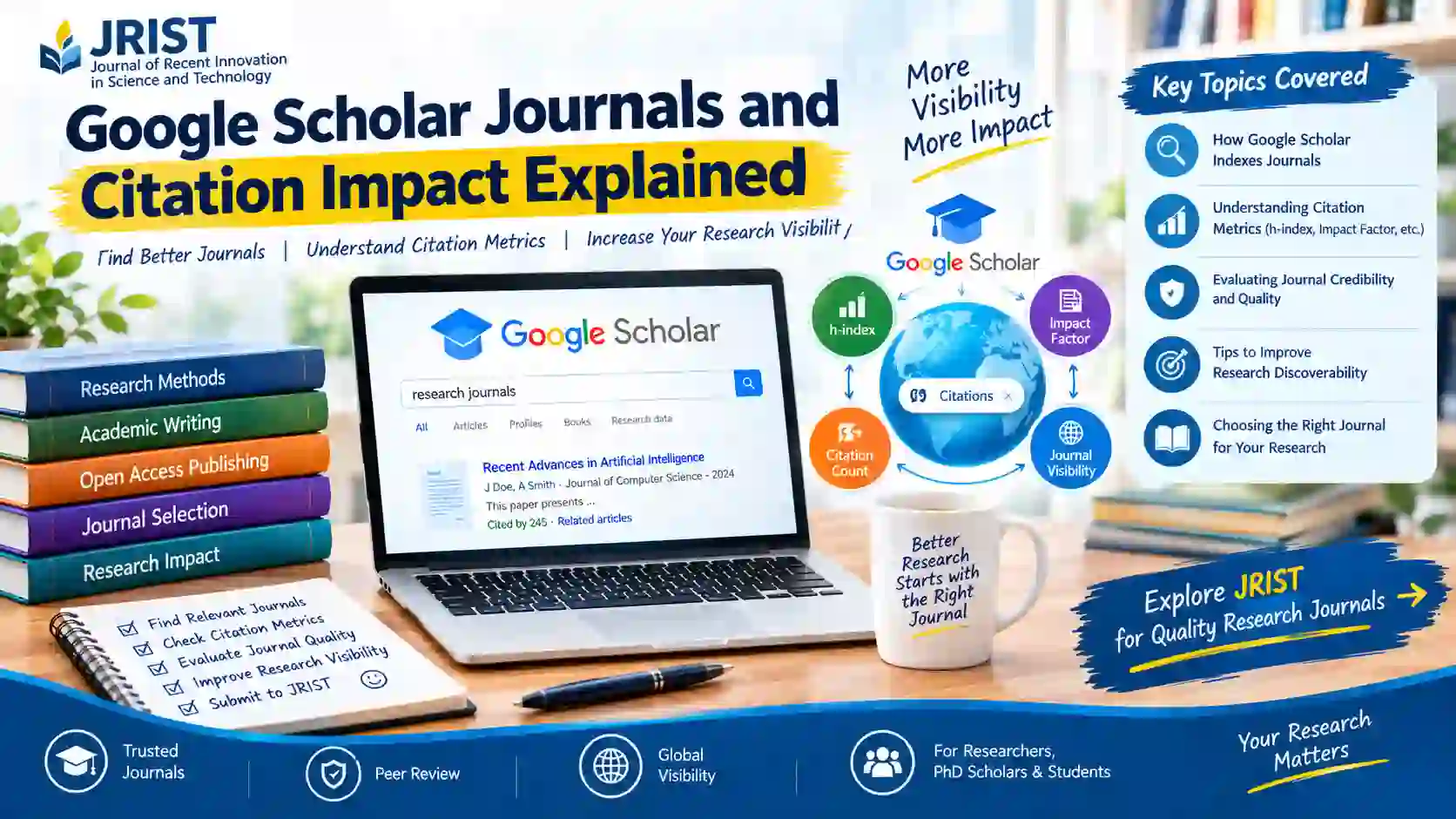
For researchers, publishing a paper is only one part of the academic journey. Understanding how research is discovered, cited, and used by other scholars is equally important. Google Scholar has become a widely used tool for finding academic literature, tracking citations, exploring related studies, and reviewing an author's publication record.
However, Google Scholar search results, journal indexing, citation counts, and journal quality are not the same thing. A journal appearing in Google Scholar search results does not automatically mean it has been formally approved by a university, recognized by a particular indexing service, or independently verified as a high-quality publication.
This guide explains how Google Scholar journals and citation impact work, how researchers can interpret citation metrics, and how to make informed decisions when choosing a journal for publication.
Google Scholar is a scholarly search service that helps users discover academic material, including journal articles, conference papers, theses, dissertations, books, preprints, and other research documents.
Researchers can use it to:
Search for studies on a particular topic.
Find related articles and different versions of a paper.
Follow the references and citations associated with publications.
Explore an author's publication profile.
Review citation counts and selected author metrics.
Identify literature relevant to a research project.
Visit Google Scholar to search scholarly literature.
Google Scholar is useful for research discovery, but its search results should be interpreted carefully. Coverage can include different document types and versions of a work. Researchers should verify publication details, the original source, and the credibility of the journal before relying on a search result.
For practical search techniques, see JRIST's guide to Google Scholar search tips for researchers.
The expression “Google Scholar journal” is commonly used to describe a journal whose articles can be discovered through Google Scholar. It is not, by itself, a formal quality designation.
This distinction matters because researchers sometimes assume that any journal appearing in search results has passed a formal approval or quality assessment. That conclusion is not justified by appearance in search results alone.
When evaluating a journal, consider the following questions:
Can you locate recent articles from the journal in Google Scholar?
Do the search results match the journal's official website and published article records?
Does the journal provide transparent information about its editors, peer review, and publication ethics?
Are its aims and scope appropriate for your research?
Are publication charges and licensing terms clearly explained?
Are claims about indexing and recognition verifiable through the relevant official sources?
Important: Google Scholar discoverability should not be treated as equivalent to inclusion in Scopus, Web of Science, or any official institutional journal list. Verify each claimed database listing independently.
Citation impact refers broadly to the extent to which a research paper, author, or collection of publications is cited by other scholarly works.
A citation can indicate that another researcher has referred to a study, used its methods, discussed its findings, or placed it within a wider body of literature. Citations can help demonstrate scholarly attention, but they do not automatically establish that a paper is correct, influential in practice, or methodologically strong.
Citation counts must be interpreted in context. For example, a review article may receive many citations because it summarizes an entire field, while a specialized experimental study may be valuable to a smaller research community and attract fewer citations.
Citation impact is best considered alongside research quality, originality, methodological rigor, relevance, and the contribution made to a field.
Different citation metrics describe different aspects of scholarly activity. No single measure provides a complete assessment of research quality.
Total citations count how often a publication or group of publications has been cited, according to a particular database.
A high citation count may indicate that a paper has attracted considerable attention. However, comparisons between researchers should account for career length, discipline, publication type, and time since publication.
This measure divides the total number of citations by the number of publications in a defined collection.
For example, a researcher with 120 citations across 20 papers has an average of six citations per paper.
This average can be misleading if a small number of highly cited papers account for most citations. It should not be used alone to rank researchers or journals.
The h-index combines publication productivity with citation counts. A researcher has an h-index of h if h of their publications have each received at least h citations.
For example, an h-index of 8 means that the researcher has at least eight papers with eight or more citations each.
The h-index does not measure every aspect of research quality. It tends to increase over time and varies across disciplines, so it is generally inappropriate to compare researchers from very different fields or career stages without additional context.
The i10-index is a simple count of publications that have received at least ten citations. Google Scholar Profiles display this measure when available.
It is easy to understand, but it does not account for differences in publication age, research field, or the distribution of citations.
Some services provide metrics designed to describe citation activity across journals or groups of publications. Examples include the h5-index and h5-median in Google Scholar Metrics for eligible publications.
The h5-index reflects the h-index calculated using a publication's articles from the preceding five complete calendar years, while the h5-median describes the median number of citations for the articles counted in that h5-index.
These indicators have limitations. Availability and coverage depend on the service, and results should be interpreted according to the metric's definition and publication category. Journal-level metrics do not establish the quality of every article in a journal.
Researchers should distinguish between metrics for an individual author and metrics for a journal or publication.
| Measure | What it describes | Main limitation |
|---|---|---|
| Total citations | Citations received by a paper or collection of works | Can be dominated by a few highly cited publications |
| h-index | Productivity and citation activity combined | Favors longer careers and varies by field |
| i10-index | Number of works with at least ten citations | Uses a fixed threshold and ignores citation distribution beyond it |
| h5-index | Citation activity of a publication over a five-year window in Google Scholar Metrics | Limited to eligible publications and the service's coverage |
| h5-median | Median citations of the articles counted in the h5-index | Does not capture every aspect of journal quality |
| Journal impact factor | A journal-level citation indicator calculated under the relevant Clarivate methodology | Not interchangeable with Google Scholar metrics or an individual author's impact |
Do not compare these indicators as if they measure the same thing. Each has a different calculation, coverage, and purpose.
Google Scholar can help authors identify journals publishing work in their subject area. It should be one part of a broader journal-selection process rather than the only criterion.
Use specific phrases related to your research question, methodology, or application. Review relevant articles and note the journals in which they were published.
Open the publisher's or journal's official page. Confirm the title, author list, publication date, DOI where applicable, abstract, and full text.
A journal should regularly publish work related to your manuscript. A broad journal is not automatically suitable simply because it accepts multiple disciplines.
Look for identifiable editors, transparent peer-review procedures, publication ethics, correction policies, and clear instructions for authors.
If a journal claims inclusion in a specific database, search the official database or directory. Confirm that the title and ISSN match the journal you are considering.
Review copyright, open access licensing, author fees, waivers, and any restrictions on sharing the accepted manuscript.
For more guidance on comparing journals, read JRIST's complete author guide to academic peer-reviewed journals.
Researchers cannot guarantee that a paper will receive citations. They can, however, make their work easier to find, understand, and assess.
Use a title that communicates the actual research topic and contribution. Avoid exaggerated claims or repeating keywords unnaturally.
A useful abstract normally explains the research problem, objective, methods, principal findings, and contribution. It should accurately reflect the paper rather than make promises unsupported by the results.
Choose terms that researchers in your discipline are likely to use when searching for similar work. Include important concepts, methods, and applications where appropriate.
Check author names, affiliations, article titles, publication dates, references, and DOI information. Inconsistent metadata can make it harder to identify and correctly attribute a paper.
A Google Scholar Profile can help researchers organize eligible publications and view citation metrics. Review the publications associated with your profile and correct misattributions or duplicate entries where possible.
Authors should also maintain consistent names and affiliations across legitimate academic platforms, while following their institution's policies.
Where permitted by the publisher's licence and policy, share the article through institutional repositories, academic websites, conference presentations, or professional networks. Clearly distinguish published articles from preprints and accepted manuscripts.
Well-designed methods, transparent reporting, relevant findings, and clear writing help other researchers understand whether and how they can use a study. Long-term scholarly value should take priority over attempts to increase citation counts artificially.
For further advice on preparing manuscripts, see how to write a research paper that gets published.
Reality: Search visibility is not a quality certification. Evaluate the journal's editorial practices, peer review, ethics, and publisher information independently.
Reality: Citations can reflect usefulness or attention, but they can also include criticism, background references, or repeated discussion. Read the research and evaluate its methods and findings.
Reality: The h-index captures only a limited part of a researcher's publication and citation record. It does not directly measure originality, accuracy, practical impact, or research integrity.
Reality: Citation outcomes depend on the relevance of the work, the research community, discoverability, time, and many other factors. No legitimate journal can guarantee a particular citation count.
Reality: These services have different coverage and evaluation processes. Always verify each database claim through its official source.
The best journal for a manuscript is not necessarily the journal with the largest citation figures. A suitable publication venue should match the research topic, provide a credible editorial process, explain its publication terms, and reach an audience likely to benefit from the findings.
Before submitting, use this checklist:
Confirm that the manuscript fits the journal's aims and scope.
Read the instructions for authors.
Review recently published papers for subject relevance and editorial standards.
Verify peer-review and publication-ethics policies.
Check current APCs, other fees, and waiver conditions.
Confirm any claimed indexing through the relevant official service.
Understand copyright, licensing, and repository policies.
Avoid journals promising guaranteed acceptance or citation outcomes.
Researchers seeking journals in science, engineering, and technology can explore JRIST's guide to science journals for innovative research as one starting point for their evaluation.
The Journal of Recent Innovation in Science and Technology (JRIST) publishes research within science, engineering, and technology. Researchers considering the journal should first review its subject coverage and confirm that their manuscript fits the journal's scope.
Start with the JRIST aims and scope, then consult the JRIST Call for Papers for current submission information.
Before submitting, review the journal's author guidelines, peer-review process, publication ethics, open access and licensing terms, and current fee policy. Authors should also independently verify any indexing or recognition relevant to their institutional requirements.
If your research is suitable, consider submitting it through the journal's official submission process for editorial assessment. Submission does not guarantee acceptance, citation growth, or inclusion in any particular database.
Ready to prepare your next research paper? Visit JRIST to explore the journal's research scope and author resources.
Google Scholar is a scholarly search and discovery service. Researchers commonly use it to find articles and examine citation information, but it should not be treated as equivalent to every curated bibliographic or citation database.
Search for the journal's title and specific article titles. Open the results and compare them with the official journal website and article records. Search visibility can vary, and the absence of a result does not by itself establish that a journal is unreliable.
There is no universal h-index threshold that defines a good researcher. The value depends on discipline, career stage, publication history, and citation practices. It should be interpreted alongside other evidence of research quality and contribution.
Citation counts describe citation activity, not the full quality of a journal. Evaluate editorial standards, peer review, ethics, scope, and transparency separately.
Discoverability can help readers find a paper, but it cannot guarantee citations. Research relevance, quality, methods, clarity, and the needs of the scholarly community all matter.
No. Citation metrics can be useful context, but a journal's suitability, credibility, audience, editorial standards, costs, and policies should guide the final decision.
Google Scholar is a useful resource for discovering scholarly literature and understanding citation activity, but its results and metrics need careful interpretation. Search visibility is not the same as journal approval, citation counts do not prove research quality, and author metrics should never be used without context.
Researchers can make stronger publication decisions by checking journal credentials, understanding citation indicators, preparing accurate metadata, and sharing their work responsibly. Above all, the goal should be to produce trustworthy research that makes a meaningful contribution—not simply to maximize a numerical metric.
For authors working in science, engineering, and technology, JRIST offers a place to explore potential publication opportunities. Review its scope and submission requirements carefully, and consider submitting suitable original research for editorial assessment.
ISSN (Online): 3117-3926
ISSN (Print): 3117-535X
| Publication Fees: | |