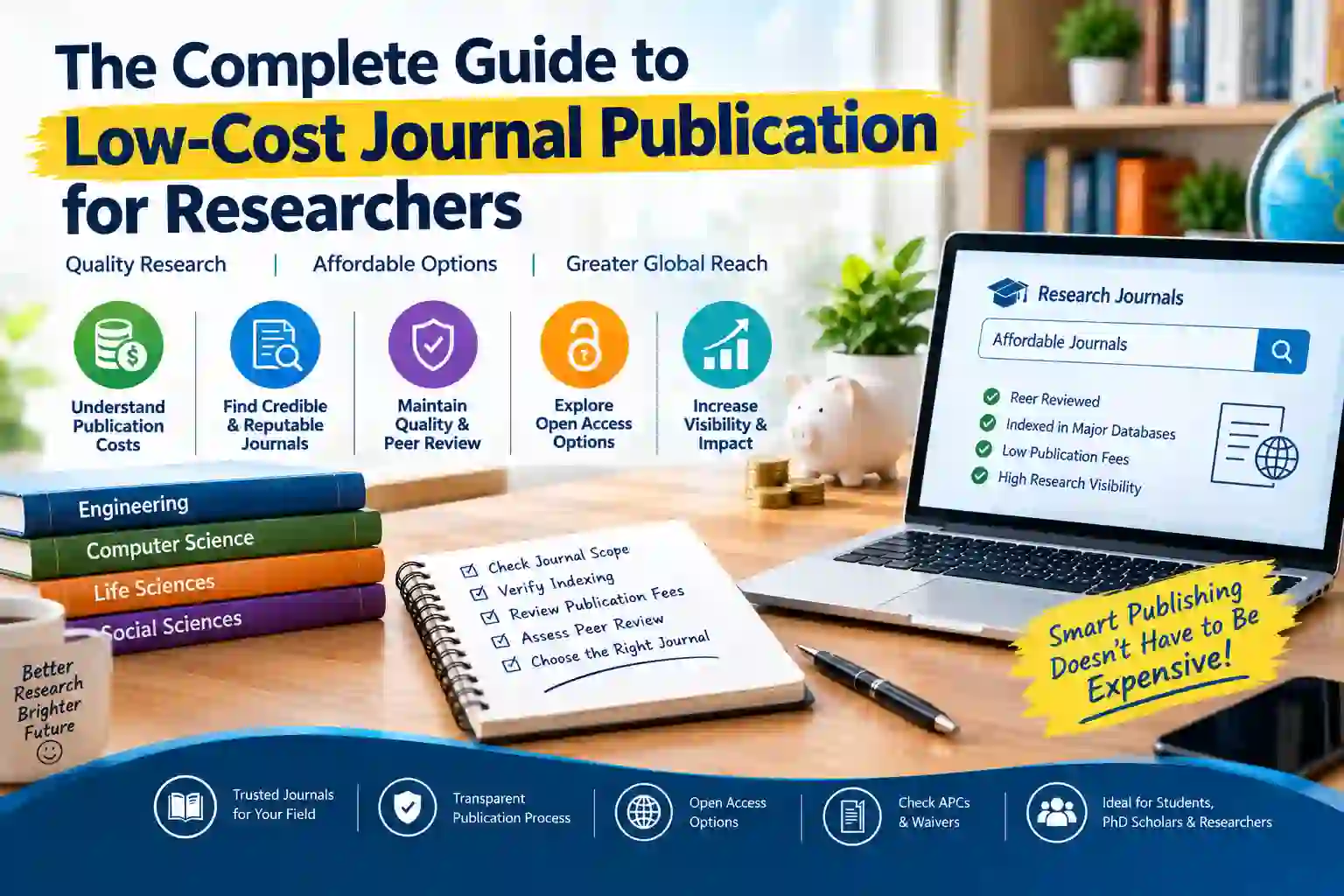
Publishing a research paper can involve more than the effort required to conduct the research itself. Manuscript preparation, editing, figures, data presentation, peer review, publication fees, open-access charges, and institutional requirements can all affect the final cost of publishing a paper.
For researchers, PhD scholars, students, and early-career academics, the challenge is not simply finding the cheapest journal. The real objective is to identify a credible and suitable journal with reasonable publication costs while protecting the academic value of the research.
This guide explains how to evaluate low-cost journal publication options, understand article processing charges (APCs), identify hidden costs, verify journal credentials, and avoid choosing a journal based solely on a low fee.
If you are currently comparing research journals, use this guide as a practical checklist before submitting your manuscript.
What Is Low-Cost Journal Publication?
Low-cost journal publication generally refers to publishing research through a journal that requires little or no direct payment from the author, or provides publication charges that are relatively manageable for the researcher's budget.
However, "low cost" does not have one universal definition. A fee that is affordable for one researcher may be expensive for another. Publication costs can also vary according to country, discipline, funding availability, institutional support, and whether the journal operates under an open-access or subscription model.
A useful way to think about publication cost is:
Publication cost should be evaluated together with journal credibility, subject relevance, peer review, accessibility, and academic requirements.
A journal charging no APC is not automatically better than a journal charging an APC, and a higher APC does not automatically indicate higher academic quality.
Why Researchers Look for Affordable Journals
Researchers may have different reasons for looking for lower-cost publication options. Common situations include:
- Limited research funding
- Self-funded postgraduate research
- Early-career researchers without institutional publication support
- Students completing dissertation or thesis requirements
- Researchers working in institutions with limited APC budgets
- Authors from regions where international publication charges can be difficult to afford
- Researchers publishing multiple papers during a project
Cost-conscious publishing is therefore a legitimate part of research planning. The important point is to avoid reducing journal selection to price alone.
Does a Low Publication Fee Mean Low Quality?
No. Publication cost and scholarly quality are separate characteristics.
A journal's operating model can influence what authors pay. Some journals are supported by subscriptions, universities, academic societies, research institutions, grants, sponsors, or other sources. Others use APCs to support open-access publishing.
Consequently, a low-cost journal can still have meaningful editorial policies and peer review. At the same time, a high-cost journal should not automatically be assumed to have stronger editorial standards.
Researchers should evaluate the evidence behind a journal's academic practices rather than using the publication fee as a quality indicator. See our detailed guide on why low publication fees do not necessarily mean low quality.
Understanding the Different Types of Journal Publication Costs
One reason researchers find publication costs confusing is that journals may use different terminology for author charges.
1. Article Processing Charge (APC)
An APC is a fee charged by some journals for publishing an accepted article, particularly in open-access publishing models. The amount and conditions vary substantially between journals.
2. Submission Fee
Some journals may charge a fee when a manuscript is submitted. This is different from an APC, which is generally associated with publication after acceptance.
3. Page Charges
Some publication models may charge authors according to article length or number of pages. Researchers should check the journal's official author-fee information carefully.
4. Optional Charges
Additional costs may sometimes apply to services or article elements such as color figures, supplementary material, special formatting, or other optional publication services.
5. Language and Editing Costs
Language editing is usually separate from the journal's publication fee. Authors should distinguish between an editorial service purchased independently and an official journal charge.
For a more detailed explanation, read our complete guide to research paper publication costs and APCs.
How Much Should You Budget for Publishing a Research Paper?
There is no single standard publication price that applies to all journals. Costs can range from no author fee to substantial APCs, depending on the journal, publishing model, discipline, and services provided.
Instead of setting a budget around a single number, researchers can divide expected expenses into several categories:
| Expense Category | Questions to Ask |
|---|---|
| Journal publication fee | Is there an APC or another mandatory publication charge? |
| Submission fee | Is payment required when submitting? |
| Editing | Does the manuscript require professional language editing? |
| Figures | Are there additional charges for color or special figures? |
| Research data | Are there costs associated with data storage or repositories? |
| Institutional requirements | Does your university require specific databases or publication models? |
| Currency conversion | Will international payment involve exchange or transaction costs? |
This approach gives researchers a more realistic estimate than comparing APCs alone.
Low-Cost Does Not Mean Choosing the Cheapest Journal
Suppose two journals charge different publication fees. It may be tempting to select the journal with the smaller amount immediately.
Before doing so, compare:
- Scope and subject relevance
- Peer-review process
- Editorial board
- Indexing claims
- Publication ethics
- Article quality
- Digital preservation
- Copyright and licensing
- Publication frequency
- Expected readership
- Institutional acceptance requirements
A cheaper journal that does not satisfy your university or research project's requirements may ultimately cost more in time and effort.
How to Find Affordable Research Journals
A systematic search is more reliable than relying on advertisements promising "cheap publication" or "fast acceptance."
Step 1: Start With Your Research Topic
Identify the exact field and subfield of your manuscript. For example, computer science, mechanical engineering, civil engineering, electronics, materials science, or interdisciplinary applied research.
Then search for journals that regularly publish work in that area.
Step 2: Build a Shortlist
Create a shortlist of several potentially suitable journals rather than submitting immediately to the first affordable option you find.
Researchers working in computer science and engineering can also review this resource on low-publication-fee journals in computer science and engineering.
Step 3: Verify the Journal's Official Information
Check the journal's official website for:
- Publisher information
- ISSN
- Aims and scope
- Editorial board
- Peer-review policy
- Publication ethics
- Author guidelines
- Copyright and licensing
- Publication charges
- Archiving and preservation information
Step 4: Verify Indexing Independently
If indexing is important for your degree, promotion, funding, or institutional requirements, verify the journal directly through the relevant indexing service.
Do not rely solely on a badge or list displayed on a journal's website. The exact journal title and ISSN should be checked wherever possible.
Step 5: Read Recent Articles
Open several recently published papers and examine their subject matter, research methods, article quality, references, and presentation.
This provides useful evidence about the journal's actual publishing activity and whether its readership is likely to overlap with your research area.
How to Evaluate a Low-Cost Journal Before Submission
A useful journal evaluation can be divided into six areas.
1. Scope
The journal should have a clearly defined scope that matches your manuscript. A technically strong paper submitted outside the journal's subject area may still be unsuitable.
2. Peer Review
Look for a clearly described peer-review process. The journal should explain how manuscripts are evaluated and how editorial decisions are made.
3. Editorial Transparency
The editorial team, publisher, contact details, policies, and author instructions should be easy to find.
4. Research Ethics
Look for policies covering plagiarism, conflicts of interest, corrections, retractions, authorship, and research misconduct.
5. Discoverability
Consider how readers will find the article after publication. Relevant indexing and scholarly search visibility can be important depending on your research goals.
6. Long-Term Access
Check whether the journal has an established approach to preserving published articles so that they remain accessible over time.
How to Avoid Hidden Publication Costs
A journal may advertise an attractive APC while other charges appear elsewhere in the author guidelines. Before submission, search the journal website for terms such as:
- APC
- Article Processing Charge
- Publication Fee
- Page Charge
- Submission Fee
- Color Charge
- Additional Charges
- Waiver
- Discount
Save or record the official fee information you reviewed before submitting. If the journal later presents an unexpected charge, you will have a clear reference for comparison.
Waivers Can Make Publication More Affordable
Some journals offer full or partial APC waivers based on country, institutional circumstances, funding availability, or other eligibility conditions.
Researchers should therefore check the journal's official waiver policy before assuming that an APC automatically makes the journal unaffordable.
If a journal advertises a waiver, confirm:
- Who qualifies?
- Does the waiver apply automatically?
- Must it be requested before submission?
- Does it cover the complete APC?
- Are there other charges that remain payable?
Affordable Journals for PhD Scholars and Early-Career Researchers
PhD scholars and early-career researchers often have particularly tight publication budgets. However, publication requirements can also be more specific.
Before selecting an affordable journal, determine what your university, department, supervisor, funding body, or doctoral program actually requires.
For example, one institution may require publication in a particular database, while another may focus on peer review, subject relevance, or a specific journal category.
Our guide to affordable journals for PhD scholars and early-career researchers provides additional considerations for researchers working with limited publication budgets.
Low-Cost Open-Access Publishing
Open access and low cost are related concepts, but they are not the same thing.
An open-access journal makes published research available to readers without the traditional subscription barrier. Depending on its funding model, the journal may or may not charge authors an APC.
Researchers should therefore avoid assuming that:
- Open access always means expensive APCs.
- No APC automatically means high quality.
- Paid publishing automatically means better visibility.
The publishing model should be evaluated alongside the journal's editorial and scholarly practices.
For researchers interested in open-access publishing, our guide to open-access research journals provides additional background.
Low-Cost Journal vs. Paid Journal: What Should You Compare?
| Factor | Low-Cost Option | Paid Publication Option |
|---|---|---|
| Author Cost | May involve no or lower mandatory fees | May involve an APC or other charges |
| Peer Review | Must be evaluated independently | Must be evaluated independently |
| Indexing | Verify relevant databases | Verify relevant databases |
| Open Access | Depends on the journal's publishing model | May be included depending on the journal |
| Quality | Cannot be determined from price alone | Cannot be determined from price alone |
| Waivers | May be available | May reduce the APC |
The key lesson is simple: cost is one selection criterion, not the entire selection process.
What About Fast Publication and Low Cost?
Researchers sometimes search for journals that are both inexpensive and extremely fast. This combination deserves careful evaluation.
A legitimate journal may have an efficient editorial workflow, but researchers should be cautious about claims such as "guaranteed acceptance in 48 hours" or "publication immediately after payment."
Fast editorial processing and rigorous peer review are not necessarily contradictory, but a credible journal should explain what its timeline actually represents.
If speed is important to you, compare the journal's stated editorial process rather than choosing based only on a promotional claim. You can also review our guide on publishing faster without paying thousands.
Red Flags in Extremely Cheap or Free Journals
A low or zero publication fee should not automatically be viewed as suspicious. Nevertheless, researchers should investigate journals that display several of the following warning signs:
- Guaranteed acceptance
- Guaranteed publication regardless of peer review
- Unverifiable indexing claims
- Unclear publisher identity
- Missing editorial information
- No explanation of peer review
- Pressure to submit or pay immediately
- Unexpected charges appearing late in the process
- Promises of extremely short review periods without explanation
- Journal scope that is excessively broad without a clear academic rationale
None of these characteristics should be considered in isolation. Researchers should investigate the journal using multiple independent sources before making a decision.
How to Compare Five Affordable Journals Efficiently
Instead of keeping dozens of browser tabs open, create a simple comparison sheet.
| Criterion | Journal A | Journal B | Journal C | Journal D | Journal E |
|---|---|---|---|---|---|
| Scope match | Check | Check | Check | Check | Check |
| Peer review | Verify | Verify | Verify | Verify | Verify |
| Indexing | Verify | Verify | Verify | Verify | Verify |
| Publication fee | Check | Check | Check | Check | Check |
| Waiver | Check | Check | Check | Check | Check |
| Ethics policies | Check | Check | Check | Check | Check |
| Recent articles | Review | Review | Review | Review | Review |
This simple process reduces the temptation to select a journal based only on its advertised price.
Why Journal Scope Should Come Before Publication Cost
Imagine that a journal charges very little but publishes almost no research related to your manuscript. Another journal charges somewhat more but has a strong readership in your specific research area.
The second journal may provide a more appropriate scholarly environment because the research is being communicated to readers who are actually interested in the subject.
For this reason, the recommended order is:
- Research topic and journal scope
- Peer-review and editorial standards
- Required indexing or institutional criteria
- Research visibility and readership
- Publication ethics and transparency
- Publication cost
Cost remains important, but it should be evaluated after establishing whether the journal is academically suitable.
How to Reduce Your Total Publication Cost
Researchers can sometimes reduce publishing expenses without compromising the quality of their journal selection.
Use Institutional Resources
Check whether your university or research institution provides APC funding, publisher agreements, library support, editing services, or research grants.
Check Waiver Policies Early
Do not wait until after acceptance to investigate whether you qualify for a waiver if the journal requires a waiver request before submission.
Prepare the Manuscript Carefully
Following author guidelines from the beginning can reduce unnecessary formatting corrections and delays.
Choose the Right Journal the First Time
Repeated submissions to unsuitable journals consume time and may create additional editing and administrative expenses.
Researchers can improve their manuscript preparation by reviewing this guide to writing and preparing a research paper for publication.
How to Check Whether a Journal Fits Your Research
Before submitting, compare your manuscript against at least three recent papers from the journal.
Look for similarities in:
- Research topic
- Methodology
- Technical terminology
- Article type
- Target audience
- Research scale
- Application area
If you cannot find recent articles remotely related to your research, the journal may not be the right venue even if its publication fee is attractive.
Low-Cost Publication and Research Visibility
Publication cost is only one part of the long-term value of a research article. After publication, researchers generally want their work to be discoverable, readable, and citable.
Visibility can depend on factors such as:
- Scholarly indexing
- Search-engine discoverability
- Article metadata
- DOI registration where applicable
- Open accessibility
- Research topic relevance
- Quality of the research itself
- How effectively the findings are communicated
Google Scholar can be useful for scholarly discovery and citation tracking. However, researchers should distinguish Google Scholar visibility from selective journal indexing systems and verify any institutional requirements separately.
For practical search strategies, see our guide on using Google Scholar to find research journals and scholarly literature.
Should Researchers Choose a Journal With a High Impact Metric?
A journal's citation metrics can provide useful information, but they should not be treated as the sole measure of the value of an individual paper.
Citation behavior varies significantly between disciplines. A mechanical engineering journal, computer science journal, medical journal, and humanities journal may have very different citation patterns.
Researchers should therefore examine the specific metric, database, calculation period, and discipline before drawing conclusions.
More importantly, the journal should meet the requirements that matter for your particular research project, institution, or career stage.
A Practical Checklist Before Submitting to a Low-Cost Journal
Use the following checklist before uploading your manuscript:
- ☐ The journal's scope matches my research.
- ☐ I have read several recently published articles.
- ☐ The peer-review process is clearly explained.
- ☐ The editorial board is identifiable.
- ☐ The publisher is clearly identified.
- ☐ Important indexing claims have been independently verified.
- ☐ The publication fee is clearly stated.
- ☐ I understand all mandatory and optional charges.
- ☐ I have checked the waiver policy.
- ☐ The journal has clear research-ethics policies.
- ☐ Copyright and licensing terms are understandable.
- ☐ The journal's publication model suits my research goals.
- ☐ The journal meets my university or funding requirements.
- ☐ I have retained a record of the journal's current fee information.
Final Takeaway: Affordable Publishing Requires Careful Journal Selection
The goal of low-cost research publication should not be to find the lowest possible price. The goal should be to publish credible research through a suitable journal without spending more than necessary.
Researchers can achieve this by separating price from quality and evaluating journals using evidence: scope, peer review, editorial transparency, indexing, ethics, preservation, accessibility, readership, and publication requirements.
A careful comparison can also reveal opportunities that are easy to overlook, such as no-fee journals, institutional support, APC waivers, and journals with reasonable publication charges.
For researchers comparing budget-conscious publication options, our guide to budget-friendly research journals for students and scholars provides additional considerations.
The most useful question is therefore not “Which journal is cheapest?” but:
“Which credible journal gives my research the right academic home at a publication cost I can reasonably support?”
Frequently Asked Questions
What is the cheapest way to publish a research paper?
The cost depends on the journal and its publishing model. Some journals do not charge authors, while others use APCs or other fees. Researchers should verify the complete official fee structure rather than comparing only advertised APCs.
Are free journals legitimate?
Yes. Some legitimate journals do not charge authors because they use institutional, society, subscription, grant, or other funding models. However, no-fee status alone does not establish credibility. Peer review, editorial transparency, ethics, indexing, and publication practices should still be evaluated.
Are low-APC journals suitable for PhD scholars?
They can be, provided they satisfy the academic and institutional requirements applicable to the researcher. PhD scholars should check their university's current publication rules before submitting.
Does a high APC mean a journal is better?
No. Publication cost does not by itself demonstrate journal quality. Researchers should evaluate editorial standards, peer review, scope, indexing, ethics, and research visibility independently of the fee.
How can I verify a journal's publication fee?
Use the journal's official website and locate its author-fee, APC, or publication-charge policy. Check whether the stated amount applies to all authors and whether additional charges or waiver conditions exist.
Should I choose a low-cost journal with fast publication?
Speed should be evaluated alongside peer review and editorial quality. A short processing time is not inherently problematic, but researchers should be cautious about guaranteed acceptance or publication claims that bypass meaningful editorial evaluation.
What should I check before submitting to an affordable journal?
At minimum, check the journal's scope, peer-review process, editorial board, publisher, indexing, ethics policies, publication fee, waiver policy, licensing, preservation, recent articles, and your institution's publication requirements.