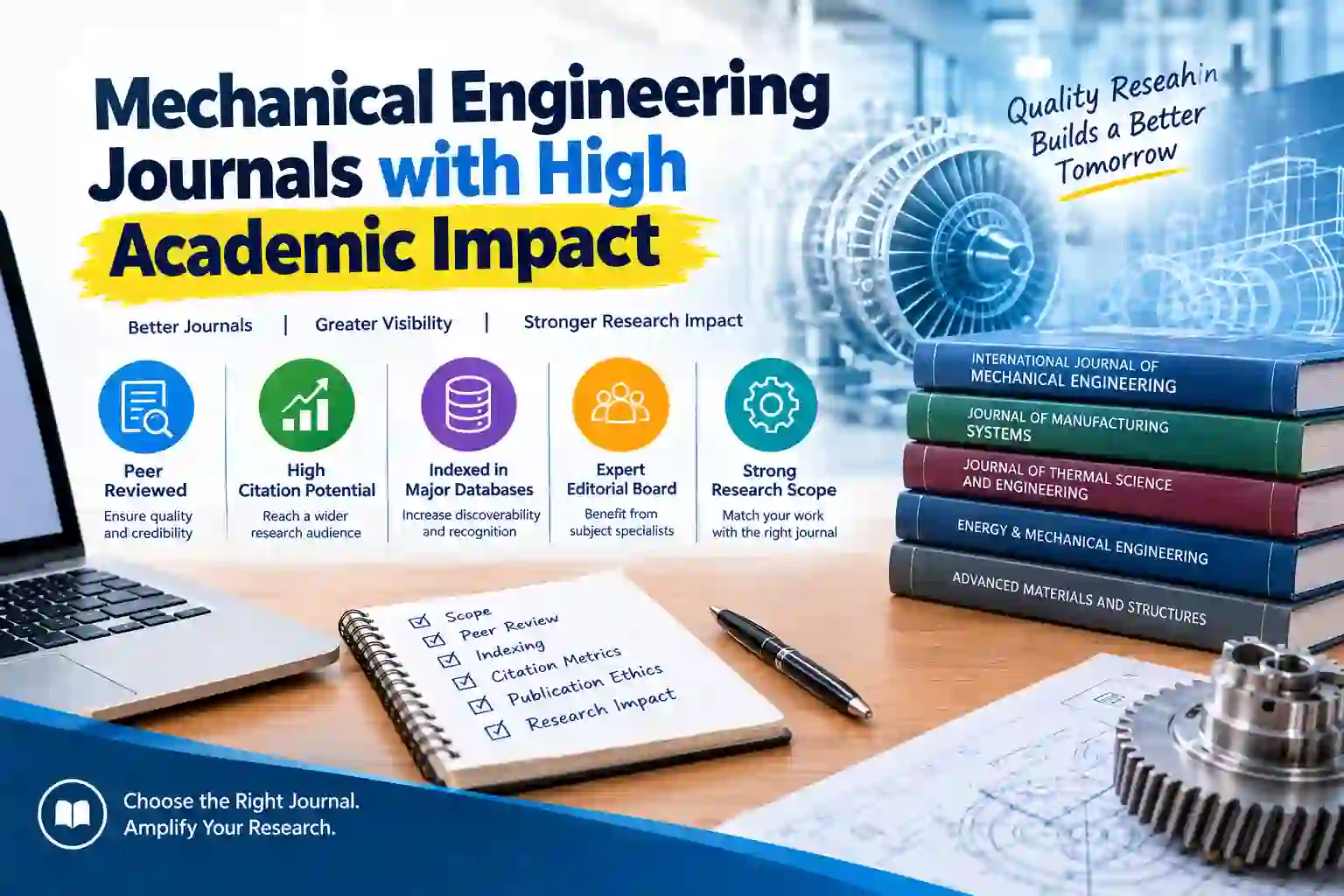
Choosing the right journal can significantly influence how easily a mechanical engineering research paper reaches the appropriate academic audience. Researchers often search for mechanical engineering journals with high academic impact, but journal impact should not be judged by a single metric such as an Impact Factor, CiteScore, or citation count.
A strong journal choice should match the technical scope of the research, maintain a credible peer-review process, provide transparent editorial policies, and offer appropriate visibility for the intended research community. This guide explains how researchers, PhD scholars, postgraduate students, and engineering professionals can evaluate mechanical engineering journals before submitting a manuscript.
For a broader perspective on selecting reputable publication venues across scientific disciplines, researchers can also explore this guide to science journals for innovative research.
What Does “High Academic Impact” Mean for a Mechanical Engineering Journal?
The phrase high academic impact can have different meanings depending on the researcher’s objective. A journal may have strong citation performance but limited relevance to a particular engineering specialty. Conversely, a highly specialized journal may have a smaller overall citation volume while being extremely influential within its research community.
For mechanical engineering researchers, academic impact can be assessed through several dimensions:
- Citation performance: Citation-based indicators can provide information about how frequently published research is referenced.
- Indexing and discoverability: Inclusion in appropriate scholarly databases can improve the discoverability of published work.
- Subject relevance: A journal should have a clearly defined scope that matches the manuscript.
- Peer-review quality: A transparent and meaningful review process is essential for scholarly credibility.
- Editorial expertise: An established editorial board with relevant subject expertise can strengthen the journal's academic direction.
- Research readership: A journal's real value depends partly on whether the researchers who need the work actually read it.
- Publication ethics: Clear policies concerning plagiarism, conflicts of interest, corrections, retractions, and research integrity are important.
- Long-term preservation: Reliable digital preservation helps maintain access to published research.
Therefore, researchers should avoid treating the expression “high impact” as synonymous with one numerical ranking.
Why Journal Selection Matters in Mechanical Engineering
Mechanical engineering covers a remarkably broad range of research. A paper on computational fluid dynamics has a very different audience from a study on advanced manufacturing, tribology, robotics, thermal systems, composite materials, or structural mechanics.
Submitting to a journal that does not closely match the manuscript can reduce the likelihood of reaching the appropriate reviewers and readers. Even technically strong research may face rejection if the subject falls outside the journal's stated scope.
Before preparing a submission, researchers should therefore consider whether the journal regularly publishes work in the same research area.
Major Mechanical Engineering Research Areas
When evaluating journals, begin with the specific discipline represented by your manuscript. Common mechanical engineering research areas include:
| Research Area | Typical Topics |
|---|---|
| Thermal Engineering | Heat transfer, thermodynamics, refrigeration, energy systems and thermal management |
| Fluid Mechanics | Computational fluid dynamics, turbulence, multiphase flow and fluid machinery |
| Manufacturing | Additive manufacturing, machining, automation, production systems and process optimization |
| Materials and Mechanics | Composite materials, fracture mechanics, fatigue, deformation and material characterization |
| Mechanical Design | Machine design, optimization, mechanisms, CAD and design methodologies |
| Tribology | Friction, lubrication, wear and surface engineering |
| Robotics | Robotic systems, control, autonomous machines and human-machine interaction |
| Automotive Engineering | Vehicle systems, propulsion, safety, dynamics and electric mobility |
| Energy Engineering | Renewable energy, energy conversion, storage and efficiency |
| Industrial and Systems Engineering | Optimization, reliability, production systems and engineering decision-making |
How to Identify High-Impact Mechanical Engineering Journals
1. Check the Journal’s Scope Before Looking at Its Metrics
The first question should be simple: Does this journal publish research similar to mine?
Read the aims and scope, recent articles, article categories, and keywords used by the journal. Look at papers published during the previous year rather than relying only on the journal's title.
A journal that consistently publishes research closely related to your work may be more useful than a broader publication venue with a higher numerical ranking but little connection to your research community.
2. Examine Peer-Review Policies
Peer review is one of the most important elements of scholarly publishing. Researchers should determine whether the journal clearly explains its review model, editorial decision process, reviewer responsibilities, and expected timelines.
Be cautious about journals that promise guaranteed acceptance or unrealistically short peer-review periods. A legitimate journal should distinguish between rapid editorial processing and guaranteed publication.
Researchers who want a broader understanding of scholarly journal standards can read this complete guide to academic peer-reviewed journals.
3. Evaluate Citation Metrics Carefully
Citation indicators can be useful, but they need context. Depending on the database and discipline, researchers may encounter metrics such as Journal Impact Factor, CiteScore, SJR, SNIP, h-index, or other indicators.
These measurements are not interchangeable. They may use different databases, time periods, calculation methods, and publication types.
A responsible journal-selection process should therefore record the exact metric, database, year, and source rather than simply stating that a journal has a “high impact.”
4. Verify Indexing Independently
A journal may advertise that it is “indexed” without making the exact database clear. Researchers should verify important indexing claims directly through the relevant database rather than relying solely on a journal's promotional material.
This is particularly important when an institution, university, funding agency, or doctoral program requires publication in a particular database.
Google Scholar can also be useful for discovering scholarly literature and tracing citations, but researchers should distinguish Google Scholar visibility from selective indexing or formal journal evaluation systems. For additional guidance, see these Google Scholar search tips for researchers.
5. Investigate the Editorial Board
A credible mechanical engineering journal should provide identifiable information about its editorial leadership and editorial board.
Researchers should look for:
- Editor-in-Chief and associate editors
- Institutional affiliations
- Relevant mechanical engineering expertise
- Clearly defined editorial responsibilities
- Transparent contact information
The presence of well-known researchers on an editorial board can be informative, but names alone do not establish journal quality. Researchers should also consider whether the editorial board is genuinely active and relevant to the journal's scope.
6. Review Recently Published Articles
One of the most practical methods of evaluating a journal is to examine its recent publications.
Ask:
- Are the papers technically relevant to my research?
- Are the methodologies appropriate for the discipline?
- Are references and citations presented professionally?
- Are the articles accessible and discoverable?
- Does the journal publish original research consistently?
- Are article-level publication details clearly presented?
Reading several recent papers can reveal more about a journal's actual research community than a marketing statement.
Examples of Mechanical Engineering Journal Categories to Consider
There is no universal list of “best” mechanical engineering journals because the appropriate venue depends heavily on the research topic and publication requirements. Researchers may investigate journals specializing in:
- Mechanical design and machine systems
- Manufacturing and production engineering
- Thermal and energy engineering
- Fluid mechanics and heat transfer
- Computational mechanics
- Materials and structural mechanics
- Tribology and surface engineering
- Robotics and automation
- Automotive and transportation engineering
- Mechatronics and intelligent mechanical systems
Within each category, compare journals using the same criteria rather than selecting a publication solely because its title contains “international,” “advanced,” “high impact,” or similar promotional terminology.
High Impact Does Not Always Mean High Publication Cost
Another common misconception is that an academically strong journal must necessarily charge a large article processing charge (APC). Publication cost and academic quality are separate considerations.
Some journals operate through subscription models, institutional support, societies, universities, grants, or other funding structures. Others use open-access APCs to support publication and distribution.
Researchers should therefore evaluate quality and cost independently.
This is particularly important for PhD scholars and early-career researchers working with limited research budgets. Our guide on why low publication fees do not necessarily mean low quality explains the factors researchers should investigate before choosing an inexpensive journal.
What Should Researchers Check Before Paying an APC?
Before making any payment, verify the journal's official fee policy. A transparent journal should clearly state whether it charges:
- Submission fees
- Article processing charges
- Page charges
- Color or multimedia charges
- Fast-track or optional services
- Withdrawal or other administrative fees
Researchers should also check whether waivers or discounts are available.
For a broader comparison of publication expenses, see this guide to research paper publication costs and APCs.
Open Access and Academic Visibility
Open access can make research available to readers without a subscription barrier. For researchers, this may be attractive when the goal is to maximize accessibility to students, academics, practitioners, and researchers who may not have institutional access to subscription databases.
However, open access should not automatically be interpreted as high quality. The same evaluation principles still apply: peer review, editorial standards, research ethics, transparency, indexing, preservation, and subject relevance.
Researchers interested in open-access publishing can also review this guide to open-access research journals for broader publication considerations.
Red Flags When Choosing a Mechanical Engineering Journal
A journal deserves additional scrutiny when it displays several warning signs. These do not automatically prove that a journal is illegitimate, but they should prompt further verification.
- Guaranteed acceptance regardless of manuscript quality
- Promises of publication within an unrealistically short period
- Unclear or hidden publication fees
- Fake or unverifiable indexing claims
- Editorial board members who cannot be independently verified
- Very broad scope covering unrelated academic disciplines without explanation
- Missing peer-review information
- Unclear publisher identity or contact information
- Pressure to make immediate payment
- Journal metrics presented without identifying the source or year
Researchers should never choose a journal solely because an email claims that their manuscript has been “selected” for fast publication.
How to Choose a Journal for a Mechanical Engineering Research Paper
A practical selection process can be divided into five stages.
- Define the research topic. Identify the exact technical area, methodology, application, and intended audience.
- Create a shortlist. Identify several journals that have recently published research similar to your manuscript.
- Verify journal credentials. Check peer review, editorial information, indexing, publisher information, ethics policies, licensing, and preservation.
- Compare practical requirements. Review word limits, manuscript structure, reference style, submission requirements, publication timelines, and fees.
- Make the final decision. Select the journal that provides the strongest combination of subject fit, credibility, visibility, accessibility, and practical suitability.
Researchers looking for additional strategies can also read our guide on how to publish a paper in high-impact scientific journals.
How Manuscript Quality Influences Academic Impact
Selecting a strong journal is only one part of the publication process. The eventual academic impact of a paper also depends on the quality and usefulness of the research itself.
A mechanical engineering manuscript should clearly establish:
- The engineering problem being addressed
- The research gap or unresolved limitation
- The novelty of the proposed approach
- The methodology and experimental or computational setup
- The reliability and limitations of the results
- The practical or theoretical contribution
- The relationship between the findings and existing research
Clear technical writing is equally important. A paper with a strong research contribution can lose effectiveness if the objectives, methodology, results, or conclusions are difficult to understand.
For practical advice, researchers can explore these engineering research paper writing best practices.
Should You Choose a High-Ranking Journal or a Better-Fit Journal?
The answer depends on the purpose of the research and the requirements of the author's institution or funding organization.
A highly ranked journal may provide substantial visibility, but it may also have a narrow scope, highly competitive acceptance standards, or publication requirements that are not appropriate for every manuscript.
A specialized journal with a strong reputation in a particular mechanical engineering field may provide a better audience and more relevant readership.
Therefore, instead of asking only “What is the highest-impact journal?”, researchers should ask:
“Which credible journal is the best academic and subject fit for this particular research paper?”
Mechanical Engineering Journal Selection Checklist
| Evaluation Factor | What to Check |
|---|---|
| Scope | Does the journal regularly publish research in your specialization? |
| Peer Review | Is the review process clearly explained? |
| Editorial Board | Are editors identifiable and relevant to the subject? |
| Indexing | Can important indexing claims be independently verified? |
| Citation Metrics | Is the metric identified by database and year? |
| Ethics | Are plagiarism, conflicts, corrections and retractions addressed? |
| Fees | Are APCs and other charges clearly disclosed? |
| Licensing | Are copyright and reuse conditions clearly explained? |
| Preservation | Is there a credible long-term digital preservation arrangement? |
| Recent Articles | Does the journal publish credible research similar to yours? |
Final Thoughts
Finding mechanical engineering journals with high academic impact requires more than searching for a high numerical ranking. Researchers should assess the complete publication environment: subject relevance, peer review, editorial expertise, indexing, citation indicators, publication ethics, accessibility, preservation, and cost.
The strongest journal is not necessarily the one with the most impressive promotional claim. It is the credible publication venue where your research fits the scope, reaches the right scholarly audience, and is evaluated through a transparent editorial and peer-review process.
Researchers comparing publication options should also consider whether the journal provides a reasonable balance between academic standards, research visibility, accessibility, and publication cost. For additional guidance, see our resource on publishing engineering research papers in peer-reviewed journals.
Frequently Asked Questions
What makes a mechanical engineering journal high impact?
A high-impact journal is generally evaluated using multiple indicators, including citation performance, scholarly visibility, editorial quality, peer review, indexing, research relevance, and reputation within its discipline. No single metric provides a complete assessment.
Should I choose a journal based only on Impact Factor?
No. Impact Factor is only one journal-level indicator. Researchers should also evaluate scope, peer-review standards, indexing, editorial practices, article quality, audience, publication ethics, and institutional requirements.
Are high-impact mechanical engineering journals always expensive?
No. Academic impact and publication cost are separate issues. Some journals charge APCs, while others use subscription, institutional, society, or other funding models. Always verify the current official fee policy before submission.
How can I verify whether a journal is properly indexed?
Use the official database or indexing service to verify the journal title, ISSN, and current indexing status. Do not rely exclusively on a journal's website or promotional emails.
Is a specialized mechanical engineering journal better than a multidisciplinary journal?
Not necessarily. The best choice depends on the research. A specialized journal can provide a highly relevant audience, while a multidisciplinary journal may be appropriate for interdisciplinary engineering research. Subject fit should be a major consideration in either case.
Can a lower-cost journal still be academically credible?
Yes. Publication cost does not by itself determine scholarly quality. Researchers should evaluate peer review, editorial standards, indexing, ethics, transparency, and the quality of published research before considering the fee.