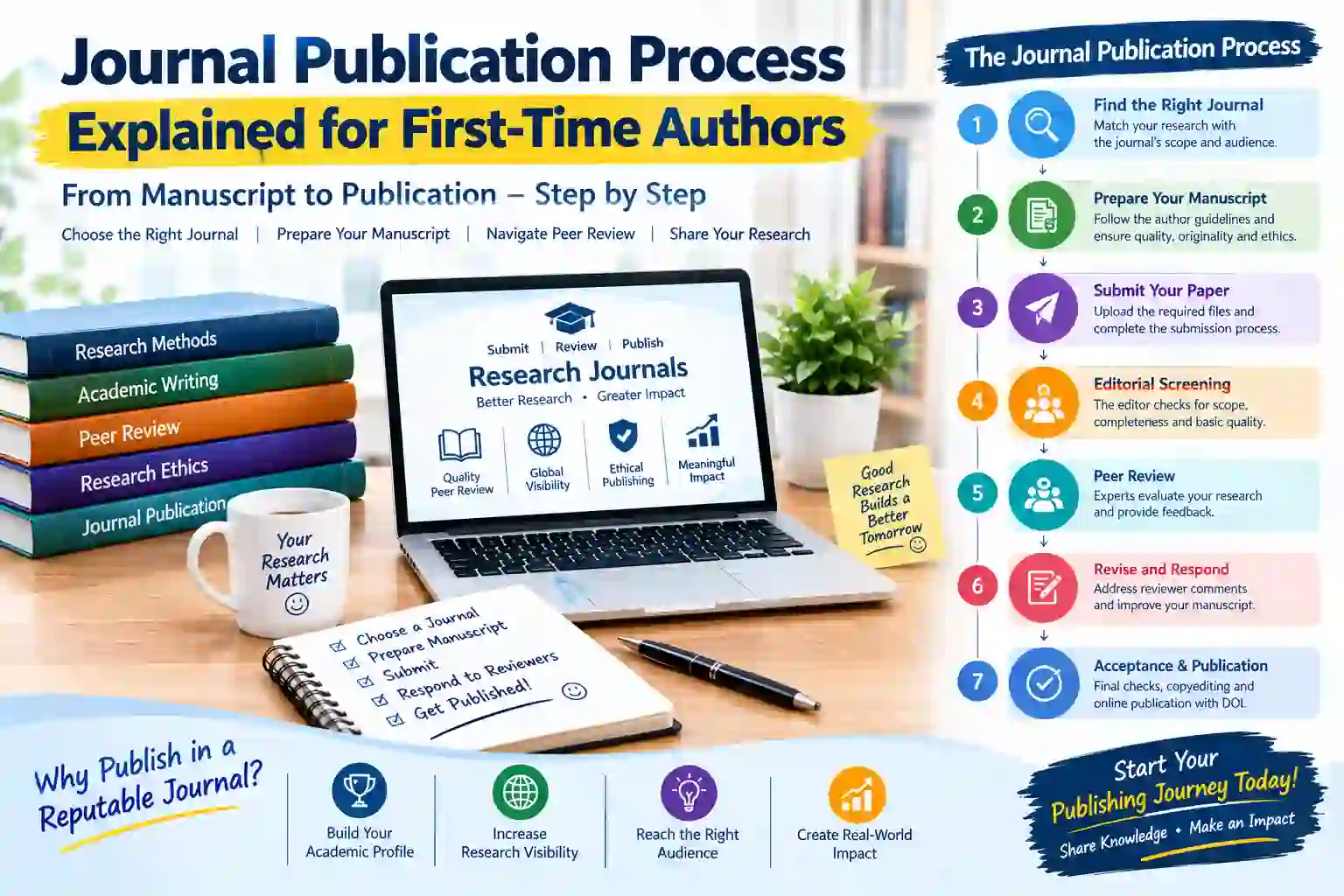
Publishing a research paper in an academic journal is an important milestone for students, PhD scholars, early-career researchers, and experienced academics. However, for first-time authors, the journal publication process can seem confusing. Questions about selecting the right journal, preparing a manuscript, submitting files, responding to reviewers, and understanding publication decisions are common.
The good news is that journal publishing becomes easier to navigate when you understand each stage and prepare carefully. A successful submission is not simply about writing a paper and uploading it. It requires relevant research, ethical reporting, clear presentation, appropriate journal selection, and a willingness to improve your work through feedback.
This practical guide explains the publication journey from the first draft to the final published article. It also explains how researchers can evaluate journals and consider submitting suitable work to the Journal of Recent Innovation in Science and Technology (JRIST).
What Is the Journal Publication Process?
The journal publication process is the sequence of steps through which a researcher prepares, submits, and develops a manuscript for publication in an academic journal. Depending on the journal and the manuscript, the process may involve an initial editorial screening, peer review, revisions, acceptance, copyediting, proof correction, and online publication.
Not every manuscript follows exactly the same route. Some submissions are declined before external review, while others require one or more rounds of revision. Review duration and final outcomes vary according to the journal's policies, the subject area, reviewer availability, and the quality and suitability of the manuscript.
Step 1: Identify a Clear and Researchable Topic
Before choosing a journal, identify the research problem your paper addresses. A useful research topic should be sufficiently focused, relevant to the field, and supported by an appropriate research method or technical approach.
Ask yourself the following questions:
- What specific problem does the study investigate?
- Why is the problem important to researchers or practitioners?
- What is already known about this subject?
- What limitation, knowledge gap, or practical challenge does the study address?
- What evidence supports the findings and conclusions?
For example, a computer science paper might evaluate a machine-learning model against established baselines, while an engineering paper might investigate the performance of a material, device, or system. An interdisciplinary paper should explain how its different subject areas contribute to the central research question.
Practical tip: Write a one-paragraph summary of the problem, method, principal findings, and contribution before preparing the full manuscript. If the contribution is difficult to explain clearly, refine the research question first.
Step 2: Choose the Right Academic Journal
Journal selection is one of the most important decisions for a first-time author. A reputable journal is not necessarily the one with the highest impact metric or the fastest advertised publication timeline. It is the journal whose scope, editorial standards, readership, and publication policies fit your research.
Before submitting, examine these factors:
- Scope: Does the journal publish research in your subject area?
- Article types: Does it accept original research, review articles, case studies, or other relevant formats?
- Peer-review policy: Is the review process explained clearly?
- Editorial transparency: Are the editor, publisher, contact information, and editorial policies identifiable?
- Publication fees: Are any submission charges or article processing charges clearly disclosed?
- Access and licensing: Can readers access the paper, and what reuse conditions apply?
- Indexing claims: Can claimed indexing or abstracting services be verified directly through the relevant databases?
- Author instructions: Are manuscript formatting, referencing, ethics, and submission requirements available?
For additional guidance, read our complete guide to academic peer-reviewed journals and explore science journals for innovative research.
Researchers in computer science can also consult our guide to peer-reviewed computer science journals. Authors working across scientific and engineering disciplines may find the applied science journal publishing guide useful.
Step 3: Read the Author Guidelines Carefully
Once you have shortlisted a suitable journal, read its current author guidelines before formatting your paper. Each journal may specify its own manuscript structure, file types, word limits, reference style, figures, tables, declarations, and submission requirements.
A typical original research article contains the following sections, although the required structure varies by discipline:
- Title: A concise and accurate description of the study.
- Abstract: A brief summary of the problem, methods, main findings, and contribution.
- Keywords: Terms that accurately represent the paper's subject and help readers discover it.
- Introduction: The research problem, background, knowledge gap, and objectives.
- Literature review or related work: Relevant previous research and the position of the current study.
- Materials and methods: Sufficient information to understand and evaluate the research approach.
- Results: The principal findings, supported by appropriate evidence.
- Discussion: Interpretation of the findings, comparison with earlier work, and implications.
- Conclusion: A concise summary of the contribution, limitations, and possible future work.
- References: Complete and accurate details of cited sources.
Some disciplines combine results and discussion or use a different structure. Follow the target journal's instructions rather than applying a generic template without checking.
For practical writing advice, see how to write and prepare a research paper for publication.
Step 4: Prepare an Original, Ethical, and Well-Documented Manuscript
A strong manuscript communicates the research clearly and provides enough evidence for readers and reviewers to evaluate the work. Good presentation matters, but formatting cannot compensate for weak methods, unsupported conclusions, or a contribution that is not explained adequately.
Before submission, check the following:
- Explain the research objective and contribution clearly.
- Use credible and relevant sources to support the background and discussion.
- Describe methods, datasets, materials, and analytical procedures accurately.
- Use readable figures and tables with descriptive captions.
- Check equations, units, terminology, and technical details.
- Ensure every in-text citation has a corresponding reference and vice versa.
- Disclose limitations instead of making claims that exceed the evidence.
- Use plagiarism-detection tools responsibly and review any problematic overlap.
- Disclose the use of AI tools when required by the journal's current policy.
Authors must not fabricate or manipulate data, invent references, copy others' work without attribution, or submit the same manuscript to multiple journals simultaneously when the journals' policies prohibit it. Any necessary permissions, ethics approvals, funding statements, conflict-of-interest disclosures, and author contributions should be handled according to the study and journal requirements.
For engineering authors, our resource on engineering research paper writing and publication provides additional preparation guidance.
Step 5: Submit Your Manuscript Through the Journal's Submission System
Many academic journals use an online submission platform to collect manuscripts and author information. During submission, the corresponding author may be asked to create an account, enter the manuscript title and abstract, select keywords, add all co-authors, and upload the required files.
Depending on the journal, the required documents may include:
- The main manuscript in the accepted file format.
- Figures, tables, or supplementary files if uploaded separately.
- A cover letter explaining the paper's relevance and contribution.
- Author names, institutional affiliations, and email addresses.
- Ethics, consent, funding, and conflict-of-interest declarations where applicable.
- Other documents specifically requested by the journal.
Ensure that all authors have reviewed and approved the final manuscript and agreed to the submission. The corresponding author should provide accurate contact details and confirm that the author list and order are correct.
Before clicking the final submission button, check that the uploaded file is complete, the title and abstract are correct, and all required declarations have been provided. Save the submission confirmation and manuscript identification number for future communication.
Step 6: Initial Editorial Screening
After submission, the editorial team generally checks whether the manuscript meets the journal's basic requirements. This stage may be called an initial assessment, editorial screening, or desk review.
Editors may consider:
- Whether the paper falls within the journal's scope.
- Whether the manuscript follows essential submission requirements.
- Whether the research question and contribution are sufficiently clear.
- Whether ethical declarations and required files are present.
- Whether the manuscript raises concerns about originality, research integrity, or suitability for review.
A manuscript may be returned for technical corrections, declined at this stage, or sent forward for peer review. A desk rejection does not automatically mean that the research has no value. It may indicate a mismatch with the journal, insufficient evidence, unclear presentation, or a need for substantial improvement.
How to improve your chances at screening: Follow the author guidelines, explain the paper's contribution in the abstract and introduction, and select a journal that genuinely publishes work in your field.
Step 7: Understand the Peer-Review Process
Peer review allows a journal to obtain subject-specific evaluations of a manuscript before making a publication decision. Depending on the journal, the review model may be single-anonymous, double-anonymous, open, or another clearly stated arrangement.
Reviewers may assess the originality and relevance of the research, the appropriateness of the methods, the quality of the evidence, the accuracy of the interpretation, the engagement with previous literature, and the clarity of the presentation.
Common editorial outcomes include:
- Accept: The manuscript can proceed toward publication, subject to any remaining requirements.
- Minor revision: Limited changes or clarifications are requested.
- Major revision: More substantial changes or additional analysis may be needed.
- Reject: The journal decides not to publish the manuscript.
Some journals use additional decision categories, and a revision invitation does not guarantee eventual acceptance. Peer-review timelines vary, so authors should consult the journal's stated policies and avoid assuming that all manuscripts will receive a decision within a fixed number of days.
Step 8: Respond to Reviewer Comments Professionally
Receiving revision comments is a normal part of academic publishing. Even experienced researchers may be asked to clarify methods, improve figures, strengthen the literature review, discuss limitations, or explain how their conclusions follow from the results.
A good revision response should:
- Thank the editor and reviewers for their time and feedback.
- Address each comment separately and in the order presented.
- Explain the changes made and identify the relevant section or page.
- Provide a reasoned and respectful explanation when a suggestion cannot be followed.
- Ensure that the revised manuscript and response document are consistent.
- Check the revised files carefully before resubmission.
Do not treat every criticism as a personal judgment. Review comments can help make the study clearer and more useful. At the same time, authors should not make changes that misrepresent their findings or compromise research integrity.
Step 9: Acceptance, Proofreading, and Publication
If the editor accepts the manuscript, the paper may move into production. Depending on the journal's workflow, this stage can include copyediting, layout preparation, metadata checks, reference verification, and author proof correction.
Authors should carefully check the proof for errors in names, affiliations, equations, figures, tables, references, and other publication details. Proof correction is generally intended to identify errors and confirm the presentation, not to introduce extensive new research or rewrite the entire paper without editorial approval.
Before publication, verify the final title, author order, affiliations, acknowledgements, funding statements, and other declarations. Once published, retain the article's official URL and DOI if one has been assigned. A DOI provides a persistent identifier for the article; it does not, by itself, establish a journal's quality or indexing status.
Step 10: Share Your Published Research Responsibly
Publication is not the end of the research journey. Authors can help readers discover their work by sharing the official article link through institutional profiles, academic networks, personal websites, and relevant professional communities, in accordance with copyright and licensing conditions.
Researchers should also maintain accurate author profiles, keep their institutional information current, and ensure that article metadata is consistent wherever it appears. Google Scholar and other discovery services may index eligible scholarly content, but inclusion is not guaranteed and should not be confused with indexing in Scopus or Web of Science.
For more guidance, read our Google Scholar search tips for researchers and our guide to research visibility and Google Scholar profiles.
How Long Does the Journal Publication Process Take?
There is no universal timeline for journal publication. The total time depends on the journal's editorial workflow, the availability of reviewers, the number of revision rounds, the complexity of the research, and production requirements.
| Stage | What Happens | What Authors Can Do |
|---|---|---|
| Preparation | The manuscript is written and checked. | Follow the guidelines and verify references. |
| Initial screening | The editor assesses suitability and completeness. | Provide accurate metadata and required documents. |
| Peer review | Reviewers evaluate the research. | Monitor official communications and wait for the decision. |
| Revision | Authors respond to requested changes. | Submit a clear response and revised manuscript. |
| Production | The accepted article is prepared for publication. | Check proofs and publication details promptly. |
These are stages, not promised durations. For an estimate, consult the target journal's current editorial information. Be cautious of claims that guarantee acceptance or publication within a few days without a credible explanation of the review process.
Common Mistakes First-Time Authors Should Avoid
- Choosing a journal only because it is fast: Scope, editorial standards, readership, and transparency matter just as much.
- Ignoring the author guidelines: Missing files or incorrect formatting can delay assessment.
- Making unsupported claims: Conclusions must be consistent with the methods and evidence.
- Using irrelevant references: Cite literature because it informs the research, not simply to increase the reference count.
- Overlooking publication charges: Check the current fee policy before submission and confirm whether any charge applies to your article.
- Trusting unverified indexing claims: Confirm coverage directly with the database or indexing service.
- Responding defensively to reviewers: Address comments with evidence and professional explanations.
- Submitting without co-author approval: Confirm authorship, order, and final manuscript approval before submission.
Remember that a low publication fee does not automatically indicate poor quality, and a high fee does not guarantee quality. Our article explains why low publication fees do not necessarily mean low quality. You can also review our guide to research paper publication costs and APCs before making a decision.
Why Consider Submitting Your Research to JRIST?
The Journal of Recent Innovation in Science and Technology (JRIST) provides a publication venue for research within its stated subject areas. Researchers should begin by checking whether their manuscript aligns with the journal's aims and scope and whether they can meet its author and ethical requirements.
JRIST's subject areas include computer science and information technology, mechanical engineering, electrical and electronics engineering, and civil and environmental engineering. Authors should consult the current JRIST aims and scope to confirm that their particular topic is appropriate.
If your work presents a meaningful research contribution, uses an appropriate methodology, and is clearly written, preparing a careful submission is a constructive next step. First-time authors do not need to know every aspect of academic publishing before beginning; they need to understand the requirements, prepare responsibly, and respond constructively to editorial feedback.
Before submitting, review the current author instructions, peer-review policy, publication ethics, licensing information, and fee policy. Do not assume acceptance or a particular publication date in advance.
Ready to explore submission? Visit the JRIST Call for Papers, review the current requirements, and submit only if your manuscript fits the journal's scope.
Top Trending Keywords and Research Publication Resources
Explore these computer science journal and research publication resources for further guidance on journal selection, manuscript preparation, peer review, open access, and research visibility.
- Journal publication process
- How to publish a research paper
- Journal publication for first-time authors
- Academic peer-reviewed journals
- Scientific research paper submission
- Research paper writing guidelines
- Peer-review process explained
- Open access research journals
- Research journal selection guide
- Article processing charges and publication fees
- Research paper revision and resubmission
- JRIST journal submission guidelines
Frequently Asked Questions
1. What is the first step in publishing a research paper?
Start by defining your research contribution and identifying journals whose aims and scope match your work. Then review the author guidelines and prepare the manuscript accordingly.
2. Can a beginner publish a research paper?
Yes. Students and first-time authors can submit research when they have a suitable study, follow ethical practices, meet the journal's requirements, and obtain any necessary guidance or approvals. Publication is not guaranteed.
3. Is peer review compulsory for every academic journal?
Review models and editorial policies vary. Authors who specifically need peer-reviewed publication should verify that the journal has a clearly described review process and confirm the applicable policy before submission.
4. Does paying a publication fee guarantee acceptance?
No. A legitimate publication fee, where applicable, should not be treated as a guarantee of acceptance. Editorial decisions should follow the journal's stated assessment and review process.
5. Does receiving a DOI mean that a journal is indexed in Scopus or Web of Science?
No. A DOI identifies a digital object, such as a research article. It does not independently verify indexing in Scopus, Web of Science, or any other database. Check the relevant database directly.
6. What should authors do if their paper is rejected?
Read the decision carefully, identify the reasons for rejection, and revise the manuscript where appropriate. If the paper is suitable for another journal, select a new target and follow its submission requirements. Do not submit the same manuscript simultaneously to multiple journals when their policies prohibit it.
7. How can first-time authors submit to JRIST?
First, check the JRIST aims and scope and current author instructions. If the manuscript is suitable, follow the submission steps provided through the JRIST Call for Papers.
Final Thoughts
The journal publication process is a series of manageable steps: develop a clear research question, choose a suitable journal, prepare an ethical and well-documented manuscript, submit it correctly, respond thoughtfully to peer review, and check the final proofs.
For first-time authors, the most valuable approach is to focus on the quality and relevance of the research rather than promises of rapid acceptance. Careful journal selection, transparent communication, and a willingness to improve the manuscript can make the experience more productive.
If your research fits the scope of the Journal of Recent Innovation in Science and Technology (JRIST), take the next step by reviewing the journal's current policies and submission requirements. Your first submission can be an important learning experience and a step toward sharing your research with the wider academic community.