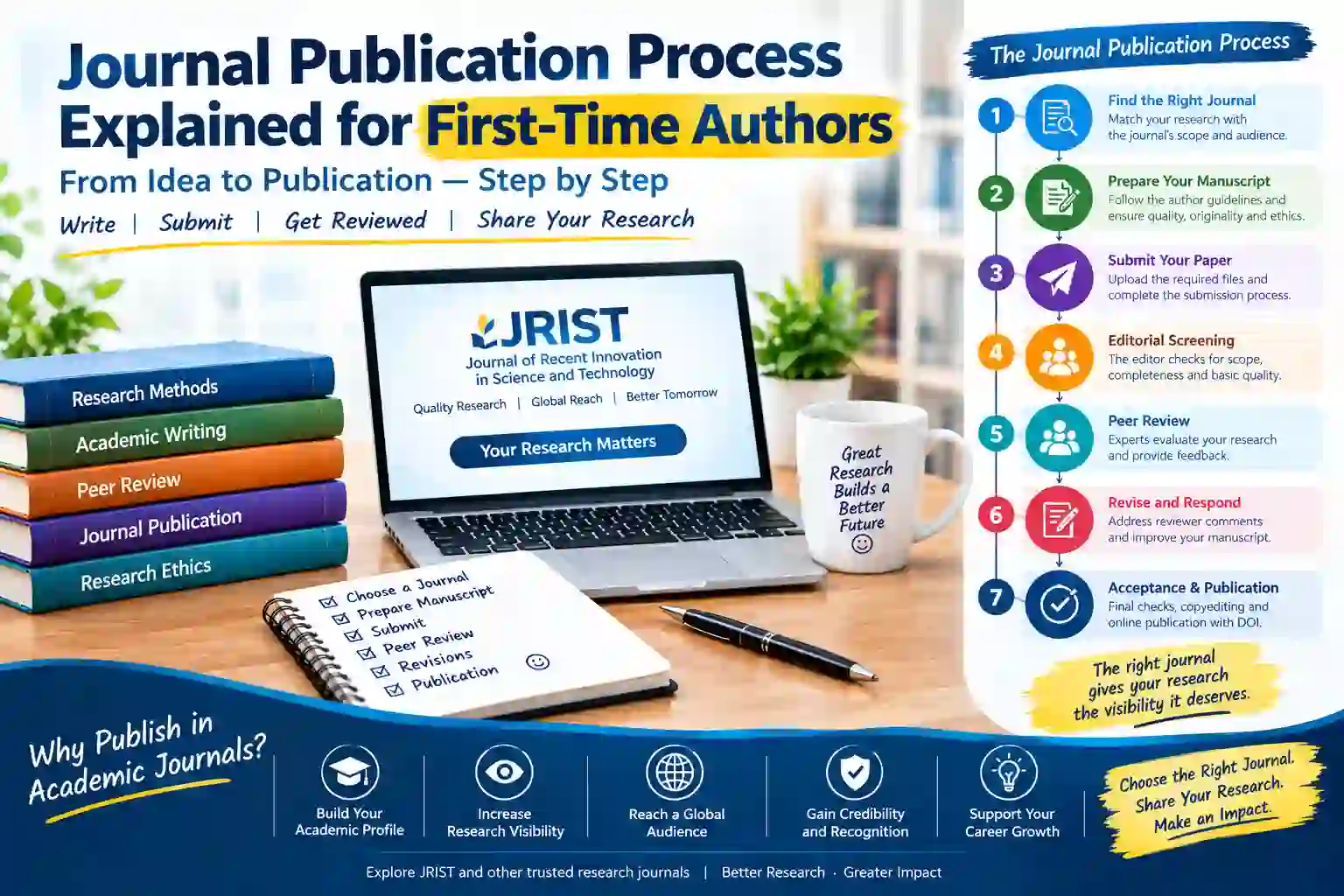
 Publishing research in a credible academic journal is an important part of a researcher's professional journey. For PhD scholars, university faculty members, postgraduate students, and early-career academics in India, journal selection can influence how research is evaluated, discovered, and used by other scholars.
This is why many researchers search for UGC approved journals, UGC journal lists, peer-reviewed publications, and suitable journals for academic promotion or doctoral research. However, understanding journal eligibility requires more than checking a label on a publisher's website. Researchers must distinguish historical UGC-CARE references from current institutional requirements and independently verify a journal's credentials.
In this guide, we explain the potential benefits of publishing in a suitable, credible journal, how to evaluate journal quality, which mistakes to avoid, and how to identify an appropriate publication venue for your research.
What Are UGC Approved Journals?
The term "UGC approved journals" is widely used by researchers in India to describe journals they believe meet the publication requirements of the University Grants Commission (UGC), a university, or another academic authority.
Historically, the UGC maintained an approved-journal list and subsequently established the Consortium for Academic Research and Ethics (UGC-CARE) framework to support research quality, publication ethics, and the identification of credible journals. Official UGC materials explain the objectives behind the CARE initiative and its historical journal-evaluation framework.
However, researchers should not assume that an old UGC-approved list or a historical UGC-CARE entry automatically establishes a journal's current eligibility for every academic purpose. Requirements can depend on the applicable regulations, university rules, discipline, and date of evaluation.
Before submitting a paper, consult the official UGC website, relevant current regulations, and your university's research or academic office. Ask for written clarification if journal eligibility affects a PhD requirement, faculty recruitment, promotion, or another formal assessment.
Why Does Journal Selection Matter for Academic Researchers?
Choosing a suitable journal helps researchers communicate their findings to the right audience and establish a reliable scholarly record. The journal should match the research topic, use transparent editorial practices, and provide publication policies that authors can understand before submitting.
A journal's reputation alone is not enough. Researchers should evaluate its editorial board, peer-review process, publication ethics, indexing claims, accessibility, and relevance to the intended academic purpose.
7 Potential Benefits of Publishing in a Credible Academic Journal
1. Support for Academic and Research Requirements
Some universities, departments, doctoral programmes, and academic employers specify conditions for acceptable research publications. Publishing in a journal that satisfies the applicable requirements can help researchers document their scholarly work.
Eligibility is not universal. A journal accepted for one institutional purpose may not automatically satisfy another institution's requirements. Confirm the current rules before choosing a journal based on an academic requirement.
2. Recognition of Research Contributions
A published paper provides a formal record of a researcher's contribution. It allows other scholars to examine the study, assess its methods, discuss its findings, and build upon its results.
For early-career researchers, preparing and publishing a well-supported article can also develop valuable skills in academic writing, evidence-based reasoning, responding to reviewers, and communicating research limitations.
3. Greater Opportunities for Research Discovery
Publication can make research accessible to readers beyond the author's institution. Visibility depends on several factors, including the journal's audience, discoverability, metadata quality, open-access arrangements, subject relevance, and the usefulness of the findings.
Indexing in a recognized database may help readers discover an article, but indexing claims must be checked independently. A DOI, an ISSN, or a Google Scholar result does not by itself establish inclusion in Scopus, Web of Science, or a particular UGC-related eligibility category.
Researchers can learn more from our guide to Google Scholar search tips for researchers.
4. Constructive Peer Review and Manuscript Improvement
A journal with a clearly explained peer-review process may provide valuable feedback on the research question, methodology, analysis, interpretation, and presentation. Reviewer comments can help authors identify weaknesses and improve the manuscript before publication.
Peer review does not guarantee that every published conclusion is correct. Its value depends on the review process, editorial judgment, research integrity, and the quality of the evidence.
For practical advice, explore our guide to academic peer-reviewed journals.
5. Stronger Research Communication Skills
Preparing a journal manuscript encourages authors to explain complex ideas clearly, review relevant literature, justify research methods, organize evidence, and acknowledge limitations. These skills are valuable for PhD research, academic collaboration, technical communication, and future research projects.
First-time authors can start with our guide on writing a research paper for publication.
6. Opportunities for Academic Collaboration
When research is shared through appropriate academic channels, other researchers may identify common interests, compare findings, or contact the authors about future projects. A clearly written article with accurate author affiliations and contact information makes it easier for readers to understand who conducted the work and how it relates to the field.
Collaboration is not guaranteed by publication. It develops through relevant research, professional communication, and meaningful engagement with other scholars.
7. A Verifiable Record of Scholarly Work
Published articles provide a record that can be cited in academic profiles, research portfolios, institutional reports, and applications where the publication is relevant. Accurate metadata, stable article links, and persistent identifiers can make that record easier to verify.
However, publication counts should not be treated as a complete measure of research quality. The contribution, methodological rigor, integrity, relevance, and influence of the work also matter.
How to Verify a Journal Before Submission
One of the most important steps for any researcher is to verify the journal rather than relying only on advertising or search-engine results. Use the following checklist before submitting your manuscript.
| What to Check | Questions to Ask |
|---|---|
| Current eligibility | Does the journal meet the specific current requirements of my university or academic authority? |
| Aims and scope | Does the journal regularly publish work related to my research topic? |
| Editorial board | Are the editor names, affiliations, and responsibilities clearly disclosed? |
| Peer review | Is the review process explained, including the types of decisions authors may receive? |
| Publication ethics | Are plagiarism, authorship, corrections, conflicts of interest, and research misconduct addressed? |
| Indexing | Can each indexing claim be confirmed through the official database or service? |
| Publication charges | Are all applicable fees, waivers, and payment conditions disclosed before submission? |
| Recent issues | Does the journal publish regularly, and are its articles relevant and accessible? |
| ISSN and publisher | Do the journal title, ISSN, publisher details, and official website correspond? |
The UGC's historical academic and research materials discuss the importance of publication ethics and avoiding dubious or substandard journals. Researchers can consult the official UGC material on the development of the CARE framework as historical background, while checking the current official rules separately.
Does Publishing in a UGC-Related Journal Guarantee Academic Benefits?
No. Publication in a journal does not automatically guarantee a PhD award, academic promotion, faculty appointment, research funding, or acceptance of a publication for a particular institutional purpose.
The outcome depends on the applicable regulations and the decision-making authority. An institution may consider the article's publication date, journal eligibility, article type, authorship, research relevance, and other conditions.
Researchers should therefore confirm the exact requirements with their university or employer before submission. Keep copies of the relevant policy, journal information, publication confirmation, and final article for documentation.
How to Choose the Right Journal for Your Research
Instead of searching only for an "approved" or "high-impact" journal, begin with the research itself. The right journal should provide a suitable readership and a credible process for evaluating your work.
- Define your contribution: Summarize the problem, method, findings, and significance of your research.
- Identify relevant journals: Search for journals that publish similar research and fit your discipline.
- Read recent articles: Examine whether the journal's content and technical level align with your manuscript.
- Verify journal credentials: Check indexing claims, editorial details, publication ethics, and current institutional requirements.
- Review author instructions: Confirm the manuscript format, article types, required declarations, and reference style.
- Understand the costs: Check submission fees, article processing charges, optional services, and waiver policies.
- Submit responsibly: Ensure that all authors approve the final manuscript and follow the journal's submission and originality policies.
For more information, see our guides to choosing a journal for innovative research and understanding research publication costs.
Common Warning Signs Researchers Should Not Ignore
A journal's claims should be examined carefully, especially when the publisher promises unusually rapid publication or guaranteed acceptance. Warning signs may include:
- Guaranteed acceptance or publication without meaningful editorial evaluation.
- Unverifiable claims of UGC approval or database indexing.
- Fake or misleading impact factors and ranking claims.
- Unclear ownership, editorial leadership, or contact details.
- Fees that are revealed only after acceptance without prior disclosure.
- Review timelines that are unrealistic for the stated assessment process.
- Articles that appear unrelated to the journal's declared scope.
- Pressure to submit or pay immediately without access to clear policies.
None of these signals should be evaluated in isolation when evidence is uncertain, but several together warrant careful investigation. A low publication fee does not automatically mean a journal is unreliable, just as a high fee does not prove quality. Read our article explaining why low publication fees do not necessarily mean low quality.
Considering JRIST for Your Research Publication
The Journal of Recent Innovation in Science and Technology (JRIST) publishes research within its stated scientific and engineering subject areas. Researchers working in computer science and information technology, mechanical engineering, electrical and electronics engineering, and civil and environmental engineering can review the journal's scope to determine whether their work is suitable.
Before submitting to JRIST, read its current aims and scope, author instructions, peer-review policy, publication ethics, licensing information, and fee policy. Confirm that the journal meets any specific eligibility requirements imposed by your university or academic employer.
A strong submission should present a clear research question, a justified methodology, relevant literature, credible evidence, and conclusions supported by the findings. Authors should also ensure that all co-authors approve the manuscript and that the work follows applicable research and publication ethics.
If your manuscript fits the journal's subject areas, the next step is to review the current submission requirements through the JRIST Call for Papers. Submitting appropriate research gives your work an opportunity to be considered through the journal's editorial process, but acceptance and publication timing cannot be guaranteed.
Top Trending Keywords and Research Resources
Explore the UGC journal guidance and academic research publication resources available through JRIST to learn more about manuscript preparation, peer review, journal selection, and research visibility.
- UGC approved journals
- UGC journal list and verification
- Journal publication for researchers
- Academic peer-reviewed journals
- Research paper publication
- Journal selection for PhD scholars
- Scientific research journal
- Open access research journals
- Research publication ethics
- Journal indexing verification
- Research paper submission guidelines
- Academic publishing for early-career researchers
Frequently Asked Questions
1. What are the benefits of publishing in a credible academic journal?
A suitable journal can help researchers communicate findings, receive editorial and peer-review feedback, develop a verifiable scholarly record, and reach readers interested in the subject. Specific academic benefits depend on the rules of the relevant institution.
2. Is every peer-reviewed journal a UGC-approved journal?
No. Peer review and eligibility under a particular UGC-related or institutional requirement are different questions. Verify the current requirements that apply to your academic purpose.
3. How can I check whether a journal meets my university's requirements?
Consult the current university regulations or research office, verify the journal's details and any claimed indexing, and request written clarification if the rules are unclear.
4. Does a DOI prove that a journal is UGC approved?
No. A DOI is a persistent identifier for a digital object. It does not independently establish a journal's eligibility, peer-review quality, or indexing status.
5. Should I choose a journal only because it has a low publication fee?
No. Consider the scope, editorial standards, review process, transparency, discoverability, and total cost together. A low fee can be reasonable, but the journal's credibility and suitability remain essential.
6. Can I submit my research to JRIST?
You can review JRIST's aims and scope and current author instructions to determine whether your manuscript is suitable. If it is, consult the Call for Papers for current submission information. Acceptance is subject to the journal's editorial process.
Conclusion
For academic researchers, choosing a credible journal is about more than finding a label that says "UGC approved." It requires understanding current institutional requirements, verifying journal credentials, evaluating peer-review and ethical standards, and matching the manuscript to the journal's scope.
A careful publication decision can help researchers build a reliable scholarly record and communicate useful findings to the academic community. Take time to verify claims, read the author guidelines, and prepare a manuscript that reflects sound research practices.
If your research aligns with JRIST's stated scope, explore the journal's current policies and submission requirements before proceeding. A thoughtful, well-prepared submission is a better starting point than relying on promises of guaranteed acceptance or academic recognition.