ISSN (Online): 3117-3926
ISSN (Print): 3117-535X
| Publication Fees: |  |

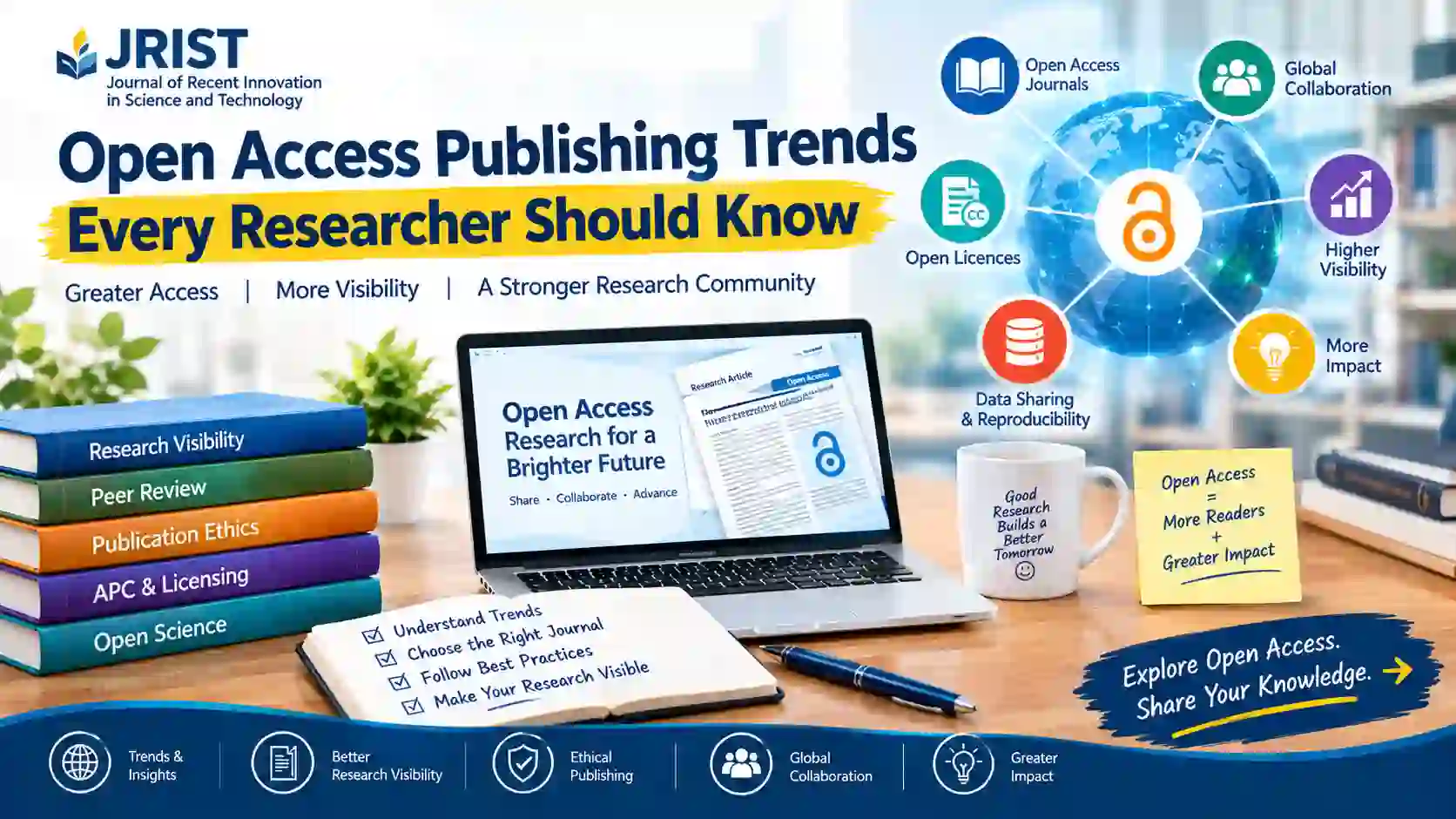
Open access publishing is changing how researchers share discoveries, collaborate across disciplines, and make scientific knowledge available to readers around the world. For PhD scholars, university faculty, independent researchers, and early-career academics, understanding these changes can help them choose suitable journals and plan their publication strategy more effectively.
However, open access does not automatically mean that a journal is reputable, that an article will be accepted quickly, or that publication is free. Researchers need to understand publishing models, peer review, licensing, article processing charges (APCs), research integrity, and discoverability before submitting a manuscript.
This guide explores important open access publishing trends every researcher should know, practical ways to evaluate journals, and steps authors can take to prepare their research for responsible publication.
Open access (OA) publishing makes scholarly work available online without requiring readers to pay a subscription or purchase individual articles. Depending on the publishing model and licence, readers may also be permitted to share, distribute, or reuse published material under specified conditions.
Open access is part of the wider open science movement, which promotes greater accessibility, transparency, collaboration, and reuse of scientific knowledge. UNESCO describes open science as including open access to publications, research data, educational resources, software, and other research outputs.
Researchers can learn more from the UNESCO Open Science programme.
It is important to distinguish between free-to-read content and openly licensed content. An article may be available to read without charge while still having restrictions on reuse. An open access article normally has a clearly stated licence explaining what readers can do with the work.
One of the central trends in open access publishing is the growing emphasis on making research available to readers without subscription barriers. Immediate access can help researchers, students, practitioners, and institutions that cannot afford extensive journal subscriptions.
For authors, open access may make it easier for readers outside their institution or country to discover and read their findings. This can support academic discussion and help research reach relevant professional communities.
Nevertheless, free access alone does not guarantee that a paper will receive more citations or become influential. Research visibility also depends on its originality, methodological quality, relevance, discoverability, and usefulness to other researchers.
What researchers should do:
Confirm whether the complete article is available without a subscription.
Check when the article becomes openly available.
Read the licence and copyright policy before submission.
Find out whether the journal permits sharing through institutional repositories or author websites.
For a broader overview of journal selection, see JRIST’s guide to the best science journals for innovative research.
Open access publishing is not only about removing paywalls. Licensing determines how published work can be reused, distributed, adapted, and attributed.
Creative Commons licences are commonly used to communicate these permissions. Their conditions differ, so authors should not assume that all open access articles can be reused in the same way.
Before submitting a paper, check:
Who retains copyright after publication.
Which licence will apply to the final article.
Whether commercial reuse is permitted.
Whether adaptations are allowed.
Whether attribution or share-alike conditions apply.
Whether the published version can be deposited in a repository.
Authors should also review funder, university, and institutional requirements. Some research programmes specify particular licensing or repository conditions.
A transparent journal should make its copyright and licensing policies easy to locate and consistent with the terms displayed on published articles. The DOAJ guidance on transparency and best practice provides a useful reference for assessing these policies.
Researchers increasingly encounter several different ways of publishing open access. Understanding who pays for publication helps authors assess their options.
| Publishing model | How access and costs generally work | What authors should check |
|---|---|---|
| Gold open access | The final article is openly available on the journal website; an APC may or may not apply. | Licence, APC, and waiver policy |
| Diamond or platinum open access | Articles are openly available, and authors generally do not pay publication charges. | Funding arrangements, editorial standards, and sustainability |
| Green open access | An author deposits an eligible manuscript version in a repository, subject to the applicable policy. | Permitted version, repository, and any embargo |
| Hybrid publishing | A subscription journal offers an open access option for individual articles, often for an APC. | Total costs and institutional or funder agreements |
These categories can overlap with different journal and repository arrangements. Always check the specific journal’s current policy rather than relying on the model’s name alone.
A useful reminder: a high APC does not prove that a journal is high quality, and a low or zero APC does not prove that it is unreliable. Editorial independence, peer review, research ethics, and transparency are more meaningful indicators.
Researchers considering affordable publication options may also find these JRIST resources useful:
Publish faster without paying thousands: a guide to budget-friendly journals
Why a low publication fee does not necessarily mean low quality
Open access describes how readers access research; it does not replace the need for editorial quality control. Reputable journals should explain how submissions are evaluated and how editorial decisions are made.
Researchers should look for clear information about:
The type of peer review used.
Who conducts the review and how conflicts of interest are managed.
The journal’s editorial board and its members’ affiliations.
Manuscript evaluation and revision procedures.
Publication ethics, corrections, and retractions.
Complaints, appeals, and research misconduct.
Publication fees and the circumstances in which they apply.
Be cautious of journals that guarantee acceptance, promise publication without meaningful review, or use pressure tactics to obtain a submission or payment. A very short advertised review time is not proof of misconduct by itself, but it deserves scrutiny if the journal cannot explain its process.
Before submitting, consult this complete guide to academic peer-reviewed journals.
Artificial intelligence tools can assist with language editing, coding, literature discovery, data analysis, and manuscript preparation. At the same time, they create risks when authors rely on generated material without verification.
Potential problems include fabricated references, inaccurate summaries, unsupported claims, undisclosed AI assistance, and the exposure of confidential research information.
Researchers should follow these practices:
Verify every reference, quotation, statistic, and factual claim.
Never present AI-generated findings as experimental results that were not obtained.
Follow the target journal’s policy on AI-assisted writing and analysis.
Disclose relevant AI use when required by the journal or research funder.
Do not list an AI tool as an author.
Protect confidential data and unpublished manuscripts when using third-party tools.
Ensure that every listed author accepts responsibility for the work.
Editors and reviewers also need appropriate safeguards when using automated tools. Journal policies should explain how such tools are used and how human oversight is maintained.
For authors, the principle is straightforward: technology can support research work, but it cannot replace scholarly responsibility.
Making an article freely available is an important step, but readers must still be able to find it. Discoverability depends on clear metadata, accessible full text, accurate titles and abstracts, persistent links, and appropriate indexing or discovery services.
Authors can improve discoverability by:
Writing a specific, informative title.
Preparing an abstract that accurately describes the research question, methods, results, and contribution.
Using relevant keywords naturally.
Providing complete author names and affiliations.
Citing reliable sources and including accurate references.
Ensuring that figures, tables, and supplementary materials are clearly labelled.
Sharing the published article through legitimate academic and institutional channels where permitted.
A DOI can provide a persistent link to a published work, but having a DOI does not itself prove that a journal is indexed in a particular database or that an article has been peer reviewed.
Researchers can use JRIST’s Google Scholar search tips to learn more about finding scholarly literature and checking discoverability.
Open access publishing is part of a wider shift towards making research processes more transparent. Depending on the discipline and ethical constraints, this may include sharing datasets, code, research protocols, materials, or supplementary information.
Transparent research practices can help other researchers understand how findings were produced and assess whether results can be reproduced.
Before sharing research data, authors should consider:
Whether participant consent permits data sharing.
Whether personal or confidential information must be removed.
Whether the dataset requires a licence or access restrictions.
Whether the data can be deposited in a suitable repository.
Whether the paper explains the availability of data and materials accurately.
Not every dataset can or should be made public. Privacy, confidentiality, intellectual property, security, and legal requirements may justify restricted access. In such cases, explain the restrictions clearly and follow the relevant institutional and ethical requirements.
The UNESCO Open Science resources offer further guidance on the broader principles of open science.
Publication fees are an important factor for many researchers, particularly independent scholars, doctoral students, and authors whose institutions do not provide publication funding.
An article processing charge is a fee that some journals charge to support publication services. Other journals operate without author-facing publication charges or use different funding arrangements. A journal may also offer waivers or discounts under defined conditions.
Before submitting, establish the full cost in writing. Check whether the quoted amount includes taxes, editing, figure processing, or other services, and whether additional charges may apply after acceptance.
Do not select a journal solely because it advertises low fees or rapid publication. Compare the journal’s scope, peer-review process, editorial credentials, licensing, preservation arrangements, and fee policy.
For further guidance, explore:
Always verify the current fees and waiver terms directly on the journal’s official website. Policies can change, and information in third-party articles may become outdated.
With a wide range of publishing options available, researchers need a repeatable method for comparing journals. The most suitable journal is not necessarily the one with the highest profile or the fastest advertised decision time. It is one that fits the manuscript and has credible, transparent editorial practices.
Use this checklist before submitting:
| Evaluation point | Questions to ask |
|---|---|
| Scope | Does the journal regularly publish research in my subject area? |
| Peer review | Is the review process explained clearly? |
| Editorial board | Are the editors’ identities, affiliations, and expertise verifiable? |
| Open access | Can readers access the article immediately, and under what licence? |
| Publication costs | Are all fees and waiver conditions clearly stated? |
| Ethics | Are authorship, plagiarism, conflicts of interest, and corrections covered by policy? |
| Indexing claims | Can each claimed database listing be confirmed directly in the database? |
| Preservation | Does the journal explain how published content is preserved? |
| Article quality | Do recently published papers meet appropriate standards for your discipline? |
| Submission process | Are author guidelines, contact details, and manuscript procedures accessible? |
Do not rely only on a journal’s own claims about rankings or indexing. Confirm important credentials through the relevant official database or institution, and check whether the specific journal title and ISSN match.
For additional help, read JRIST’s guide to choosing science journals for innovative research.
A strong submission begins before the manuscript reaches an editor. Careful preparation makes it easier for editors and reviewers to assess the research fairly and helps avoid preventable delays.
Before submission:
Confirm the journal’s scope. Read its aims and scope and compare them with your research question.
Follow the author guidelines. Check formatting, article structure, reference style, and supplementary file requirements.
Explain the contribution. State what is new, why it matters, and how it relates to previous research.
Use a suitable methodology. Describe methods, data sources, and analysis clearly enough for readers to evaluate the work.
Check research ethics. Include required ethics approval, consent, funding, and conflict-of-interest statements.
Verify citations. Ensure that every reference is accurate and supports the relevant claim.
Confirm authorship. Agree on author order, contributions, and approval of the final manuscript.
Review the licence and fees. Understand the publication terms before committing to the journal.
Prepare a professional cover letter. Briefly explain the manuscript’s relevance to the journal without overstating its significance.
Submit through the official system. Keep a copy of the files and submission confirmation.
For a detailed writing and preparation resource, see Mastering scientific publishing: how to write a research paper that gets published.
Researchers looking for a journal relevant to science, engineering, and technology may wish to explore the Journal of Recent Innovation in Science and Technology (JRIST).
Before submitting, authors should review the journal’s aims and scope, manuscript guidelines, peer-review information, publication ethics, open access policy, and current author-fee policy. These details help authors determine whether the journal is appropriate for their particular study.
Start with the JRIST aims and scope to assess subject suitability, and review the JRIST Call for Papers for submission information.
If your manuscript aligns with the journal’s scope and meets its submission requirements, consider submitting it for editorial assessment. Submission does not guarantee acceptance; every manuscript remains subject to the journal’s applicable editorial and review procedures.
Have research ready to share? Visit JRIST to explore the journal and its author resources, then use the official submission route after reviewing the current guidelines.
No. Some open access journals charge an APC, while others publish without author-facing charges or offer waivers. Check the journal’s official fee policy before submission.
No. Open access removes a reader-access barrier, but citation outcomes depend on many factors, including research quality, relevance, discoverability, and the size of the research community.
No. Open access describes access to content, not the quality-control process. Verify whether the journal conducts peer review and how that process works.
No. A DOI provides a persistent identifier for a digital object. It is not proof of journal quality, peer review, or inclusion in a particular indexing database.
Often they can, but the permitted version and reuse conditions depend on the article’s licence and the journal’s policy. Check the specific terms before depositing or reusing the work.
Compare scope, peer review, editorial transparency, licence, fees, ethical policies, discoverability, and preservation. Confirm indexing claims independently and choose a journal that fits the manuscript.
Open access publishing is about more than making papers free to read. Important considerations include transparent licensing, credible peer review, responsible use of AI, research integrity, data sharing, discoverability, publication costs, and long-term preservation.
Researchers can make better publication decisions by verifying journal policies, comparing the total costs, preparing manuscripts carefully, and resisting promises of guaranteed acceptance or unrealistic publication speed.
The goal is not simply to publish quickly. It is to publish responsibly in a suitable journal where the work can be evaluated fairly, accessed by readers, and used appropriately by the research community.
For authors working in science, engineering, and technology, JRIST invites researchers to review its scope and submission guidelines and consider submitting suitable original research for editorial assessment.
Explore open access publishing resources and research journals from the Journal of Recent Innovation in Science and Technology, along with resources on open access journals, research paper publication, peer-reviewed journals, article processing charges, academic publishing trends, science and engineering journals, research visibility, and manuscript preparation.
ISSN (Online): 3117-3926
ISSN (Print): 3117-535X
| Publication Fees: | |