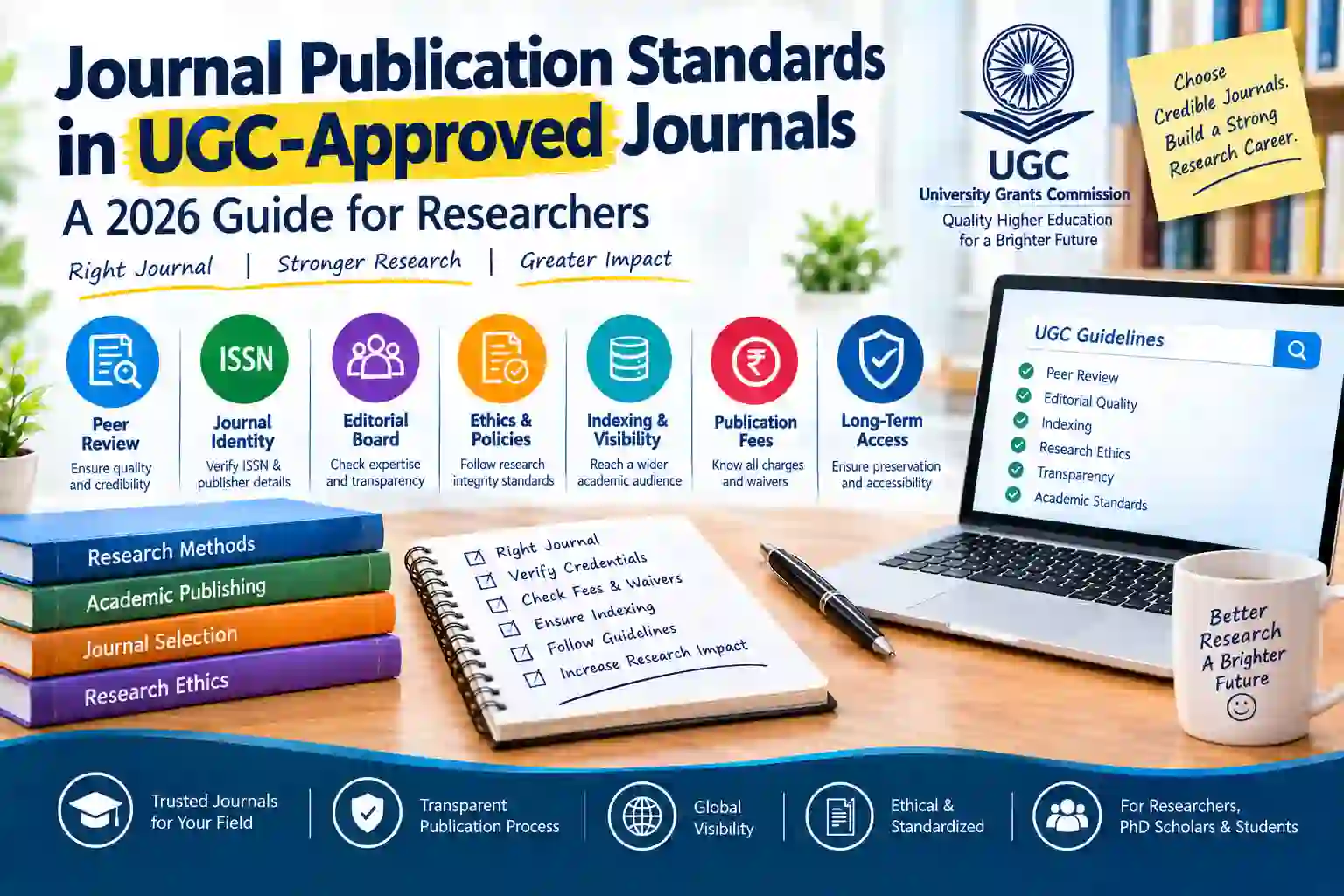
For many researchers in India, searching for UGC approved journals has traditionally been part of the process of selecting a journal for publishing a research paper. However, the academic publishing environment has changed significantly. Researchers should now look beyond a simple “UGC approved” label and examine the journal's peer-review process, editorial standards, publication ethics, transparency, indexing, archiving, and relevance to their field.
This guide explains the journal publication standards researchers should examine in 2026, with particular attention to the criteria introduced by the University Grants Commission (UGC) for choosing peer-reviewed journals.
If you are looking for reliable peer-reviewed research journals and practical publication resources, explore the research and publishing guides available from the Journal of Recent Innovation in Science and Technology.
Is There Still a UGC-Approved Journal List in 2026?
This is the first point researchers should understand before using older articles or websites that advertise a “UGC approved journal list 2026.”
UGC discontinued the UGC-CARE listing of journals. In its public notice dated 16 July 2025, UGC stated that the previously listed 1,474 UGC-CARE journals, as of 10 February 2025, were uploaded for reference purposes only. UGC also clarified that inclusion or exclusion from that historical list does not constitute validation or endorsement by the Commission.
Instead of maintaining a centralized current journal list, UGC approved suggestive parameters for choosing peer-reviewed journals. These parameters are intended to help higher educational institutions, faculty members, researchers, and students assess journals according to their academic requirements.
What Are Journal Publication Standards?
Journal publication standards are the policies and practices that determine how a scholarly journal manages submissions, peer review, editorial decisions, publication ethics, article production, indexing, archiving, and access.
A credible research journal should make these elements sufficiently transparent for authors and readers to evaluate the publication venue before submitting a manuscript.
UGC's current suggestive framework covers several areas, including journal information, editorial governance, journal policies, article quality, publication standards, research ethics, visibility, and citation-related indicators.
1. Verify the Journal Title and ISSN
The first step in evaluating a journal is confirming its identity.
Researchers should check:
- The exact journal title
- Online ISSN (e-ISSN), where applicable
- Print ISSN (p-ISSN), where applicable
- Publisher name
- Official journal website
- Editorial office and contact information
An ISSN identifies a continuing publication, but an ISSN by itself does not prove that a journal is peer reviewed, indexed, or academically recognized. Authors should therefore treat ISSN verification as one part of a broader due-diligence process.
2. Check Whether the Journal Publishes Regularly
Publication continuity is an important indicator of editorial organization.
Before submitting a manuscript, examine the journal's archive and verify whether it publishes according to its stated schedule. Look for:
- Clearly dated issues or articles
- Consistent publication history
- Current and previous volumes
- Clearly displayed publication dates
- Accessible article records
A journal that announces a quarterly schedule, for example, should provide evidence of a consistent publication history rather than relying only on future publication promises.
3. Examine the Peer-Review Policy
Peer review is one of the most important journal publication standards. Researchers should be able to find information explaining how submitted manuscripts are evaluated.
Look for information about:
- Type of peer review
- Reviewer selection
- Number or role of reviewers
- Editorial decision-making
- Revision procedures
- Conflicts of interest
- Expected review timelines
A journal should not promise guaranteed acceptance simply because an author pays a publication fee. Editorial decisions should depend on scholarly quality, relevance, research methodology, and compliance with the journal's policies.
For a broader explanation of the process, researchers can read this complete guide to academic peer-reviewed journals.
4. Review the Editorial Board
A credible journal should clearly identify its editorial leadership.
Researchers can check:
- Editor-in-Chief or chief editor
- Associate or section editors
- Editorial board members
- Institutional affiliations
- Areas of academic expertise
- Professional contact or institutional information where appropriate
Authors should also check whether the listed scholars have genuine academic affiliations and whether their research backgrounds correspond with the journal's stated scope.
5. Check the Journal's Aims and Scope
A manuscript can be technically strong and still be unsuitable for a particular journal if it falls outside the journal's scope.
Before submission, compare your:
- Research question
- Methodology
- Subject area
- Research contribution
- Keywords
- Expected readership
with the journal's stated aims and scope.
Researchers working across multiple disciplines may also benefit from understanding how interdisciplinary research can be positioned for applied science journals.
6. Check Publication Fees Before Submission
Publication fees vary considerably between journals. Some journals have no article processing charge, while others charge APCs after acceptance or use subscription-based publishing models.
A responsible journal should clearly explain:
- Whether a submission fee exists
- Whether an APC applies
- When the fee becomes payable
- Whether taxes or additional charges apply
- Whether waivers or discounts are available
- What services are included in the publication charge
Authors should not select a journal solely because it is inexpensive. A low publication fee does not automatically indicate poor quality, and a high fee does not automatically demonstrate high quality.
For more information, see why a low publication fee does not necessarily mean low quality.
Researchers can also review this complete guide to research paper publication costs and APCs before preparing a submission budget.
7. Understand the Expected Publication Timeline
Authors frequently search for fast publication journals, but publication speed should be evaluated carefully.
A transparent journal should distinguish between:
- Submission and initial screening
- Peer review
- Revision
- Final editorial decision
- Copyediting or production
- Online publication
A short stated timeline is not necessarily evidence of efficient peer review. Researchers should look for a process that balances reasonable turnaround with meaningful scholarly evaluation.
If publication speed is important to you, compare the process with guidance on publishing faster without paying thousands, rather than choosing a journal solely because it advertises rapid acceptance.
8. Examine Article Quality and Academic Contribution
Journal standards do not end with the journal website. The published articles themselves provide valuable evidence about editorial quality.
Read several recent articles and ask:
- Do the articles address meaningful research questions?
- Are research methods adequately explained?
- Are references relevant and current?
- Are conclusions supported by the results?
- Does the research make a clear academic contribution?
- Are tables, figures, and supplementary materials presented appropriately?
Authors should focus on the quality and relevance of their own manuscript rather than attempting to meet a superficial publication formula.
Researchers looking for additional guidance can read how to write and prepare a research paper for publication.
9. Follow Standard Bibliographic and Citation Practices
Professional journal publishing requires accurate bibliographic information.
Authors should carefully check:
- Reference formatting
- In-text citations
- Author names
- Article titles
- Journal titles
- Publication years
- Volume and issue information
- DOIs where available
Incorrect or fabricated references can undermine the credibility of a research paper. Authors should therefore verify important references before submission.
10. Check Research Ethics and Plagiarism Policies
Publication ethics are a central part of responsible scholarly communication.
A journal should provide clear policies concerning issues such as:
- Plagiarism and text similarity
- Duplicate or redundant publication
- Fabrication and falsification
- Authorship
- Conflicts of interest
- Corrections and retractions
- Research misconduct
- Ethical treatment of research participants where applicable
- Use of artificial intelligence in manuscript preparation
Authors should read these policies before submitting a paper rather than assuming that every journal follows identical procedures.
11. Look for a Clear AI Policy
Artificial intelligence has become part of the modern research and publishing workflow. Journals may differ in how they permit authors to use AI tools for language improvement, editing, coding, literature organization, or other tasks.
Researchers should therefore check the journal's current AI policy and disclose AI-assisted work when required.
AI tools should not replace the author's responsibility for the accuracy, originality, citations, methodology, conclusions, and integrity of the research.
12. Examine Indexing and Research Visibility
Indexing claims should always be independently verified.
Do not rely solely on a journal website stating that it is “indexed internationally.” Check the relevant database directly whenever possible.
Depending on your discipline and institutional requirements, researchers may investigate services such as:
- Scopus
- Web of Science
- DOAJ
- Google Scholar
- ROAD
- Other recognized disciplinary or national repositories
Each database has its own inclusion criteria. Being present in one database does not automatically mean that a journal is included in another.
For researchers in computer science and related fields, this guide explains how to use Google Scholar for journal and research discovery.
13. Check the Journal Website
The journal website should make important publishing information easy to locate.
At minimum, authors should be able to find information about:
- Aims and scope
- Editorial board
- Peer-review policy
- Author guidelines
- Publication ethics
- Fees
- Copyright and licensing
- Submission procedure
- Contact information
- Previous and current publications
A professional website should also use a secure connection and provide consistent information across its pages.
14. Check Archiving and Preservation
Long-term access to scholarly literature matters. Authors should investigate how a journal preserves its published content.
Possible preservation mechanisms can include:
- Institutional repositories
- National or international repositories
- Digital preservation services
- Library repositories
- Long-term archival systems
A journal's preservation policy helps reduce the risk of published research becoming inaccessible if the publisher's website changes or experiences technical problems.
15. Understand Open Access and Copyright
Open access does not simply mean that an article can be viewed without a login. Authors should examine the journal's licensing and copyright policies.
Important questions include:
- Who retains copyright?
- Which Creative Commons license is used?
- Can authors share their published work?
- Are there repository rights?
- Is the full text freely accessible?
Researchers should select a publishing model that is compatible with their funding, institutional, and research-sharing requirements.
For additional information, explore this guide to open access research journals.
16. Examine Citation and Impact Information Carefully
Researchers often search for journals using terms such as “high impact,” “high citation,” or “high H-index.” These indicators should be interpreted carefully.
A journal's citation metrics do not determine whether an individual article is scientifically valuable. Citation patterns also vary significantly between disciplines, article types, publication years, and research communities.
Before using a metric in a university application, promotion file, thesis requirement, or research report, verify which metric your institution actually accepts.
17. Beware of Misleading “UGC Approved” Claims
Because “UGC approved journal” remains a popular search phrase, researchers may encounter websites that continue to advertise journals using this terminology.
Before trusting such a claim, ask:
- Is the claim referring to the historical UGC-CARE list?
- Is the journal's inclusion date clearly stated?
- Does the university or institution currently accept that status?
- Is the journal currently indexed in the database it claims?
- Are the ISSN and publisher details verifiable?
- Is the peer-review policy publicly available?
- Are publication fees clearly disclosed?
- Does the journal provide a genuine publication archive?
This distinction is especially important in 2026 because the historical UGC-CARE list should not be treated as a current UGC endorsement.
18. What Researchers Should Check Before Submitting a Paper
A practical journal-selection checklist can help prevent avoidable publication problems.
| Check | What to Verify |
|---|---|
| Journal identity | Title, ISSN, publisher and official website |
| Scope | Subject area and relevance to your manuscript |
| Peer review | Transparent and clearly documented review process |
| Editorial board | Names, affiliations and subject expertise |
| Publication schedule | Regularity and continuity |
| Fees | Submission fees, APCs, waivers and additional charges |
| Ethics | Plagiarism, authorship, conflicts and research-integrity policies |
| AI policy | Rules for AI-assisted writing and research |
| Indexing | Verify claimed databases independently |
| Archiving | Long-term preservation and accessibility |
| Copyright | License, author rights and sharing conditions |
UGC-CARE vs. Current Journal Selection: What Has Changed?
| Earlier Approach | Current Approach |
|---|---|
| UGC-CARE reference list | Historical reference list only |
| Centralized journal listing | Institutional and researcher-level evaluation |
| “UGC approved” terminology | Assessment using peer-review and quality parameters |
| List-based verification | Due diligence across multiple quality indicators |
How to Choose a Journal for Your Research Paper
A practical journal-selection process can be divided into five stages:
Stage 1: Match the Scope
Start with journals that publish research in your exact subject area.
Stage 2: Verify Journal Information
Check the ISSN, publisher, editorial board, publication schedule and official website.
Stage 3: Examine the Review and Ethics Policies
Read the peer-review, plagiarism, authorship, conflict-of-interest and AI policies.
Stage 4: Verify Visibility and Preservation
Check claimed indexing databases and determine whether the journal has a credible archiving or preservation arrangement.
Stage 5: Compare Costs and Timelines
Only after the journal meets your academic requirements should you compare publication fees and expected processing timelines.
Researchers who want to compare different publication models can also review this guide to paid research journals and their advantages and limitations.
Why Low Publication Fees Should Not Be the Main Selection Criterion
Publication cost is an important practical consideration, particularly for students and early-career researchers. However, cost should be evaluated together with editorial quality, peer review, transparency, ethics and discoverability.
A journal with a lower fee may be appropriate when it also demonstrates sound publishing practices. Conversely, a high APC does not by itself demonstrate editorial quality.
Researchers interested in lower-cost options can explore budget-friendly research journals for students and scholars while still applying the same quality checks.
Special Considerations for PhD Scholars and Early-Career Researchers
PhD scholars should pay particular attention to institutional requirements before submitting a manuscript. A university department, doctoral committee, funding agency, or research supervisor may have specific requirements regarding journal indexing, peer review, publication type, authorship, or accepted databases.
Therefore, the correct question is not simply “Is this a UGC approved journal?” Instead, researchers should ask:
- Does this journal satisfy my university's current publication requirements?
- Is its peer-review process transparent?
- Is the journal relevant to my research area?
- Are its indexing claims verifiable?
- Are its publication ethics policies clear?
- Are its fees and publication timelines transparent?
- Will the published article remain accessible and discoverable?
For additional guidance, see journal options and publication considerations for PhD scholars and early-career researchers.
Frequently Asked Questions
Are UGC-CARE journals still active in 2026?
No. The UGC-CARE journal-listing mechanism was discontinued. The historical list of journals as of 10 February 2025 is available for reference, but UGC stated that inclusion or exclusion does not imply current validation or endorsement.
Is there a new UGC-approved journal list for 2026?
Researchers should not assume that there is a new centralized UGC-CARE approved list for 2026. The current framework emphasizes suggestive parameters for choosing peer-reviewed journals and allows higher educational institutions to apply criteria appropriate to their academic requirements.
Does an ISSN mean that a journal is UGC approved?
No. An ISSN identifies a serial publication but does not by itself establish peer-review quality, indexing status, or institutional acceptance.
Are peer-reviewed journals automatically UGC approved?
No. Peer review is an important quality indicator, but researchers should also examine the journal's editorial governance, ethics, publication history, transparency, indexing, archiving and other relevant criteria.
Should researchers still search for “UGC approved journals”?
The phrase remains useful as a search term because it is widely used by researchers, but it should not be interpreted as evidence that a journal currently holds UGC-CARE approval. Researchers should verify current institutional requirements and evaluate the journal using transparent, independently verifiable information.
Does a high publication fee mean a journal is better?
No. Publication fees and academic quality are separate considerations. Researchers should evaluate peer review, editorial standards, ethics, transparency, indexing and relevance rather than using APC alone as a quality indicator.
Final Takeaway
The phrase “UGC approved journal” has become deeply established in Indian academic publishing, but researchers need to understand the current regulatory and publishing context. The UGC-CARE listing mechanism has been discontinued, and the historical list should be treated as a reference rather than a current endorsement.
For researchers selecting a journal in 2026, a stronger approach is to evaluate the complete publication environment: ISSN, scope, editorial board, peer review, publication continuity, fees, research ethics, AI policy, indexing, archiving, copyright and institutional requirements.
Ultimately, choosing a journal should be based on the quality and relevance of the publication venue rather than a single label. A carefully evaluated peer-reviewed journal gives researchers a more reliable basis for submitting and communicating their work.
Related Research and Journal Publishing Guides
- Science journals for innovative research
- Low publication fee journals for computer science and engineering
- Top research journals in computer science
- Peer-reviewed computer science journals for researchers
- Engineering research paper writing and publication practices
- Publishing engineering research papers in peer-reviewed journals
- Future trends in scientific journal publishing
- Research paper submission and call for papers
Editorial note: Researchers should always confirm their university, department, doctoral program, employer, or funding body's current publication requirements before submitting a manuscript.