Reading Time: 12–15 Minutes
Updated: July 2026
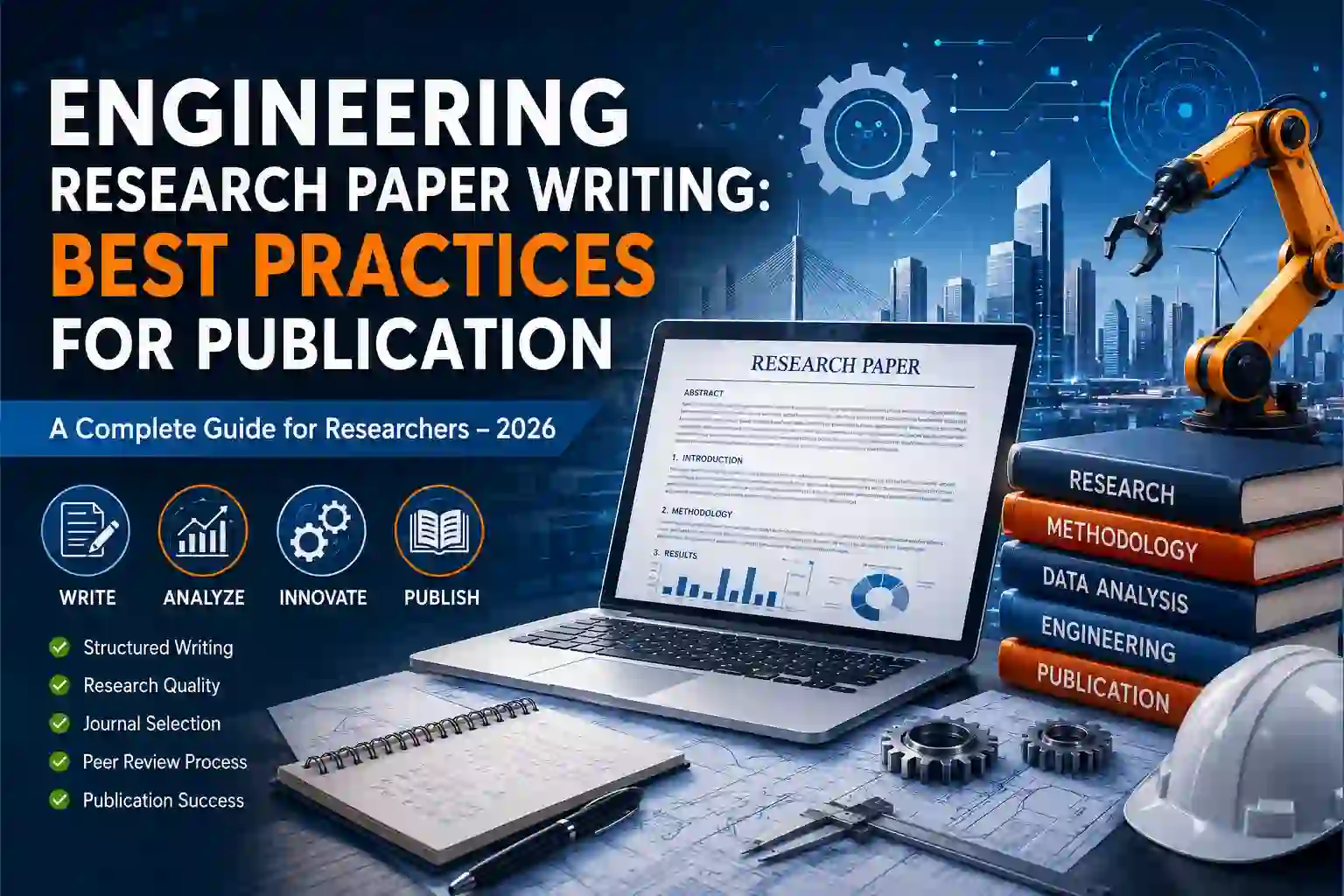
Engineering innovations shape modern society—from sustainable infrastructure and renewable energy systems to artificial intelligence, robotics, semiconductor technologies, and smart manufacturing. Behind every breakthrough lies rigorous research that has been carefully documented, reviewed, and published.
However, conducting outstanding engineering research is only half the journey. Presenting that research effectively in a well-structured manuscript is equally important. Many promising papers are rejected not because the research lacks quality, but because authors struggle with organization, clarity, formatting, methodology presentation, or selecting an appropriate journal.
This comprehensive guide explains the complete process of engineering research paper writing using proven best practices followed by successful researchers worldwide. Whether you're preparing your first manuscript or aiming to publish in high-impact peer-reviewed journals, this guide will help improve your writing quality and publication success.
If you're new to scholarly publishing, you may also find our Mastering Scientific Publishing Guide helpful before beginning your manuscript.
Table of Contents
- Why Engineering Research Paper Writing Matters
- Before You Start Writing
- Planning Your Research Paper
- Building High-Quality Engineering Research
- Setting Publication Goals
Why Engineering Research Paper Writing Matters
Engineering research directly influences technological advancement, industrial innovation, environmental sustainability, healthcare improvements, transportation systems, cybersecurity, automation, and countless other sectors. Publishing your findings enables researchers, engineers, policymakers, educators, and industries worldwide to build upon your work.
A professionally written research paper helps:
- Share innovative engineering solutions globally
- Increase research visibility
- Receive citations from other researchers
- Strengthen academic credibility
- Improve career advancement opportunities
- Support funding applications
- Encourage interdisciplinary collaboration
- Contribute to future technological developments
Publishing in reputable peer-reviewed journals also validates the quality of your research through independent expert evaluation.
If you're still exploring suitable journals, browse our guide on Publishing Engineering Research Papers in Peer-Reviewed Journals .
Before You Start Writing
Successful engineering papers begin long before the first sentence is written. Careful planning dramatically improves both writing efficiency and publication outcomes.
1. Clearly Define Your Research Problem
Every successful engineering paper addresses a specific problem. Rather than attempting to solve multiple unrelated issues, focus on one clearly defined research question.
Ask yourself:
- What engineering challenge am I solving?
- Why is this problem important?
- Who benefits from this research?
- What knowledge gap exists?
- How does my work improve existing solutions?
A clearly defined research objective keeps the manuscript focused and prevents unnecessary content.
2. Conduct an Extensive Literature Review
A strong literature review demonstrates your understanding of previous research while identifying existing limitations.
An effective literature review should:
- Summarize important previous studies
- Identify research gaps
- Compare existing methodologies
- Highlight conflicting findings
- Explain why your research is needed
Avoid simply listing previous studies. Instead, synthesize their findings and explain how they relate to your research objectives.
Planning Your Research Paper
Many authors begin writing without an outline, leading to repetitive content and weak logical flow. Creating a structured writing plan before drafting helps maintain consistency throughout the manuscript.
Create an Outline First
A typical engineering research paper follows this structure:
- Title
- Abstract
- Keywords
- Introduction
- Literature Review
- Methodology
- Experimental Setup
- Results
- Discussion
- Conclusion
- Future Work
- References
Preparing this framework before writing makes the entire process significantly easier and reduces editing time later.
Building High-Quality Engineering Research
Excellent writing cannot compensate for weak research. Before investing time in manuscript preparation, ensure your study demonstrates scientific rigor.
Your Research Should Be:
- Original
- Reproducible
- Technically accurate
- Data-driven
- Ethically conducted
- Well documented
- Properly referenced
- Relevant to current engineering challenges
Engineering journals increasingly prioritize reproducibility, transparency, and availability of supporting datasets. Maintain organized records of experiments, simulations, software versions, design parameters, and statistical analyses throughout your project.
You can also improve your publication strategy by reading our comprehensive Academic Peer-Reviewed Journals Author Guide .
Set Clear Publication Goals
Before writing, identify the journal category you intend to target. Different journals emphasize different aspects of engineering research.
| Journal Type | Typical Focus |
|---|---|
| Applied Engineering | Industrial implementation and practical solutions |
| Computer Science Engineering | Algorithms, AI, cybersecurity, software systems |
| Mechanical Engineering | Manufacturing, design optimization, thermal systems |
| Electrical Engineering | Power systems, electronics, communications |
| Civil Engineering | Infrastructure, structural analysis, smart cities |
| Interdisciplinary Engineering | Cross-domain innovations and emerging technologies |
Selecting an appropriate journal early helps tailor your manuscript to its audience, formatting requirements, and editorial expectations.
Researchers working in computing and information technology can also explore our guide:
Top Computer Science Journal Options for Publishing Research in 2026
Key Takeaways (Part 1)
- High-quality engineering research begins with a clearly defined research problem.
- A strong literature review identifies knowledge gaps and supports your contribution.
- Planning your manuscript before writing improves clarity and organization.
- Well-documented, reproducible research increases publication success.
- Selecting the right journal early helps align your manuscript with editorial expectations.
Continue to Part 2: We will cover the complete structure of an engineering research paper, including how to write an effective title, abstract, introduction, methodology, results, discussion, figures, tables, citations, and common writing mistakes that lead to rejection.
The Standard Structure of an Engineering Research Paper
Most engineering journals follow the internationally accepted IMRAD structure (Introduction, Methods, Results, and Discussion). Organizing your manuscript according to this framework improves readability and helps reviewers evaluate your work efficiently.
Each section has a specific purpose and should contribute logically to the overall narrative of your research.
| Section | Purpose |
|---|---|
| Title | Clearly describe the research topic and contribution. |
| Abstract | Summarize objectives, methods, results, and conclusions. |
| Keywords | Improve discoverability in search engines and indexing databases. |
| Introduction | Present the problem, research gap, objectives, and significance. |
| Literature Review | Discuss previous work and identify existing gaps. |
| Methodology | Explain how the research was conducted. |
| Results | Present findings objectively. |
| Discussion | Interpret results and compare with previous studies. |
| Conclusion | Summarize contributions and suggest future research. |
| References | Cite all sources accurately. |
Writing an Effective Research Paper Title
Your title is the first element that readers, editors, reviewers, and search engines encounter. A clear, informative title significantly improves discoverability and click-through rates.
Characteristics of a Strong Title
- Clearly explains the research topic
- Includes important keywords
- Avoids unnecessary abbreviations
- Describes the primary contribution
- Remains concise and specific
Example
Weak:
Performance Analysis of a New System
Improved:
Performance Evaluation of an AI-Based Fault Detection System for Smart Manufacturing
Notice how the improved title immediately communicates the research domain, technology, and application area.
How to Write an Effective Abstract
The abstract often determines whether readers continue to the full paper. Many editors also use the abstract during the initial screening process.
An engineering abstract should generally contain between 150 and 250 words and briefly explain:
- The research problem
- Objectives
- Methodology
- Main findings
- Practical significance
Avoid
- Lengthy background information
- References
- Undefined abbreviations
- Detailed equations
- Excessive technical jargon
Choosing SEO-Friendly Research Keywords
Keywords help databases index your article correctly and improve search visibility. Select keywords that accurately reflect your research while matching common search terms used by researchers.
For example, a paper on intelligent manufacturing could include:
- Engineering Research
- Artificial Intelligence
- Machine Learning
- Predictive Maintenance
- Industrial Automation
- Fault Detection
- Deep Learning
- Smart Manufacturing
Avoid repeating words already included in the journal title unless specifically recommended by the journal.
Writing a Strong Introduction
The introduction provides the foundation for the entire manuscript. Reviewers expect this section to explain why the research matters before discussing technical details.
A Good Introduction Should:
- Introduce the engineering problem
- Explain current challenges
- Summarize existing research
- Identify the knowledge gap
- Present research objectives
- State the novelty of the work
A Useful Structure
- Background
- Current limitations
- Research gap
- Your proposed solution
- Main contributions
By the end of the introduction, readers should clearly understand what your paper contributes beyond existing literature.
Writing a High-Quality Literature Review
Rather than summarizing papers one by one, organize the literature into themes, methodologies, technologies, or engineering approaches.
A strong literature review demonstrates that your proposed work advances existing knowledge instead of duplicating previous studies.
Best Practices
- Use recent peer-reviewed publications
- Compare different methodologies
- Discuss strengths and weaknesses
- Identify unresolved challenges
- Explain how your work addresses these gaps
For additional guidance on scholarly publishing, read our Complete Author Guide to Academic Peer-Reviewed Journals .
Writing the Methodology Section
The methodology is one of the most carefully reviewed sections of any engineering paper. It must provide enough detail for another researcher to reproduce your work.
Include
- Research design
- Materials
- Equipment
- Software tools
- Simulation environment
- Experimental setup
- Datasets
- Algorithms
- Evaluation metrics
- Statistical methods
Example Components
| Component | Example |
|---|---|
| Software | MATLAB, Python, ANSYS, COMSOL |
| Hardware | GPU workstation, FPGA board, embedded controller |
| Dataset | Public benchmark dataset or experimentally collected data |
| Evaluation | Accuracy, precision, recall, RMSE, F1-score |
Provide sufficient detail while avoiding unnecessary repetition.
Presenting Results Clearly
The Results section should present findings objectively without lengthy interpretation.
Effective engineering papers combine:
- Tables
- Graphs
- Performance comparisons
- Images
- Experimental observations
- Statistical summaries
Tips
- Label every figure clearly.
- Number all tables sequentially.
- Reference each figure within the text.
- Report measurement units consistently.
- Highlight statistically significant findings.
Writing an Insightful Discussion
Unlike the Results section, the Discussion interprets your findings and explains their broader significance.
Address Questions Such As:
- Why did the results occur?
- How do they compare with previous research?
- What engineering implications do they have?
- What limitations remain?
- What future improvements are possible?
Avoid exaggerating the impact of your findings. Balanced discussions build reviewer confidence.
Best Practices for Figures and Tables
Visual elements often communicate engineering concepts more effectively than lengthy text. High-quality graphics also improve reader engagement.
Recommendations
- Use high-resolution images.
- Maintain consistent fonts and formatting.
- Ensure graphs are readable in grayscale if required.
- Avoid unnecessary decorative effects.
- Use descriptive captions.
- Explain every visual element within the text.
Using References Correctly
Accurate referencing demonstrates academic integrity and acknowledges previous contributions.
Most engineering journals require citation styles such as:
- IEEE
- APA
- Vancouver
- Elsevier Harvard
- Springer Nature
Always verify the journal's author guidelines before submission.
Researchers planning their publication strategy should also explore our guide on Publishing Engineering Research Papers in Peer-Reviewed Journals .
Common Mistakes That Lead to Rejection
Editors frequently reject engineering manuscripts because of avoidable writing and presentation issues.
- Poor English grammar
- Unclear research objectives
- Weak literature review
- Insufficient novelty
- Incomplete methodology
- Poor-quality figures
- Incorrect citations
- Overstated conclusions
- Failure to follow journal formatting guidelines
- Ignoring reviewer expectations
Key Takeaways (Part 2)
- Follow the standard IMRAD structure for maximum clarity.
- Craft a concise, keyword-rich title and informative abstract.
- Use a logical introduction that clearly defines the research gap.
- Provide a detailed and reproducible methodology.
- Present results objectively and interpret them thoughtfully in the discussion.
- Use professional figures, tables, and accurate citations.
- Avoid common writing mistakes that frequently lead to manuscript rejection.
Continue to Part 3: Learn how to choose the right engineering journal, navigate the peer-review process, respond to reviewer comments effectively, improve your acceptance rate, and maximize the visibility and impact of your published research through indexing, open access, and strategic publication practices.
Choosing the Right Engineering Journal
Selecting the right journal is one of the most important decisions in the publication process. Even an excellent manuscript may be rejected if it does not align with a journal's scope, audience, or editorial priorities. Before submission, carefully review the journal's aims, recently published articles, indexing status, peer-review process, and author guidelines.
Factors to Consider Before Submission
| Evaluation Factor | Why It Matters |
|---|---|
| Journal Scope | Ensures your topic matches the journal's focus. |
| Peer Review Process | Confirms research quality through expert evaluation. |
| Indexing | Improves visibility and discoverability. |
| Publication Frequency | May affect publication timelines. |
| Acceptance Rate | Provides insight into competitiveness. |
| Publication Ethics | Protects authors and maintains research integrity. |
| Open Access Policy | Determines accessibility for readers worldwide. |
| Author Guidelines | Ensures formatting and submission compliance. |
If you are searching for reputable journals in computing and engineering, explore our guide:
Top Computer Science Journal Options for Publishing Research in 2026
Always Match the Journal Scope
Many manuscripts are rejected during the editor's initial screening because they fall outside the journal's subject area. Before submitting your paper, compare your manuscript with several recently published articles to determine whether your work aligns with the journal's focus.
For example:
- Artificial Intelligence and Machine Learning
- Mechanical Engineering Design
- Electrical and Electronics Engineering
- Civil and Structural Engineering
- Materials Science
- Industrial Engineering
- Environmental Engineering
- Computer Engineering
Choosing a journal with a matching scope significantly improves your chances of progressing to peer review.
Follow the Author Guidelines Carefully
Every engineering journal provides detailed author instructions. Editors often perform an initial technical screening before sending manuscripts for peer review. Failure to follow submission guidelines may result in immediate rejection or requests for technical corrections.
Typical Requirements Include:
- Paper formatting
- Reference style
- Word limits
- Figure resolution
- Table formatting
- Ethics statements
- Conflict of interest declarations
- Data availability statements
- Supplementary materials
Creating a submission checklist before uploading files helps minimize avoidable delays.
Understanding the Peer Review Process
Peer review is the foundation of scholarly publishing. Independent experts evaluate your manuscript for originality, technical quality, methodology, significance, and clarity before publication.
Typical Peer Review Workflow
- Manuscript Submission
- Editorial Screening
- Reviewer Assignment
- Technical Evaluation
- Reviewer Recommendations
- Revision by Authors
- Final Editorial Decision
- Publication
The review process helps improve the quality of published research while maintaining scientific standards.
Learn more about publishing workflows in our guide:
Publishing Engineering Research Papers in Peer-Reviewed Journals
How to Respond to Reviewer Comments
Receiving revision requests is a normal part of academic publishing. Most accepted engineering papers undergo at least one round of revisions before publication.
Best Practices
- Respond politely and professionally.
- Address every reviewer comment individually.
- Clearly indicate where revisions were made.
- Provide evidence when disagreeing respectfully.
- Avoid emotional responses.
- Thank reviewers for their valuable suggestions.
A well-organized response letter demonstrates professionalism and can positively influence the editor's final decision.
Maintain High Publication Ethics
Ethical publishing is essential for maintaining trust within the global research community. Engineering researchers should ensure that every manuscript adheres to accepted ethical standards throughout the research and publication process.
Good Publication Practices
- Submit only original work.
- Avoid plagiarism and self-plagiarism.
- Report data honestly.
- Disclose conflicts of interest.
- Obtain necessary ethical approvals.
- Credit all contributors appropriately.
- Avoid duplicate submissions.
- Respect copyright and licensing requirements.
Strategies to Increase Acceptance Rate
Although no publication can be guaranteed, authors can significantly improve their chances by following proven best practices.
| Strategy | Benefit |
|---|---|
| Target the correct journal | Improves editorial fit |
| Use professional English | Enhances readability |
| Present clear novelty | Demonstrates research contribution |
| Use updated references | Shows awareness of recent developments |
| Follow formatting rules | Reduces technical rejection |
| Include high-quality figures | Improves presentation |
| Proofread multiple times | Removes language errors |
| Request colleague feedback | Identifies weaknesses before submission |
Maximizing the Impact of Your Published Research
Publication is only the beginning of your research journey. Promoting your work responsibly helps increase visibility, readership, and citations.
Ways to Increase Research Impact
- Share your publication through institutional websites.
- Present your work at academic conferences.
- Maintain an updated researcher profile.
- Share accepted manuscripts where permitted by journal policies.
- Collaborate with researchers in related disciplines.
- Use descriptive titles and informative abstracts.
- Select meaningful keywords.
Future Trends in Engineering Research Publishing
Scholarly publishing continues to evolve rapidly. Researchers should stay informed about emerging practices that influence manuscript preparation, peer review, and dissemination.
Emerging Trends
- Artificial intelligence-assisted manuscript screening
- Open science initiatives
- Greater emphasis on research transparency
- Open peer review models
- Data and code sharing requirements
- Machine-readable research metadata
- Enhanced digital publishing platforms
- Improved reproducibility standards
Explore these developments in our articles:
- Future Trends in Scientific Journal Publishing (2026)
- Latest Trends in Scientific Journal Publishing (2026 Guide)
Finding the Right Publication Opportunity
If your engineering research is ready for submission, selecting an active peer-reviewed journal with a transparent editorial process can streamline your publication journey.
Researchers seeking publication opportunities are encouraged to review the latest submission announcements and author guidelines available through our Call for Papers page.
You can also visit the JRIST Homepage to explore the journal's aims, scope, published articles, editorial policies, and submission resources.
Key Takeaways (Part 3)
- Select a journal that closely matches your research topic and audience.
- Carefully follow the journal's author guidelines before submission.
- Understand the peer-review process and respond professionally to reviewer feedback.
- Maintain high ethical standards, including originality, transparency, and accurate reporting.
- Increase your paper's visibility through strategic dissemination and discoverability practices.
- Stay informed about emerging trends in scientific publishing to remain competitive in the evolving research landscape.