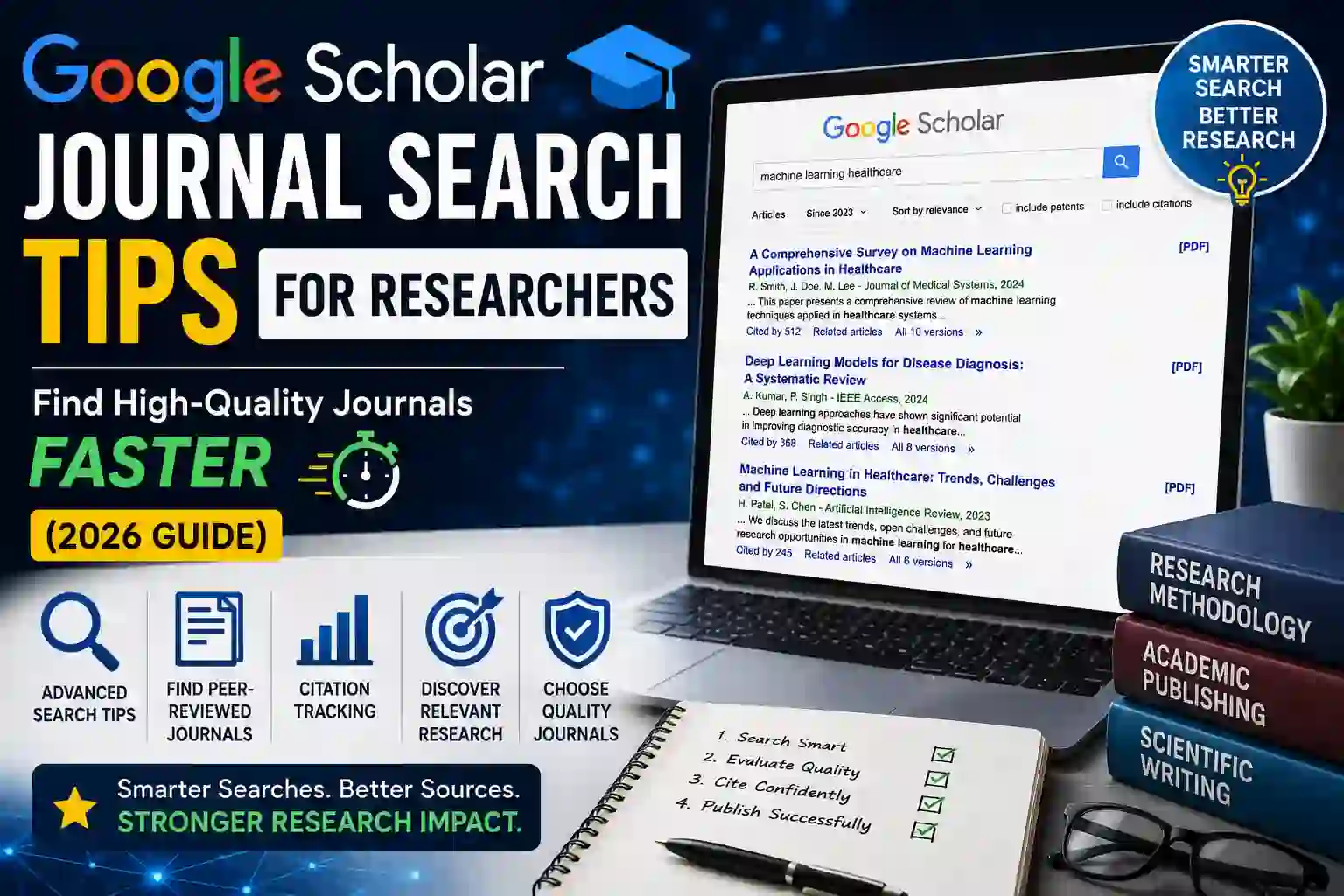
Finding the right research paper shouldn't feel like searching for a needle in a haystack.
Imagine spending weeks preparing your literature review only to discover later that you overlooked a groundbreaking paper that directly relates to your research. Many researchers—from undergraduate students to experienced professors—face this challenge every day. The problem isn't always the lack of available research; it's knowing how to search effectively.
This is where Google Scholar becomes one of the most valuable tools in a researcher's workflow. Unlike a general web search engine, Google Scholar is specifically designed to help users discover scholarly articles, theses, books, conference papers, patents, and citations from reputable academic sources.
However, simply typing a few keywords into the search box often produces thousands of results, many of which may not be relevant to your research question. Learning how to use Google Scholar strategically can save countless hours while helping you identify high-quality journals, influential studies, and emerging research trends.
Whether you are preparing your first manuscript, conducting a systematic literature review, or searching for the ideal journal to publish your work, this guide will provide practical techniques that can significantly improve your research efficiency.
If you're also planning to publish your research, you may find our Academic Peer-Reviewed Journals: Complete Author Guide helpful before submitting your manuscript.
Table of Contents
- What is Google Scholar?
- Why Researchers Should Use Google Scholar
- Benefits Compared to Traditional Search Engines
- Understanding Google Scholar Search Results
- Basic Search Techniques
- Advanced Search Tips
- Finding High-Quality Journals Faster
- Evaluating Research Papers
- Avoiding Common Search Mistakes
- Best Practices for Literature Reviews
- Frequently Asked Questions
Why Google Scholar Matters More Than Ever in 2026
The volume of scientific publications continues to grow rapidly every year. Thousands of new journal articles are published daily across engineering, computer science, medicine, environmental science, data science, artificial intelligence, and countless other disciplines.
Without an efficient search strategy, researchers can quickly become overwhelmed.
Google Scholar helps organize this enormous body of scholarly information by indexing publications from:
- Academic journals
- Universities
- Research institutions
- Conference proceedings
- Books
- Preprint repositories
- Professional societies
- Publisher databases
Because it aggregates content from multiple academic sources, Google Scholar often becomes the first stop for researchers beginning a new project.
What Is Google Scholar?
Google Scholar is a free academic search engine that indexes scholarly literature across a wide range of disciplines. Instead of searching the general web, it focuses specifically on academic publications and related research outputs.
Researchers use Google Scholar to:
- Search scholarly articles
- Locate peer-reviewed journals
- Find highly cited papers
- Track citations
- Discover influential authors
- Explore related research
- Access open-access publications
- Build literature reviews
Unlike subscription-based databases, Google Scholar provides broad access without requiring institutional login for searching, making it an excellent starting point for researchers worldwide.
Why Researchers Prefer Google Scholar
There are many academic databases available today, but Google Scholar remains popular because of its simplicity, accessibility, and extensive coverage.
Some of its biggest advantages include:
- Free to use
- Simple interface
- Broad multidisciplinary coverage
- Citation tracking
- Related article suggestions
- Author profiles
- Access to multiple publishers
- Integration with citation managers
Whether your research focuses on computer science, mechanical engineering, electronics, environmental science, or interdisciplinary studies, Google Scholar provides a centralized platform for discovering relevant scholarly literature.
Google Scholar vs. Traditional Google Search
| Google Search | Google Scholar |
|---|---|
| Indexes general websites | Indexes scholarly publications |
| Blogs, news, commercial sites | Academic journals and conference papers |
| SEO determines rankings | Academic relevance and citations influence visibility |
| General web content | Scientific research |
| Popular websites | Peer-reviewed literature |
For serious academic work, Google Scholar provides far more relevant results than a conventional search engine.
Who Should Use Google Scholar?
Google Scholar is valuable for researchers at every stage of their academic journey.
- Undergraduate students
- Master's students
- PhD scholars
- Faculty members
- Research scientists
- Industry researchers
- Engineers
- Medical professionals
- Data scientists
- Policy researchers
Even experienced researchers regularly rely on Google Scholar to stay informed about newly published studies within their field.
When Should You Use Google Scholar?
Google Scholar is useful throughout the entire research lifecycle.
Before Starting Research
Search existing literature to understand what has already been studied and identify knowledge gaps.
During Literature Review
Locate highly cited publications and recent advances relevant to your topic.
While Writing Your Manuscript
Verify references, compare methodologies, and strengthen your discussion with recent evidence.
Before Selecting a Journal
Analyze where similar studies have been published and identify journals that regularly accept research related to your topic.
If you're unsure how to choose an appropriate journal, read our guide on Top Computer Science Journal Options for Publishing Research in 2026.
Common Challenges Researchers Face
Despite its simplicity, many researchers fail to use Google Scholar efficiently.
Common problems include:
- Using overly broad keywords
- Ignoring advanced search features
- Reading only the first few results
- Not checking citation counts
- Missing recently published papers
- Choosing unsuitable journals
- Confusing conference papers with journal articles
- Failing to evaluate source quality
Fortunately, these issues can be avoided with a few practical search strategies, which we'll explore in the next sections.
The Importance of Finding High-Quality Journals
Finding a relevant article is only part of the research process. Researchers must also evaluate the quality and credibility of the journals where those studies are published.
High-quality journals typically demonstrate:
- Rigorous peer review
- Transparent editorial policies
- Experienced editorial boards
- Consistent publication schedules
- Ethical publishing practices
- Wide visibility within the academic community
Selecting trustworthy sources improves both the quality of your literature review and the credibility of your own research.
For more guidance on journal evaluation, see our article Best Peer-Reviewed Computer Science Journals for Researchers.
How Google Scholar Supports Better Publishing Decisions
Beyond literature discovery, Google Scholar can help you identify suitable publication venues by revealing where influential papers in your field have been published.
By reviewing multiple highly cited articles on your topic, you can identify journals that consistently publish similar research, helping you make more informed submission decisions.
If you're preparing a manuscript for publication, you may also benefit from these resources:
- Mastering Scientific Publishing: How to Write a Research Paper That Gets Published
- Publishing Engineering Research Papers in Peer-Reviewed Journals
- Struggling to Publish Interdisciplinary Research? Here's How to Get Accepted by Applied Science Journals
What's Coming in Part 2?
Now that you understand why Google Scholar is an essential research tool, the next section will focus on advanced search techniques that help you locate high-quality journal articles more efficiently. You'll learn how to use search operators, filters, citation tracking, author searches, related articles, and other powerful features to streamline your literature review and identify the best journals for your research.
Master Google Scholar Search Like a Research Professional
Many researchers use Google Scholar exactly like a regular search engine—typing a few words and clicking the first result. While this approach may occasionally produce useful articles, it often overlooks highly relevant publications hidden deeper in the search results.
Learning a few advanced search techniques can dramatically improve both the quality and efficiency of your literature review. Instead of spending hours filtering irrelevant articles, you can quickly discover authoritative papers, influential authors, and the journals most relevant to your research.
Start with Specific Keywords
The quality of your search results depends largely on the keywords you choose. Broad search terms often produce thousands of unrelated papers, while carefully selected phrases narrow the results to studies that closely match your research objectives.
Example of a Broad Search:
Artificial Intelligence
This query returns millions of results covering every application of AI.
A More Specific Search:
Artificial Intelligence for Predictive Maintenance in Smart Manufacturing
This targeted query is much more likely to return articles directly relevant to industrial engineering and manufacturing systems.
As your research progresses, continue refining your keywords to reflect the specific technologies, methods, and application domains involved in your study.
Use Quotation Marks for Exact Phrases
Quotation marks tell Google Scholar to search for the exact phrase instead of individual words appearing in any order.
Without Quotes:
deep learning healthcare diagnosis
With Quotes:
"deep learning for healthcare diagnosis"
This simple technique significantly improves result accuracy, especially for established research topics or commonly used technical terms.
Combine Keywords Using Boolean Logic
Boolean operators help broaden or narrow your search depending on your research goals.
| Operator | Purpose | Example |
|---|---|---|
| AND | Include both concepts | Machine Learning AND Cybersecurity |
| OR | Search alternative terms | IoT OR Internet of Things |
| - (Minus) | Exclude unwanted topics | Blockchain -Cryptocurrency |
Using these operators helps eliminate irrelevant results and ensures your searches remain focused.
Use the Advanced Search Feature
Many researchers overlook Google Scholar's Advanced Search options, which allow you to search more precisely by:
- Exact phrase
- Specific author
- Publication name
- Date range
- Title-only search
- Keywords appearing anywhere in the article
These filters become particularly valuable when conducting systematic literature reviews or preparing manuscripts for publication.
Filter Results by Publication Year
Research evolves rapidly, especially in fields such as Artificial Intelligence, Data Science, Computer Engineering, and Environmental Technology.
Limiting results to recent years helps you identify the latest developments.
Example:
- Past Year
- Since 2024
- Custom Range (2021–2026)
For emerging technologies, prioritizing recent publications ensures your literature review reflects current knowledge.
Sort by Relevance or Date
Google Scholar provides two useful sorting options.
| Sorting Method | Best Use |
|---|---|
| Relevance | Finding influential foundational papers |
| Date | Tracking the newest research developments |
Researchers should use both approaches during different stages of their literature review.
Use the "Cited By" Feature
One of Google Scholar's most powerful tools is the Cited by feature.
Instead of reading only one paper, you can explore every newer study that has cited it.
This allows you to:
- Track research evolution
- Identify influential publications
- Discover current methodologies
- Find emerging research directions
- Locate active research groups
Highly cited articles often serve as the foundation of a strong literature review.
Explore "Related Articles"
Another overlooked feature is Related Articles.
Rather than searching repeatedly with different keywords, Google Scholar automatically recommends studies that share similar topics, methodologies, or citation patterns.
This feature is particularly useful when:
- Expanding a literature review
- Discovering interdisciplinary research
- Finding similar methodologies
- Exploring neighboring research fields
Search by Author
If you identify an influential researcher, searching by author name can quickly reveal their complete body of work.
Benefits include:
- Finding related publications
- Identifying research collaborations
- Following ongoing projects
- Discovering highly cited papers
Many leading researchers publish multiple studies within the same research area, making author searches extremely valuable.
Search Within Specific Journals
If you've already identified a reputable journal, search directly within that publication.
This helps you:
- Understand the journal's scope
- Study writing styles
- Identify common methodologies
- Evaluate publication standards
Before selecting a journal, review several recently published articles to ensure your manuscript aligns with its editorial focus.
Our guide on Top Computer Science Journal Options for Publishing Research in 2026 provides additional advice for choosing appropriate publication venues.
Identify Highly Cited Research Papers
Citation counts provide useful insight into a paper's academic influence.
Although citations should never be the only measure of quality, highly cited publications often represent:
- Foundational theories
- Widely accepted methodologies
- Benchmark datasets
- Influential review articles
- Landmark discoveries
Including these papers strengthens the credibility of your literature review.
Evaluate Journal Quality Before Reading
Not every journal indexed by Google Scholar maintains the same editorial standards.
Before investing time in reading multiple articles from a journal, evaluate:
- Peer-review process
- Editorial board
- Publication ethics
- Article quality
- Journal transparency
- Publishing history
For additional guidance, read our comprehensive resource:
Academic Peer-Reviewed Journals: Complete Author Guide
Create a Personal Research Library
As your literature review grows, keeping track of articles becomes increasingly important.
Develop a consistent system for organizing:
- Journal articles
- Conference papers
- Review papers
- Datasets
- Research notes
- Citation information
Using reference management software alongside Google Scholar can significantly reduce citation errors and save time during manuscript preparation.
Analyze Publication Trends
Google Scholar can also help identify emerging research areas.
Notice patterns such as:
- Increasing publication volume
- Frequently occurring keywords
- Popular research methods
- Leading institutions
- International collaborations
Understanding these trends helps researchers identify promising future research opportunities.
For insights into where academic publishing is heading, explore:
- Latest Trends in Scientific Journal Publishing (2026 Guide)
- Future Trends in Scientific Journal Publishing
How Google Scholar Helps You Choose the Right Journal
Google Scholar is not only useful for finding literature—it can also guide your journal selection strategy.
Review several high-quality papers similar to your own and note:
- Which journals publish comparable studies?
- How interdisciplinary are the published articles?
- What research methods are commonly accepted?
- What writing style does the journal prefer?
This approach helps ensure that your manuscript is submitted to a journal where it has the greatest chance of acceptance.
If you're preparing your first submission, these resources may also be helpful:
- Mastering Scientific Publishing: How to Write a Research Paper That Gets Published
- Publishing Engineering Research Papers in Peer-Reviewed Journals
- Struggling to Publish Interdisciplinary Research? Here's How to Get Accepted by Applied Science Journals
Coming Up in Part 3
In the final section, we'll cover how to identify peer-reviewed and trustworthy journals, avoid predatory publishers, conduct an efficient literature review, manage citations, avoid common Google Scholar mistakes, answer frequently asked questions, and provide a practical checklist to help you find high-quality journals faster and publish your research with confidence.
How to Identify High-Quality Journals Using Google Scholar
Finding relevant research papers is only one part of the research process. Equally important is evaluating the quality of the journals where those papers are published.
Publishing in or citing reputable journals improves the credibility of your research and increases the likelihood that your work will be respected by editors, reviewers, and fellow researchers.
Google Scholar itself does not rank journals based on quality, but it provides several indicators that can help you evaluate whether a journal is suitable for your research.
Signs of a High-Quality Journal
Before trusting or submitting to a journal, evaluate the following characteristics:
| Indicator | Why It Matters |
|---|---|
| Peer Review | Ensures research has been evaluated by subject experts. |
| Editorial Board | Experienced editors improve publication quality. |
| Publication Ethics | Demonstrates commitment to academic integrity. |
| Consistent Publication Schedule | Shows reliability and professionalism. |
| Clear Author Guidelines | Indicates transparent editorial processes. |
| Research Quality | Published articles demonstrate originality and scientific rigor. |
Evaluate Individual Articles Before Citing Them
Not every article found through Google Scholar deserves to be included in your literature review.
Ask yourself:
- Does the paper directly relate to my research question?
- Was it published in a reputable journal?
- Is the methodology scientifically sound?
- Are the conclusions supported by evidence?
- Has the work been cited by other researchers?
- Is the article reasonably current for my field?
Quality should always take priority over quantity.
How to Avoid Predatory Journals
Unfortunately, not every journal that appears online follows accepted scholarly publishing standards. Predatory journals often promise rapid publication while providing little or no meaningful peer review.
Before submitting your manuscript, verify that the journal has:
- A clearly defined peer-review process.
- Transparent publication policies.
- An identifiable editorial board.
- Published issues with genuine research articles.
- Complete contact information.
- Ethical publishing guidelines.
- A realistic review timeline.
Never choose a journal solely because it promises quick publication. Quality and credibility should always come first.
Build an Effective Literature Review Using Google Scholar
A strong literature review demonstrates your understanding of existing research while identifying gaps that justify your own study.
Instead of collecting hundreds of unrelated articles, focus on building a structured collection of high-quality sources.
Step 1: Identify Foundational Papers
Begin with highly cited publications that introduced important theories or methodologies.
Step 2: Find Recent Studies
Use date filters to locate the newest developments in your research area.
Step 3: Compare Methodologies
Analyze how different researchers approached similar problems.
Step 4: Identify Research Gaps
Look for unanswered questions, inconsistent findings, or opportunities for interdisciplinary collaboration.
Step 5: Organize References
Group articles by themes, methodologies, or application areas rather than publication date alone.
Google Scholar Tips for Finding the Right Journal
If your goal is publication rather than literature review, Google Scholar can also help identify suitable journals.
Review several papers similar to your manuscript and note:
- Which journals publish related work?
- How broad is the journal's scope?
- What writing style is commonly used?
- What research methods are frequently accepted?
- How interdisciplinary are the published studies?
This simple strategy significantly improves journal selection and reduces the likelihood of desk rejection.
Researchers preparing manuscripts should also explore our guide:
Common Google Scholar Mistakes Researchers Should Avoid
| Mistake | Recommended Practice |
|---|---|
| Using very broad keywords | Use specific technical phrases and search operators. |
| Ignoring publication dates | Balance foundational papers with recent research. |
| Reading only first-page results | Explore multiple pages and related articles. |
| Ignoring citation counts | Use citations to identify influential studies. |
| Not checking journal quality | Evaluate editorial standards before citing or submitting. |
| Using outdated references exclusively | Include recent publications whenever appropriate. |
| Failing to organize references | Maintain a structured reference library. |
Google Scholar Best Practices Checklist
- ✔ Start with precise keywords.
- ✔ Use quotation marks for exact phrases.
- ✔ Apply date filters when necessary.
- ✔ Examine citation counts.
- ✔ Explore "Related Articles."
- ✔ Search by author for leading researchers.
- ✔ Compare multiple journals before submitting.
- ✔ Read recent review articles.
- ✔ Verify journal credibility.
- ✔ Organize references throughout your project.
Frequently Asked Questions
Is Google Scholar free?
Yes. Anyone can use Google Scholar to search scholarly literature without paying subscription fees. However, access to some full-text articles may depend on publisher policies or institutional subscriptions.
Can I use Google Scholar for a literature review?
Absolutely. Google Scholar is one of the most widely used tools for discovering scholarly articles, identifying influential studies, and building comprehensive literature reviews.
Does Google Scholar include peer-reviewed journals?
Yes. Google Scholar indexes many peer-reviewed journals along with conference papers, books, theses, and other scholarly materials. Researchers should still verify the quality and credibility of individual journals before citing or submitting.
How do I know whether a journal is suitable for my manuscript?
Review the journal's aims and scope, recent publications, author guidelines, and editorial policies. Comparing your manuscript with previously published articles is one of the best ways to evaluate journal suitability.
How often should I update my literature review?
Researchers should periodically repeat their searches throughout a project to capture newly published studies that may strengthen their manuscript.
Final Thoughts
Google Scholar is much more than a simple academic search engine. When used strategically, it becomes a powerful research assistant that helps you discover influential papers, evaluate journal quality, identify research trends, and make informed publishing decisions.
Developing effective search habits not only saves valuable time but also improves the quality of your literature review, strengthens your manuscript, and increases your chances of publishing in respected peer-reviewed journals.
Whether you are beginning your first research project or preparing your next journal submission, mastering Google Scholar will remain an essential skill throughout your academic career.
Continue Learning with JRIST Resources
Expand your publishing knowledge with these practical guides:
- Journal of Recent Innovation in Science and Technology (JRIST)
- Current Call for Papers
- Academic Peer-Reviewed Journals: Complete Author Guide
- Mastering Scientific Publishing: How to Write a Research Paper That Gets Published
- Publishing Engineering Research Papers in Peer-Reviewed Journals
- Top Computer Science Journal Options for Publishing Research in 2026
- Best Peer-Reviewed Computer Science Journals for Researchers
- Latest Trends in Scientific Journal Publishing (2026 Guide)
- Future Trends in Scientific Journal Publishing
- How to Get Accepted by Applied Science Journals
Ready to Publish Your Research?
If you're looking for a multidisciplinary platform that welcomes innovative research in computer science, engineering, applied sciences, and emerging technologies, consider submitting your manuscript to JRIST. Visit our Call for Papers to learn about current submission opportunities, author guidelines, and upcoming issues.