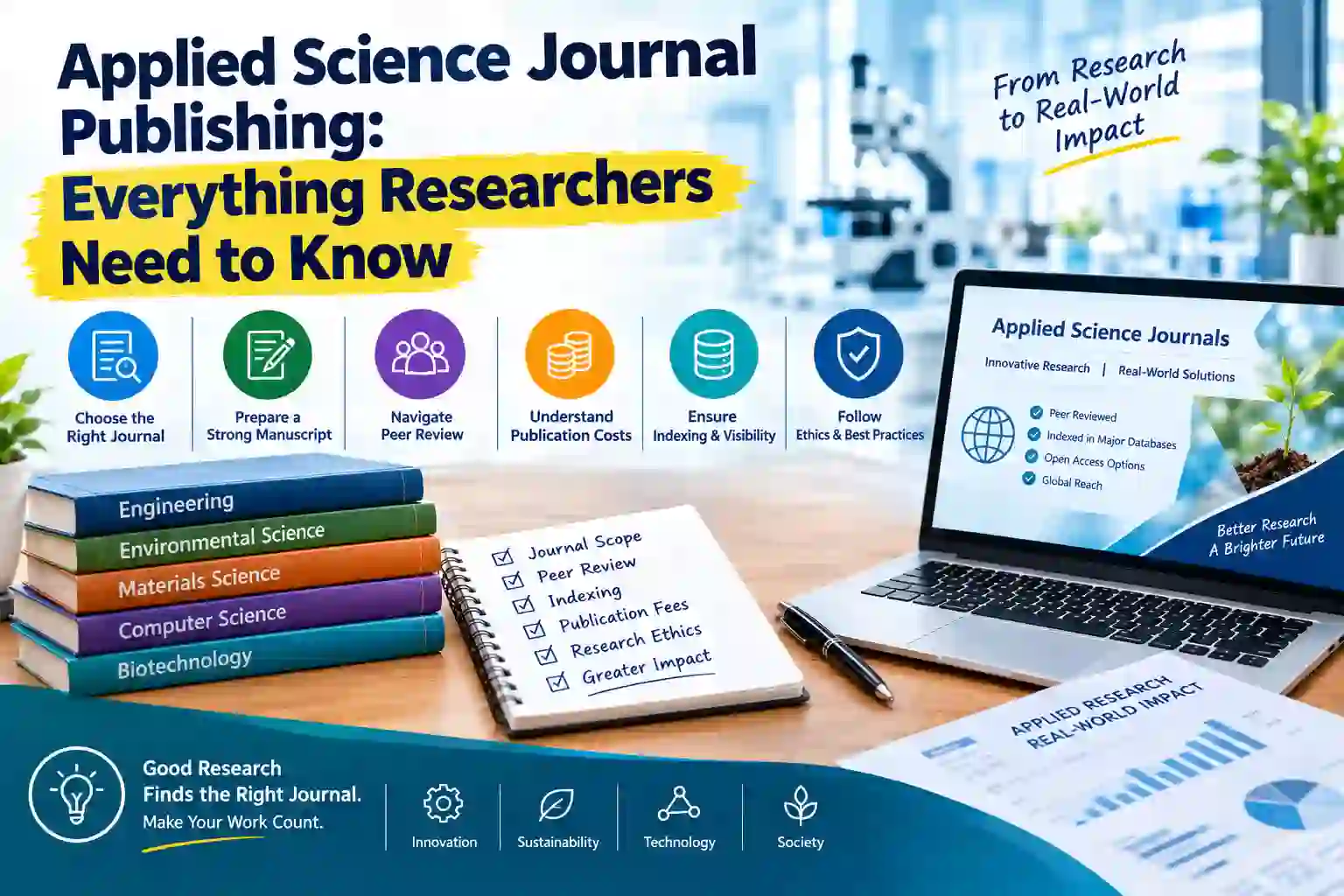
Applied science journal publishing connects research findings with practical problems in technology, engineering, industry, healthcare, environmental systems, computing, materials, energy, and other areas where scientific knowledge can be translated into useful applications.
For researchers, publishing applied science research is about more than finding a journal that accepts manuscripts. The journal should be relevant to the research question, appropriate for the intended audience, transparent about peer review and publication policies, and suitable for the academic or professional requirements of the author.
This complete guide explains how to select an applied science journal, prepare a strong manuscript, evaluate peer review and indexing claims, understand publication costs, avoid common submission mistakes, and improve the long-term visibility of published research.
Researchers beginning their journal search can explore research journals and publication resources before narrowing their selection to a particular scientific discipline.
What Is Applied Science?
Applied science focuses on using scientific knowledge, methods, and evidence to address practical problems or develop solutions for real-world applications. It often sits between fundamental scientific investigation and practical implementation.
For example, an applied research project may investigate:
- A new material for an engineering application
- An optimization method for an industrial process
- A machine-learning model for a practical problem
- An energy-efficient technology
- A water or environmental treatment method
- A manufacturing process improvement
- A computational technique for solving an engineering problem
- A sensor or electronic system for monitoring real-world conditions
- A medical or biological technology with practical applications
Applied research can therefore cross traditional disciplinary boundaries. A single study may combine computer science, engineering, mathematics, environmental science, materials science, or other fields.
Why Applied Science Publishing Is Different
Applied research is often evaluated on two complementary dimensions: the scientific strength of the investigation and the usefulness or significance of its application.
A technically sophisticated study may still be difficult to publish if the practical problem is poorly defined. Similarly, a promising application may not be convincing without a rigorous methodology and reliable evidence.
A strong applied science paper should therefore answer three fundamental questions:
- What scientific or technical problem is being investigated?
- What evidence supports the proposed solution or finding?
- Why does the result matter in a practical or research context?
This balance between scientific rigor and practical relevance should influence both manuscript preparation and journal selection.
What Types of Research Are Published in Applied Science Journals?
Applied science is broad, and different journals specialize in different research areas. Common categories include:
| Applied Science Area | Examples of Research Topics |
|---|---|
| Engineering | Design, manufacturing, materials, structures, energy systems, automation and optimization |
| Computer Science | Artificial intelligence, machine learning, software systems, data analytics and cybersecurity applications |
| Electronics | Sensors, embedded systems, communication technologies, circuits and intelligent devices |
| Environmental Science | Pollution control, water treatment, waste management, environmental monitoring and sustainability |
| Energy | Renewable energy, energy efficiency, storage, conversion and smart energy systems |
| Materials Science | Material development, characterization, composites, coatings and performance testing |
| Industrial Applications | Process optimization, automation, reliability, quality control and production systems |
| Interdisciplinary Science | Research combining multiple scientific and technological disciplines to address a practical problem |
How to Choose the Right Applied Science Journal
Journal selection is one of the most important decisions in the publication process. A journal should be selected because it is appropriate for the research, not simply because it advertises a rapid publication timeline or a particular metric.
1. Start With the Journal's Scope
Read the journal's aims and scope carefully before preparing your submission.
Do not rely only on the journal title. Examine recently published papers and determine whether researchers are publishing work similar to yours.
For broader guidance on evaluating scientific publication venues, see our guide to science journals for innovative research.
2. Examine Recent Articles
Recent publications are one of the most useful sources of evidence when evaluating journal suitability.
Look at several recent articles and ask:
- Do they address similar research problems?
- Are the methodologies comparable?
- Does the journal publish experimental, computational, theoretical, or review research relevant to your manuscript?
- Are the intended readers likely to be interested in your findings?
- Does the quality and presentation of the published research meet your expectations?
3. Check the Peer-Review Process
A credible scholarly journal should provide clear information about how submitted manuscripts are evaluated.
Researchers should look for information about:
- Editorial screening
- Peer-review methodology
- Reviewer selection or responsibilities
- Revision procedures
- Editorial decisions
- Conflicts of interest
Avoid selecting a journal simply because it promises guaranteed acceptance or publication regardless of the manuscript's quality.
Authors who want a broader understanding of peer-reviewed publishing can read this guide to academic peer-reviewed journals.
4. Verify Indexing Claims
Indexing can affect how easily published research is discovered and may also be important for university, doctoral, funding, or promotion requirements.
However, researchers should distinguish between different types of scholarly databases. Being discoverable through a scholarly search engine is not necessarily equivalent to being indexed in every selective bibliographic database.
When indexing is important, verify the journal directly through the relevant database and check the journal's ISSN where possible.
5. Evaluate the Editorial Board
Review the journal's editorial board and determine whether its members have identifiable academic or professional expertise relevant to the journal's scope.
An editorial board should not be judged simply by the number of names displayed. Researchers should also look for transparent affiliations, appropriate subject expertise, and clearly described editorial responsibilities.
What Makes a Strong Applied Science Research Paper?
A strong applied science manuscript should demonstrate a logical connection between the research problem, methodology, evidence, and practical implications.
A typical research paper should clearly explain:
- The problem or application being addressed
- The existing knowledge and research gap
- The objective of the study
- The proposed approach or methodology
- The experimental, computational, or analytical procedure
- The results
- The limitations of the study
- The practical or scientific implications
- The contribution compared with previous work
Researchers should avoid describing an application as innovative without explaining what is actually new. Novelty should be demonstrated through comparison with relevant prior research.
How to Write the Introduction of an Applied Science Paper
The introduction should establish the problem before presenting the proposed solution.
A useful structure is:
- Introduce the broader scientific or technological problem.
- Explain why the problem matters.
- Summarize relevant previous research.
- Identify a specific limitation, gap, or unresolved problem.
- Explain how the current study addresses that gap.
- State the main objectives or contributions.
The introduction should not become a long literature summary without a clear research question. The reader should understand why the study was necessary by the end of the section.
Methodology Is Central to Applied Research
Applied science readers need enough methodological information to understand how the findings were produced and evaluate whether the conclusions are supported by the evidence.
Depending on the research area, this may include:
- Experimental setup
- Materials and equipment
- Dataset characteristics
- Software or computational environment
- Mathematical models
- Simulation parameters
- Sampling procedures
- Statistical methods
- Performance metrics
- Validation procedures
A paper should also acknowledge important limitations. Transparent reporting of limitations generally provides readers with a more accurate understanding of what the research demonstrates.
Results and Discussion: Show the Evidence
The results section should present findings clearly and systematically. Tables, graphs, figures, equations, or other technical representations should be used when they improve understanding.
The discussion should then explain what the results mean.
Researchers should avoid simply repeating numerical results in the discussion. Instead, explain:
- How the findings relate to the research objective
- Whether the results support the original hypothesis or expectation
- How the findings compare with previous studies
- Why differences may have occurred
- What the findings mean for practical applications
- What limitations affect interpretation
- What research should be conducted next
Interdisciplinary Applied Research
Many applied science problems do not fit neatly into one discipline. A smart manufacturing study, for example, might combine mechanical engineering, computer vision, artificial intelligence, automation, and data analytics.
Interdisciplinary research can be highly valuable, but journal selection becomes more important because the manuscript needs to satisfy readers from potentially different backgrounds.
If your research combines several fields, consider whether a multidisciplinary or applied-science journal explicitly welcomes interdisciplinary work.
Researchers facing this situation may find our guide on publishing interdisciplinary research in applied science journals useful.
Applied Science Journal Publishing and Publication Fees
Publication costs vary considerably among journals. Some journals charge APCs, while others operate through subscription, institutional, society, grant, or other funding models.
Before submitting, determine whether the journal charges:
- Submission fees
- Article processing charges
- Page charges
- Color or supplementary-material charges
- Other mandatory publication fees
Also check whether the journal provides waivers or discounts and whether eligibility must be established before submission.
Researchers comparing publication expenses can consult this complete guide to research paper publication costs and APCs.
Does a Low-Cost Journal Mean Lower Academic Quality?
Not necessarily. A journal's publication fee does not by itself establish the quality of its peer review, editorial process, or published research.
Some journals can operate with low or no author charges because they have alternative funding arrangements. Conversely, a high APC does not automatically prove that a journal has stronger academic standards.
Researchers should therefore assess the complete publication environment rather than using price as a shortcut for quality.
Read our detailed discussion of why low publication fees do not necessarily mean low quality.
Open Access in Applied Science Publishing
Open-access publishing can make research available to readers without a conventional subscription barrier. This can be particularly useful for applied research that may interest academics, industry professionals, engineers, policymakers, educators, or practitioners.
However, open access should not be treated as a quality indicator by itself.
When evaluating an open-access journal, researchers should still investigate:
- Peer-review procedures
- Editorial standards
- Research ethics
- Indexing and discoverability
- Licensing
- Publication fees
- Long-term preservation
The publishing model and the journal's scholarly standards should be evaluated separately.
How to Evaluate Journal Impact for Applied Research
Researchers often search for "high-impact applied science journals." However, journal impact can be difficult to summarize with a single number.
Citation-based indicators can provide useful information, but different metrics use different databases, time periods, and calculation methods.
Researchers should therefore consider multiple indicators:
- Journal citation indicators
- Research visibility
- Relevant indexing
- Article-level citations
- Subject-specific reputation
- Readership and audience
- Editorial and peer-review standards
Most importantly, a journal metric should not replace assessment of whether the journal is appropriate for the manuscript.
For additional discussion of publishing in established scientific venues, see this guide on publishing research in high-impact scientific journals.
How to Improve the Discoverability of an Applied Science Paper
Publication is only the beginning of a research paper's lifecycle. Researchers also need to make their work easy for other scholars to discover and understand.
Use a Precise Title
A good title should communicate the subject, method, application, or major contribution without unnecessary wording.
Write a Useful Abstract
The abstract should clearly summarize the problem, approach, major findings, and significance of the study.
Choose Appropriate Keywords
Keywords should reflect the terminology researchers actually use when searching for literature in the field.
Maintain High-Quality Metadata
Accurate author names, affiliations, article titles, abstracts, keywords, references, and persistent identifiers help scholarly systems process and discover research.
Use Persistent Identifiers Where Available
A DOI can provide a persistent mechanism for identifying a published article and can support citation and discovery workflows.
Researchers interested in improving scholarly discovery can also read these Google Scholar search tips for researchers.
Research Ethics in Applied Science Publishing
Ethical publishing is an essential part of credible applied research.
Depending on the study, authors may need to address:
- Authorship and contributor responsibilities
- Conflicts of interest
- Funding disclosure
- Data availability
- Plagiarism and text reuse
- Image manipulation
- Human or animal research approvals where applicable
- Duplicate or redundant publication
- Research misconduct
Authors should follow the journal's ethical requirements and accurately report how the research was conducted.
Common Reasons Applied Science Papers Are Rejected
Rejection does not necessarily mean that the research is poor. A manuscript may be rejected because it is unsuitable for the journal, insufficiently developed, unclear, or unable to demonstrate a convincing contribution.
Common problems include:
- Mismatch between manuscript and journal scope
- Unclear research question
- Insufficient explanation of novelty
- Weak literature review
- Incomplete methodology
- Unsupported conclusions
- Poor-quality figures or tables
- Insufficient validation
- Failure to address limitations
- Weak technical writing
- Failure to follow author guidelines
Careful manuscript preparation can prevent many avoidable problems.
For additional guidance, see our resource on how to write and prepare a research paper for publication.
How to Prepare an Applied Science Manuscript Before Submission
Use this preparation sequence before uploading your manuscript:
- Confirm the journal scope. Make sure your research fits the journal's stated subject area.
- Read the author guidelines. Check article structure, word limits, formatting, figures, references, and supplementary materials.
- Check the manuscript structure. Ensure that the research problem, methodology, results, and conclusions are logically connected.
- Verify references. Check citations for accuracy and consistency.
- Review figures and tables. Make sure they are readable, correctly labeled, and discussed in the manuscript.
- Check ethics and declarations. Include funding, conflict-of-interest, data, ethical approval, and author-contribution information where required.
- Proofread the manuscript. Correct grammar, terminology, formatting, and inconsistencies before submission.
- Prepare submission files. Follow the journal's required file types and naming conventions.
How Long Does Applied Science Journal Publishing Take?
Publication timelines differ between journals and individual manuscripts. The process may involve:
- Manuscript submission
- Initial editorial screening
- Reviewer invitation
- Peer review
- Editorial decision
- Author revision
- Further review where necessary
- Acceptance
- Copyediting or production
- Online publication
Researchers should distinguish between the time required for an editorial decision and the total time from submission to publication.
A very short advertised timeline should not automatically be interpreted as an advantage. The quality and transparency of peer review remain important.
Researchers who need to manage publication speed and cost can also read our guide on publishing faster without paying thousands.
How to Compare Applied Science Journals
| Factor | Questions for Researchers |
|---|---|
| Scope | Does the journal regularly publish research like mine? |
| Peer Review | Is the review process clearly explained? |
| Editorial Board | Are the editors identifiable and relevant to the field? |
| Indexing | Can important indexing claims be independently verified? |
| Research Ethics | Are authorship, plagiarism, conflicts and corrections addressed? |
| Publication Fees | Are all mandatory and optional charges clearly stated? |
| Licensing | Are copyright and reuse conditions clearly explained? |
| Preservation | Is there a mechanism for long-term access to published articles? |
| Recent Articles | Does the journal publish relevant and credible research? |
| Institutional Requirements | Does it satisfy the requirements applicable to your degree or organization? |
Applied Science Publishing for PhD Scholars and Early-Career Researchers
For PhD scholars and early-career researchers, journal selection may have consequences beyond the individual paper. Publication requirements can be linked to thesis submission, academic progression, funding, institutional evaluation, or professional development.
Before submitting, researchers should identify exactly what their institution requires. Do not assume that a journal's claim of being "international," "indexed," or "high impact" automatically satisfies a university's rules.
Researchers with limited budgets can also review this guide to affordable journals for PhD scholars and early-career researchers.
How to Avoid Predatory or Questionable Publishing Practices
Researchers should investigate journals carefully before submitting, especially when approached through unsolicited emails.
Warning signs can include:
- Guaranteed acceptance
- Guaranteed publication without meaningful review
- Unverifiable indexing claims
- Unclear publisher identity
- Editorial board members who cannot be verified
- Pressure to pay immediately
- Unexpected fees appearing after submission
- Unusually broad scope without a clear academic rationale
- Unclear peer-review procedures
A single warning sign does not necessarily establish that a journal is illegitimate. Researchers should consider multiple pieces of evidence and verify important claims independently.
What Applied Science Researchers Should Look for in 2026
Scientific publishing continues to evolve. Researchers increasingly encounter changes involving open access, research data, persistent identifiers, digital preservation, machine-readable metadata, preprints, research integrity, and new approaches to scholarly communication.
The fundamentals, however, remain important: rigorous research, transparent reporting, appropriate peer review, ethical conduct, accurate metadata, and a journal that reaches the intended scholarly audience.
For a broader look at developments in scholarly publishing, see our guide to future trends in scientific journal publishing.
Applied Science Journal Submission Checklist
Before submitting your manuscript, use this checklist:
- ☐ The journal's scope matches my research.
- ☐ I have read several recent papers from the journal.
- ☐ The research question is clearly stated.
- ☐ The novelty or contribution is explained.
- ☐ The methodology is sufficiently detailed.
- ☐ Results are supported by appropriate evidence.
- ☐ Limitations are acknowledged.
- ☐ Figures and tables are correctly prepared.
- ☐ References are accurate and relevant.
- ☐ The manuscript follows the journal's author guidelines.
- ☐ Publication fees have been verified.
- ☐ Indexing claims have been independently checked.
- ☐ Ethical and authorship declarations are complete.
- ☐ Copyright and licensing terms have been reviewed.
- ☐ The journal meets my institutional requirements.
Final Takeaway
Applied science journal publishing requires researchers to think beyond acceptance and publication speed. The long-term value of a research paper depends on whether it is published in a suitable scholarly environment where the work can be evaluated, discovered, understood, and used by the appropriate research community.
The most reliable approach is to evaluate journals systematically: begin with scope, investigate peer review, examine recent articles, verify indexing, review editorial and ethical policies, understand publication costs, and confirm that the journal meets your institutional requirements.
At the manuscript level, focus on a clearly defined problem, reproducible methodology, convincing evidence, transparent limitations, and a practical or scientific contribution that readers can understand.
For researchers interested in engineering applications, additional guidance is available in this resource on publishing engineering research papers in peer-reviewed journals.
Frequently Asked Questions
What is an applied science journal?
An applied science journal publishes research that applies scientific knowledge, methods, or technologies to practical problems, systems, products, processes, or real-world applications. Many applied science journals are interdisciplinary.
How do I choose an applied science journal?
Start by checking the journal's scope and recent publications. Then evaluate peer review, editorial information, indexing, publication ethics, fees, licensing, preservation, readership, and institutional requirements.
Are applied science journals peer reviewed?
Many applied science journals use peer review, but researchers should verify the specific journal's review process rather than assuming that every publication venue follows the same model.
Does an applied science journal need to be interdisciplinary?
No. Some applied science journals focus on a specific field such as mechanical engineering, materials science, environmental science, or computer science. Others explicitly welcome interdisciplinary research.
Are open-access applied science journals reliable?
Open access describes how readers access published research and does not by itself establish journal quality. Researchers should independently evaluate peer review, editorial standards, ethics, indexing, preservation, and transparency.
Can applied science research be published in an engineering journal?
Yes, when the research falls within the journal's scope. Many applied engineering studies address practical problems involving design, manufacturing, materials, energy, automation, computation, or industrial systems.
How can I improve my chances of acceptance?
Choose a journal that genuinely fits the research, follow its author guidelines carefully, explain the research gap and contribution clearly, provide sufficient methodological detail, support conclusions with evidence, and address limitations honestly.